

FILM · 1997 · USA
Men in Black
- Directed by
- Barry Sonnenfeld
- Runtime
- 98 min
- Studio
- Columbia Pictures, Amblin Entertainment, Parkes+MacDonald Production
194 archived facts 6 topics 1 source Last reviewed Nov 2026
After a police chase with an otherworldly being, a New York City cop is recruited as an agent in a top-secret organization established to monitor and police alien activity on Earth: the Men in Black. Agent K and new recruit Agent J find themselves in the middle of a deadly plot by an intergalactic terrorist who has arrived on Earth to assassinate two ambassadors from opposing galaxies.

194 Interesting Facts About Men in Black
Interesting Facts (81)
- #001
Contains a major spoiler — show
Vincent D'Onofrio prepared for Edgar by watching lots of insect documentaries. For the character's distinctive walk, he wore knee braces that kept him from bending his legs and taped his ankles.
- #002
Contains a major spoiler — show
The Arquillians were originally dreamed up for a minor character: a bartender named Chuckie who would shine a beam of light from his head to prove he was an alien. Rick Baker suggested he be a tiny alien living inside the head of a robot body. The character was eventually cut, but the producers liked Baker's idea so much that they used it for characters more central to the plot.
- #003
Contains a major spoiler — show
The film was going to be set in underground bases and in places like Kansas, Washington, D.C. and Nevada, but Barry Sonnenfeld made New York City its main Earth location. He felt it was more believable that aliens could hide in a big city (safety in numbers) and that New Yorkers would shrug off people behaving strangely (who were really aliens in disguise). He also thought many of the city's structures looked like flying saucers, rocket ships and other secret alien technology that could be REAL spacecraft.
- #004
Contains a major spoiler — show
In the elevator with Agent Kay, James tells him he doesn't want to be called "sport" or "kid" or anything like that, and Kay goes on calling him exactly that for the rest of the film. Only near the end, just before Kay loses his nerve, does he finally call him "J."
- #005
Contains a major spoiler — show
Kay describes the little ball Jay accidentally sends bouncing through MIB headquarters as "a practical joke from the Great Attractor." The "Great Attractor" is real: a gravitational anomaly about 250 million light-years from Earth that affects the motion of every galaxy within hundreds of millions of light-years. Astronomers first detected it in 1973.
- #006
Contains a major spoiler — show
Barry Sonnenfeld said he had Tommy Lee Jones play every scene straight. Jones was frustrated at not being allowed comic takes, but Sonnenfeld insisted Agent Kay had to be completely serious for the comedy to work.
- #007
Contains a major spoiler — show
The blue goo at the start of the film came from a 25-gallon barrel the crew blew up.
- #008
During pre-production, Barry Sonnenfeld reworked much of the film's look: "I started by saying that aliens shouldn't look the way humans perceive them. Why do they need eyes? Rick would do these great designs and I'd say, 'That's great - but how will we know where it's looking?' So I arrived at where everyone else was, it just took me three months."
- #009
Contains a major spoiler — show
A script revision during filming changed the role of the 'Galaxy': the two Arquillians in the restaurant were originally from warring species, and they were going to swap the galaxy to end a war Edgar the Bug wanted to keep going. Luckily, some creative tricks spared them from reshooting several scenes. The Arquillians' restaurant dialogue, for example, was originally in English, but in post-production it was re-recorded in a foreign language so subtitles with a new explanation could be added. Likewise, new lines were written for Frank the Pug, whose scenes had to go through post-production anyway. In the DVD extras, Barry Sonnenfeld jokingly advises fellow directors to put a talking dog in every film, since it makes changing the plot mid-shoot so much easier.
- #010
Contains a major spoiler — show
Turning Vincent D'Onofrio into Edgar the Bug took Rick Baker six hours a day. Strips of silk were glued to D'Onofrio's cheeks and tied behind his head to stretch his face.
- #011
Contains a major spoiler — show
When Kay and James are in the restaurant, the scene opens with Kay delivering the punchline of a joke that is probably a variation on this one: A farmer went to the city with his pet rooster to see a movie. Animals weren't allowed in the theater, so he tucked the rooster into the front pocket of his overalls and smuggled it into the crowded cinema. When the lights went down, he let the bird peek out so it could see. The woman next to him noticed and nudged her husband. "This man's a pervert, he's got his [euphemism for rooster] out." Her husband replied: "So? It's nothing you haven't seen before." To which she said: "But honey, this one's eating my popcorn!" The punchline (and probably a version of the setup) is the same as the comedian's in the first burlesque house scene of "The Sting" (1973).
- #012
For the iconic suits, costume designer Mary E. Vogt worked hard to avoid looking too much like The Blues Brothers (1980). She said she drew on Cary Grant's classic gray suit in North by Northwest (1959).
- #013
Contains a major spoiler — show
When Kay deletes all of James's records, the photo shown is an old high school picture of Will Smith.
- #014
Contains a major spoiler — show
At the end, Agent Jay tells Agent L that Dennis Rodman is an alien. Since Rodman was little known in Italy, Germany, Spain and France at the time, the Italian, German, Spanish and French dubs changed the name to Michael Jackson. Oddly enough, Michael Jackson has a small role in Men in Black II (2002).
- #015
Contains a major spoiler — show
The explanation Kay first gives Beatrice is an Easter egg for UFO buffs: it nonsensically mashes together 4 of the US government's most notorious scientific explanations for UFO sightings. They are "swamp gas" (Dr. J. Allen Hynek's explanation for a Michigan sighting that haunted him for years), "weather balloon" (the original explanation for the Roswell incident), "thermal pocket" (the 1952 mass UFO sighting over Washington, D.C.) and "light from Venus" (probably the most frequently used of all).
- #016
Rick Baker says this was his most complex job to date because every alien design needed the approval of both Barry Sonnenfeld and Steven Spielberg: "It was like 'Steven likes the head of this one, and Barry really likes the body of this one, so why don't you mix and match?' And I'd say, because that wouldn't make any sense."
- #017
Linda Fiorentino got her part in Men in Black (1997) by beating Barry Sonnenfeld at poker, or so the story goes.
- #018
Contains a major spoiler — show
The novelization reveals that James is right to shoot the cardboard Tiffany at the MiB firing range: she is the real danger, a dangerous alien in disguise, while the aliens around her are completely harmless.
- #019
Contains a major spoiler — show
It took four months to build the crew's 36-meter replica of the Queens Midtown Tunnel, exactly 1/8 the size of the real thing and accurate right down to the graffiti.
- #020
Contains a major spoiler — show
Jay's old third-grade teacher, seen on the monitors, says she teaches in Philadelphia, the city where Will Smith was "born and raised."
- #021
Contains a major spoiler — show
During one of Jay's attempts to stop the giant Edgar-bug from getting away, the bug swats him aside. Director Barry Sonnenfeld said this was one of the hardest creative calls to get past studio executives: they wanted the bug to throw a vicious punch, while Sonnenfeld thought a giant bug delivering a 'girly slap' would be far funnier. He held his ground until the studio finally gave in.
- #022
Contains a major spoiler — show
The final scene reveals that our universe sits inside a marble, just like the Galaxy. Both the scene and the idea of a miniature Galaxy were inspired by Douglas Adams's novel 'The Hitchhiker's Guide to the Galaxy,' in which Ford Prefect tells Arthur Dent about a planet used in an intergalactic game of bar billiards and knocked into a black hole ("only scored thirty points, too").
- #023
Contains a major spoiler — show
The scene of Edgar drinking the sugar water had to be shot fifteen times. According to Barry Sonnenfeld, by the end of the day Vincent D'Onofrio was "high on sugar."
- #024
Contains a major spoiler — show
Barry Sonnenfeld toyed with playing the morgue attendant himself before deciding that David Cross had the "same sensibility."
- #025
Contains a major spoiler — show
When Jay and Kay interview Beatrice, Jay has to spit out the lemonade he is offered. Perhaps Edgar the Bug had used up all the sugar in the previous scene, leaving Beatrice nothing to sweeten it with (or maybe she just wasn't much of a cook).
- #026
Contains a major spoiler — show
When Jay (Will Smith) leaps from the overpass onto the tour bus, he jumps from the Pershing Square Bridge, the same spot where Robert Neville (also Smith) is attacked by the infected dogs after sundown in I Am Legend (2007).
- #027
Contains a major spoiler — show
Many of the MiB's traits match established Men in Black lore. In alleged encounters, witnesses reported that the MiB used outdated slang and turns of phrase, and that their clothes and cars looked dated too. In the Chinese restaurant, Agent Kay tells James, "Be there or be square," a phrase that sounds out of place in a mid-1990s conversation.
- #028
Contains a major spoiler — show
The tabloid that tips K off about the Bug carries a headline at the bottom: "NASA releases evidence of contact with aliens in 1982," the same year Executive Producer Steven Spielberg directed E.T.
- #029
Contains a major spoiler — show
That high-pitched whine when the neuralyzer flashes is really a flash camera's capacitor recharging.
- #030
Because of an apparent lab error, at least some US release prints were not hard-matted for widescreen projection. If the projectionist didn't frame the image properly, viewers could see lens shadows, microphones and other things normally kept out of frame.
- #031
Contains a major spoiler — show
"Roaches check in, they don't check out," the line Agents Kay and Jay share, was the ad slogan for Roach Motel, the best-selling insecticide introduced in 1976.
- #032
Contains a major spoiler — show
The Wilhelm scream can be heard when Edgar is dragged into the hole by the bug.
- #033
Vincent D'Onofrio says he based Edgar's voice on George C. Scott and John Huston.
- #034
Contains a major spoiler — show
The ship flies over Shea Stadium in Flushing, Queens, New York, during a baseball game, and the player the flying ball hits on the head is NY Mets outfielder Bernard Gilkey.
- #035
David Schwimmer was offered Jay before Will Smith, but turned it down.
- #036
Producers Walter F. Parkes and Laurie MacDonald first wanted Barry Sonnenfeld to direct because of his darkly comic Addams Family films. But Sonnenfeld was busy shooting Get Shorty (1995), so Les Mayfield was lined up to replace him on the strength of the positive response to his Miracle on 34th Street (1994). After watching that film, the producers decided he wasn't right for a sci-fi comedy and chose to wait for Sonnenfeld.
- #037
Chris O'Donnell was first offered Jay, but turned it down because he felt it was another "new recruit" role like his Dick Grayson in Batman Forever (1995) and Batman & Robin (1997).
- #038
Contains a major spoiler — show
The plot originally revolved around a war between the Arquillians and another alien race, the Baltians. The filmmakers decided they didn't need the Baltian subplot and changed the subtitles in the restaurant scene.
- #039
Contains a major spoiler — show
The scene of James chasing a disguised alien was meant to be shot at Lincoln Center. When the New York Philharmonic decided to charge the filmmakers for using the building, Barry Sonnenfeld and Bo Welch moved it to the Solomon R. Guggenheim Museum.
- #040
To offer Will Smith the role of Agent J, Steven Spielberg had him flown by helicopter from a wedding in New York to Spielberg's house in the Hamptons.
- #041
Contains a major spoiler — show
While Kay shakes Frank the Pug for information about the Arquillians and the Bugs, he can be seen grinning for a moment: Tommy Lee Jones was shaking a real boxer during the shoot and had to fight the urge to laugh more than once.
- #042
The first stage of the makeup involved gluing Vincent D'Onofrio's eyelids shut and adding a neck appliance made of loose silicone gel. Baker explained: "The silicone gel was translucent and heavy and made nice, very fleshy folds. It also looked a bit like liver, which made it difficult to work with. We made the neck piece large so that it folded under the jawline like loose, sagging skin." Gelatin appliances designed by Kazuhiro Tsuji went on D'Onofrio's cheeks to hide where the eyes were pulled down, and other pieces went on the eyelids. Eyebrows and beard hairs were applied by hand, and hair was hand-stapled to the head appliance. Cloudy contact lenses, rotting-tooth appliances and fillers in the mouth to distort its shape completed the look.
- #043
Contains a major spoiler — show
The ship that brings the Bug to Earth, later confiscated by the MIB, turns up again on the roof of the restaurant in Men in Black II.
- #044
Contains a major spoiler — show
In one scene, before the secret is revealed, there are two quick shots of Orion the cat with its name visible on its collar.
- #045
The three-meter, translucent invertebrate dubbed the "slug guy" was another XFX creation, made with an unusual technique. "We wanted slug guy to be translucent," Johnson recalled: "So I convinced Rick to let me use a technique we'd started on Species involving the manipulation of plastic bags. It was developed by Bill Bryan. He built a rig he could sit on and motivated it just by moving his feet forward -- like sitting on a tricycle but not pedaling. A hand-held device controlled the head, and Bill could move it manually to make the slug guy sniff the ground or lift his head in different directions. The creature's tentacles were built on a positive-negative vacuum system, and as Bill accelerated forward they would expand and then contract. The tentacles were also attached to a wheel-based eccentric so that they rose and fell in a cyclical motion."
- #046
When the bug lands, it grabs Edgar and climbs out of the crater wearing his skin. Getting the effect right meant very heavy makeup for Vincent D'Onofrio. "I started out by learning how much abuse Vincent could take," Baker said. "He had incredibly loose skin that he could move everywhere -- which was great -- and he had no problem with us stretching it, pulling it and gluing it in weird places. We glued silk to his face -- just like you do in temporary face-lifts for actors and actresses so they look younger -- and ran the thread through a silicone blob to a handle he could use to pull his own skin."
- #047
Contains a major spoiler — show
After killing the Arquillians, Edgar the Bug leaves the restaurant and walks off down the sidewalk. The camera cuts back to the cat in the restaurant, and we hear it growl; the growl is actually the sound effect of the "zombie" monster from the 1996 PC game Quake (1996).
- #048
Contains a major spoiler — show
When K shows J the First Contact photographs, J reacts to the picture of a random young man greeting the aliens with "Aww, you brought that tall man some flowers!" Without realizing it, he's exactly right to say "you": the young man in the photo is K himself. Describing those present at First Contact, K sums up the others briefly ("seven agents, one astronomer") but takes care to mention "one dumb kid who got lost on the wrong back road."
- #049
ILM was also asked to enrich the headquarters scenes with digital creatures. Eric Brevig of the team explained: "After looking closely at the footage, it turned out something was missing from the scene. There was a need for aliens that couldn't be played by a mechanical creature or a person in a suit." The digital characters included a purple humanoid that greets Kay as he enters headquarters (made by modifying Mikey's digital model), a four-legged monster with several eyestalks sprouting from its body, and the worm guys. "Tony Hudson modeled two outrageously nonhuman characters," Brevig continues: "Mark Cho placed them, along with the worm guys, into this crowd of aliens and humans milling around headquarters."
- #050
Contains a major spoiler — show
The CGI versions of the towers in Flushing Meadows Corona Park, where the finale takes place, differ a lot from the real structures so they could pass as convincing flying saucers. For one thing, there are three towers of varying height, not two as the film shows. The shortest tower's saucer also intersects the tallest tower's struts, and the medium tower's saucer intersects the largest tower's struts, so the top of the tallest tower really has only one complete circle. And the saucer on top of the tallest tower is twice as thick as the short tower's, not the same as in the film.
- #051
Contains a major spoiler — show
The film ends on a long shot in which the camera pulls back from Earth to reveal Mars and the other planets, the solar system and finally the Milky Way, which turns out to be a tiny marble in a giant alien's game. Contact (1997), released nine days later, used the same idea, but kept the camera moving through more galaxies, superclusters and finally the whole universe, closing on a passport photo of young Ellie Arroway (Jena Malone). In 2004, The Simpsons (1989) paid tribute to the shot in the Couch Gag of The Ziff Who Came to Dinner (2004): after the whole universe is shown, galaxies turn into atoms, DNA strands and cells, and the camera finally emerges from Homer's head.
- #052
Contains a major spoiler — show
In describing those present at First Contact, K makes a point of mentioning "one poor kid who got lost on the wrong back road," implying that K is that kid and that the event is his own MIB origin story.
- #053
Contains a major spoiler — show
When Kay calls his old girlfriend, the satellite video feed shows the coordinates 44.41 degrees north and 70.0 degrees west. On a map, that's the small town of Readfield, Maine, about 90 meters east of Chimney Road and 600 meters north of where Chimney meets Main Street in Kent's Hill (and nowhere near Truro, Massachusetts, more than 260 miles away, though the discrepancy can be explained by the alien coordinate system required under the "Tycho Treaty").
- #054
Contains a major spoiler — show
For Edgar's movements, Vincent D'Onofrio took his cue from Peter Sellers in Dr. Strangelove or: How I Learned to Stop Worrying and Love the Bomb (1964).
- #055
The whole digital Bug sequence meant extra reshoots and added about $4.5 million to the budget, but Barry Sonnenfeld was more than happy with the result. "In retrospect," he said, "we all agreed it was the best four and a half million dollars we spent, because suddenly -- action!"
- #056
Contains a major spoiler — show
Barry Sonnenfeld called the cleaners' protective suits "condom suits."
- #057
Contains a major spoiler — show
The Bug wears Edgar's dead skin as a disguise, and as the film goes on the skin starts to rot like dead flesh.
- #058
The fins on Mikey's body were radio-controlled, and cable-operated extensions in the arms allowed dexterous movement, with the cable-controlled fingers puppeteered by the performer's own finger movements. For wider shots, acrobatic, poseable arms were used, and detailed leg extensions brought the creature to a height of about two meters.
- #059
Contains a major spoiler — show
In Jeebs's shop, among many period pieces such as a Lava Lamp, there is also an Eames Company "Saucer" lamp from its Atomic Collection, dating from around the 1950s.
- #060
The head on a stick that caps the Mikey scene was a gag Rick Baker found baffling at first. "Barry said he wanted Mikey's disguise to be crude," he said, "and I said, 'well, then why isn't the head crude? It should look more like a ventriloquist's dummy.' But Barry said: 'No, I want the head to look completely real but I just want a stick coming out from underneath.' And I kept arguing the logic of it. I said: 'Why don't we have, instead of a stick, a control rig with levers operated by this weird frog-like hand so we can see how the head is controlled?' 'No, no, no, I don't want that.' 'What if cables attached to the belt of the alien wearing it come out of its head and you can assume he controls it that way?' 'No, no, no - I want a stick with a head on it!' I just thought it was weird." The head on a stick was built in a stunt version and a radio-controlled version. "We puppeteered Mikey so that his mouth moves when he talks -- which looked really great," Baker recalled.
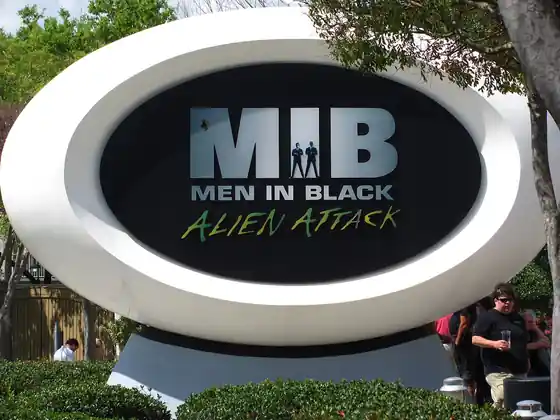
Men in Black (1997): Alien SonImage: Wikimedia Commons · Jeremy Thompson from United States of America, CC BY 2.0 - #061
It was the fourth film ever to gross more than 50 million dollars domestically on its opening weekend, after Batman Forever (1995), Independence Day (1996) and The Lost World: Jurassic Park (1997).
- #062
The Bug's upper half survives the explosion and makes one last lunge before Laurel finishes it off. A practical slime explosion was filmed on set behind the actors and then combined with the digital Bug and a digitally enhanced blast.
- #063
Contains a major spoiler — show
When K takes J through the arrivals and customs area, one of the aliens checking in is from Explorers (1985), and the "superball" from the "Great Attractor" can be seen screaming through the area.
- #064
Contains a major spoiler — show
Tony Shalhoub plays pawnshop owner Jeebs, one of many aliens disguised as humans. In Mr. Monk and the UFO (2009), he plays a human some people suspect of being a human-looking alien.
- #065
Rosenberg turns out to be a mechanical human disguise housing a small, green humanoid alien called "Chucky" or "Mr." It was designed along the lines of classic grey aliens, with gentle, large eyes and big skulls. The idea of a small creature piloting a human-shaped vehicle grew out of an early version of a key scene in a script draft. Setrakian said, "The Rosenberg alien came about as a result of a really interesting series of changes. I was reading the script and there was a scene where Kay explains to Jay that there are aliens among us. They were sitting in a bar and he said, 'Hey, the bartender here is like Chucky, he could be an alien too.' The bartender lifts a piece of skin around his neck and you see some light coming out. That's how it was described in the script." Rick Baker and his team felt the sequence was too low-key and lacked impact, and they noticed similarities with Cocoon (1985), in which the aliens' true form resembles glowing humanoids. Baker asked team members Jim McPherson and Mark Setrakian to come up with a new alien concept for the scene. "Rick said, 'This was done in Cocoon. Let's do something better.' He said, 'You two come up with something better for tomorrow morning.' We were going out to lunch. Mark and I talked about the alien over lunch and yes, the idea of an alien with foot pedals, levers and monitors was Mark's idea." Baker added: "The idea we came up with was this face that opens like a door and inside is a little green man working his levers; waving, pulling a lever and closing it back up. There would be little monitors inside so he could see [outside]." Setrakian came up with the concept, but the little alien's look was quickly designed by McPherson, deliberately in contrast to the scary designs made before Cinovation joined the project. "The look was my idea," McPherson explained. "I specifically made a grey or little green man type alien because I had seen tons of great scary alien designs made at the studio before Rick was hired; this annoyed Barry and I decided that with alien design I should be appealing rather than realistic and scary." The design was influenced by Whitley Strieber's first-person accounts of alien abduction. The idea caught Sonnenfeld's eye and was approved at once, and McPherson was asked to make a test model in record time. The maquette showed "this guy lifting his whole face off and revealing that his body is a robot and that a little alien sits in his head piloting it," said Setrakian. "The whole concept was just a breakthrough. It was something you could see for a moment, like this really great reveal, the hand-made fake head and then this little alien." McPherson added: "It was supposed to be turned into a so-called photo head and maybe even used for a video test; however, I was busy and I don't remember that happening. Rick told me to paint it red. Barry said that when he saw it he didn't like anything in that color." So Chucky's colors changed from red to greenish tones, which the final design kept. A test animatronic was built later.
- #066
Contains a major spoiler — show
Around the 4-minute mark, when K and D meet the border patrol officers in the desert, K introduces himself as "INS, Division 6." There is no Division Six, of course, but INS is the Immigration and Naturalization Service, an agency created on June 10, 1933, to stop non-US citizens entering the country illegally. Ironically, it was abolished on March 1, 2003, six years after the film's premiere.
- #067
The little mollusk-like aliens that zip across the floor were designed by KNB EFX Group under the supervision of Greg Nicotero and Howard Berger, and nicknamed "scrubbing bubbles" after their inspiration. "The design was based on the scrubbing bubbles from the old Dow bathroom cleaner commercials," Nicotero explains. "They looked like that. Bill Zahn made a fiberglass helmet and added a foam latex skirt that looked like little tentacles coming out of the bottom; that concealed the fact that they were mounted on radio-controlled cars built by Larry Odien. They basically drove around the set. The shells were painted tan brown with plenty of iridescent pink and blue, so when you looked at them your eye was always drawn to different colors."
- #068
During development the bar scene was cut, with the worm guys taking its place, but Chucky's design and concept went down so well that Sonnenfeld used it for Mr. Gentle, who became Rosenberg in the final film. "They liked the idea so much that they cut the bar scene entirely and then wrote a completely different scene with the Rosenberg alien," Setrakian said, "one that had dialogue and turned into something that revealed one of the film's plot points." Huante developed the alien and cockpit design further once it had its new central role. Sonnenfeld liked the first concept so much that he wanted the design to stay close to it.
- #069
The film ends with a final pullback: the camera retreats from Earth past the Moon, the solar system, the Milky Way and the galaxy cluster it belongs to, revealing that our universe is a marble in a game played by an unknown being. The galaxy player was modeled by Tony Hudson and given translucent green skin and flesh, with internal details showing its circulatory system and pulsing organs. The shot was designed by ILM digital artist Derek Thompson and supervised by Scott Farrar with technical director Pat Meyers. In the end, Cinovation and ILM pooled their full arsenals to bring Men in Black's aliens to life. "We had some really smart people working on this series," Brevig said. "They were especially gifted at turning technical elements into meaningful visual images. Given creative freedom, their raw talent had the chance to come through fully on screen."
- #070
Several celebrities appear on the surveillance screen, identified as aliens in disguise: weatherman Al Roker, fashion designer Isaac Mizrahi, actor Danny DeVito, Men in Black director Barry Sonnenfeld and his daughter Chloe Sonnenfeld, singer Dionne Warwick, politician Newt Gingrich, motivational speaker Tony Robbins, and directors George Lucas, Steven Spielberg and Sylvester Stallone.
- #071
Mikey's basically humanoid build meant that, after a few cosmetic tweaks to his proportions, Cinovation could build the creature as a suit. "An entirely mechanical creature is incredibly difficult and time-consuming to build," Baker said. "It's also a bit limiting. So I suggested we change the design a little and put a person inside. Barry agreed. The only actor I knew who could wear a suit like Mikey was John Alexander, with whom I'd worked on Gorillas in the Mist and Greystoke. John is a wonderful actor and a really good guy. You can torture him and he won't complain."
- #072
Among the fine organic details were Mikey's unusual eyes. "Because the eyes were on stalks," Baker said, "I thought it would be interesting to do an unusual blinking motion. It was basically like a foreskin. The skin slid over the eye to close it and then stretched back open." The suit's mechanics were designed by Rick Baker and his mechanical designer Jurgen Heimann. The detailed costume had a fully working, cable-operated head capable of a wide range of movements, including blinking eyes, eye stalks, and antennae that could extend from the mouth and ears. Two more heads were made as well: a radio-controlled version and a lighter stunt head for when the actor had to run.
- #073
Once the Bug model was finished and ready to animate, there was still the question of how to get a 15-meter monster out of a human-sized shell. Brevig said, "There are a lot of events in the story that are physically impossible. They read very well, but when you actually film them you have to resolve certain visual inconsistencies, like Edgar Bug's body emerging from Vincent D'Onofrio's. We spent a lot of time discussing the problem. We had to convince the audience that they were seeing things we weren't actually showing them — otherwise the impossibility of what we were presenting would immediately become apparent." Brevig and sequence supervisor Carl Frederick solved it with careful use of cuts and close-ups. "When Bug Edgar comes out of human Edgar," Brevig explained, "we played some of it in very close-up, so you only saw a part of it opening. We did a slight push-in and then cut to Will and Tommy Lee's reactions. The rest of the shots consisted of close-ups of the different things emerging, along with a lot of slime and ooze developed by David Meny and more reactions from the guys. We cut it together enough that the audience could never judge it. The size difference meant it emerged like a bug coming out of Edgar's egg sac." The rest of the scene shows the full 15-meter Bug. In animating it, the ILM team tried to echo D'Onofrio's performance. Coleman explained: "I studied Vincent D'Onofrio, who played Edgar as a human, for all the animators, and then we tried to mirror certain tics and twitches. We tried to get emotion out of our creature, but since Edgar is a bug he had a hard shell: we couldn't get any expression from his face, so we had to dramatize his mounting anger through body poses."
- #074
The "Illegal Alien" Agent K unmasks as the alien Mikey never blinks.
- #075
Contains a major spoiler — show
The winged insect that splatters on the van's windshield in the opening scene foreshadows Edgar the Bug.
- #076
Contains a major spoiler — show
The closing lines of Men in Black suggest calling Dennis Rodman, then a Chicago Bulls starter, about tickets. The international version swaps Rodman, little known outside the United States, for Michael Jackson. Whether anyone would still ask him for Bulls tickets is another matter; since Jackson was based in Los Angeles, Lakers or Dodgers tickets would have been more likely.
- #077
Contains a major spoiler — show
In the scene with Will Smith and Tommy Lee Jones sitting in the car, the doors were sealed airtight. Smith passed gas, and the car became completely unbearable for both of them; Barry Sonnenfeld described the atmosphere as unbearable.
- #078
The original ending was a philosophical debate between Jay and the Bug, to be done with both animatronic and digital effects. As Baker recalled, designing the creature was a long process: "The script always referred to Edgar as a Bug. There were numerous bug references throughout. So, in the first pre-production design phase, we made many drawings that looked like bugs. But Barry Sonnenfeld and Steven Spielberg seemed to have something else in mind, and the creature turned into something definitely not bug-like. It became a mix-and-match kind of thing - legs from one drawing, a head from another, a body from yet another. In the end they approved a design that didn't look like a bug at all, more like a reptile." The chosen design was an insect-like creature with a cobra-like hood and a cockroach-like head, skinny arms and legs, and a long, segmented abdomen ending in a wasp-like sting. Moto Hata built small-scale maquettes from the concept art. Because the creature had to talk, Cinovation was asked to build an animatronic Bug that could deliver the script's lines convincingly. Baker recalled: "When Edgar Bug finally came out of Vincent D'Onofrio, there was a long dialogue he had to deliver with this ridiculous bug mouth, so we made two large mechanical bugs that talked. I kept saying, 'It's going to be so absurd when we hear a normal human voice coming out of this giant bug monster,' but they said, 'No, no, he has to talk!'" Whatever Baker's doubts, construction went ahead and took months, from sculpting to mechanical assembly. The Bug was made by Moto Hata, Eddie Yang and Ryan Peterson; the sculpture was cyber-scanned and milled full-size in foam. "Then we refined it by hand," said the artist. "We put a lot of work into Edgar Bug to get it ready in time. We built two extremely detailed, 15-foot versions that could perform all kinds of great movements." Rob Freitas, another team member, explained: "One of the animatronics was from nose to tail and walked; however, the facial mechanics and arm mechanics were minimized. Then there was a piece that Edgar did from the waist up. No tail or legs. That one moved really well." Both animatronics were mechanized by Mark Setrakian and his team, and an extra head and rigs were made for the shot of the Bug's severed head hitting the windshield after the explosion. Once the full animatronics were done, Baker and his team got a nasty surprise: apparently without their knowledge, the script had been rewritten in response to Sonnenfeld's worries about the original ending. "Every week as the script changed," Sonnenfeld recalled, "I was getting more and more nervous because I thought we were making an action-adventure comedy with very little adventure. I kept thinking the film didn't have an ending: you don't want your film's ending to be an argument between the Bug and Will Smith." So the climax was turned into an action scene in which Jay tries to stop the Bug from reaching the other spaceship. The Cinovation team knew nothing of the changes. "When we arrived at Sony on the shooting day," Baker recalled, "we discovered they had rewritten the script. They now wanted the puppeteers to perform certain actions that were incompatible with the creature's mechanical and physical abilities. The tone of the film had also changed and Edgar's design no longer made sense. Unfortunately, the decision was made not to use it at all. They handed Edgar Bug over to ILM, which then went through a design and construction hell of its own." Baker was disappointed: "With the way they make films these days, they get a release date and constantly rewrite the script throughout the film's production process," he said. "Meanwhile, we started designing and creating our materials in pre-production because it takes so long to get it right. They rewrote the scene the night before we were going to shoot the scene with Edgar. At that point Barry told me, 'I don't think we're going to use this.' I was quite disappointed. But in the end I'm sure it was the right decision for the film."
- #079
Wanting his gun back, Kay goads the creature into swallowing him alive, another moment that defies physics. "Edgar has just come out of a human-sized character," Brevig said, "and now he has to swallow another one alive without harming it. The secret to getting away with it was planning everything carefully so that the physically awkward moments were hidden in the cut." The sequence was shot from angles that hid the physical impossibility of it all, and the Bug's interior was made of liquid-filled silicone and latex.
- #080
Some of the Bug's actions, like the hard punch he gives Jay, were deliberately comic. "I kept wanting to do a punch because I thought it would be really funny for an alien to throw that kind of punch," Sonnenfeld said. ILM insisted that Will's body would fall differently, so they wanted Edgar to push him instead, but in the end Sonnenfeld won the digital artists over to his version. "Not only did they agree to do it, they did a great job," he continues. "It was a real joke that was never intended to be in the film."
- #081
Contains a major spoiler — show
Around 23 minutes in, the number on the pest control truck outside the barn is (914) WE-ZAP-EM, which works out to (914) 939-2736.
Production Story (96)
- #082
Contains a major spoiler — show
After the script was rewritten, the original animatronic Bug, dropped in favor of a more action-driven ending, was scrapped after eight months of work. The new sequence with a redesigned Bug had 45 CGI shots at $100,000 each. As Barry Sonnenfeld put it, "It was the best 4.5 million dollars we spent."
- #083
When Kay fires the MIB weapon through the creature's guts, it is finally blown apart. The initial blast was a practical effect enhanced digitally in post-production. Brevig explained: "I asked physical effects supervisor Peter Chesney to build a big exploding intestine thing, so we could make it a physical event that we would shoot. Then we placed the creature around it for that moment and reinforced it." Technical director Gregor Lakner used particle system software for the explosion, in which small liquid particles and big chunks of guts and flesh burst out and rain down onto the grass.
- #084
Vincent D'Onofrio researched the role of Edgar by watching many insect documentaries. To achieve his character's distinctive walk, he wore knee pads and taped his ankles so that he would not bend his legs.
- #085
When the executive producer first called Will Smith to talk about Men in Black (1997), Smith did not believe that the person on the other end of the line was really Steven Spielberg.
- #086
Initially the Arquillians were an idea for a minor character: a bartender named Chuckie. To prove he was an alien, he was supposed to shoot a beam of light from his head. Rick Baker suggested that he was a small alien living inside the head of a robot body. In the end the character was cut, but the producers liked Baker's idea so much that they decided to use it for characters more important to the plot.
- #087
The film was to take place in underground bases and locations such as Kansas, Washington, D.C. and Nevada, but Barry Sonnenfeld made New York City the film's main Earth location. He thought it was more believable that aliens could hide in a big city (safety in crowds), and he thought New Yorkers would be more tolerant of people behaving strangely (actually aliens in disguise). He also felt that many of the city's structures resembled flying saucers and rocket ships and other secret alien technology that could be REAL spacecraft.
- #088
The BadAstronomy site, which criticizes science fiction films (such as Armageddon (1998)) for their scientific errors, praised this film because it was a comedy, yet it was surprisingly accurate when it came to astronomical facts.
- #089
While James is in the elevator with Agent Kay, he tells him that he does not want to be called "sport" or "kid" or something like that. Kay continues to address him that way throughout the film. Just before Kay loses his nerve, he finally calls him "J".
- #090
The small ball that Jay accidentally sends to MIB headquarters is said by Kay to be "a practical joke from the Great Attractor." The "Great Attractor" is a real thing, a gravitational anomaly located about 250 million light-years from Earth that affects the motion of every galaxy within hundreds of millions of light-years. It was first detected by astronomers in 1973.
- #091
The sunglasses used in Men in Black are Ray-Ban "Predator 2" glasses. After the film's release, Ray-Ban reported that sales of these glasses tripled from $1.6 million to $5 million.
- #092
Barry Sonnenfeld claimed that he directed Tommy Lee Jones to play every scene straight. Jones was frustrated that he was not allowed to do comedic takes, while Sonnenfeld insisted that Agent Kay had to be completely serious for the comedy to work.
- #093
During pre-production, Barry Sonnenfeld changed much of the film's aesthetic: "I started by saying that aliens shouldn't be the way humans perceive them. Why do they need eyes? Rick would do these great designs and I'd say, 'That's great — but how will we know where it's looking?' I ended up arriving at the same point everyone else did, it just took me three months."
- #094
During filming there was a script revision that changed the role of the 'Galaxy' in the film — the two Arquillians in the restaurant were originally warring species, and they were going to swap the galaxy to end a war that Edgar Bug wanted to continue. Fortunately, some creative tricks could be used to avoid having to reshoot several scenes. For example, the dialogue of the Arquillian restaurant was originally in English, but in post-production it was re-recorded in a foreign language so that subtitles could be added with a new explanation. Similarly, new lines were written for Pug Frank, whose scenes already had to go through post-production. In the DVD bonus material, Barry Sonnenfeld could be heard jokingly advising his fellow directors to add a talking dog to every film, which makes it easier to change the plot during shooting.
- #095
The scene where Kay is at the restaurant with James begins with Kay delivering the punchline of a joke that is probably a variation of the following: A farmer went to the city to see a movie with his pet rooster. Animals were not allowed into the theater, so he put the rooster in the front pocket of his overalls and smuggled it into the crowded theater. When the lights dimmed, he let the bird look out so it could see. The woman sitting next to him noticed and nudged her husband. "This man's a pervert, he's got his [euphamism for rooster] out." Her husband replied: "So? It's nothing you haven't seen before." To this his wife said: "But honey, this one's eating my popcorn!" The punchline (and probably a version of the setup) is the same as what the comedian says in the first scene of the burlesque house in "The Sting" (1973).
- #096
For the iconic costumes, costume designer Mary E. Vogt tried not to resemble The Blues Brothers (1980) too much. She said she was inspired by Cary Grant's classic gray suit in North by Northwest (1959).
- #097
When Kay deletes all the data records, James's photo is an old high school photo of Will Smith.
- #098
The explanation Kay first puts into Beatrice's mind was an Easter egg for UFO enthusiasts. It nonsensically mashes together 4 of the US government's most infamous scientific explanations for UFO sightings. These include "swamp gas" (Dr. J. Allen Hynek's explanation for a Michigan sighting that haunted him for years), "weather balloon" (the original explanation for the Roswell incident), "thermal pocket" (the 1952 mass UFO sighting in Washington, D.C.) and "light from Venus" (probably the most frequently used explanation).
- #099
Rick Baker claims that his work on this film was his most complex work to date because he had to get approval for the alien designs from both Barry Sonnenfeld and Steven Spielberg: "It was like 'Steven likes the head of this film, and Barry really likes the body of this one, so why don't you mix and match?' And I would say because that wouldn't make any sense at all."
- #100
When Kay explains that there are about 1,500 aliens on Earth and that most of them are just trying to make a living in Manhattan, James asks, "Cab drivers?" This is a reference to author Douglas Adams's 'The Hitchhiker's Guide to the Galaxy' novels, particularly his fourth novel 'So Long, and Thanks for All the Fish', in which the entry for the archivist Ford Prefect in the Guide implies that driving a taxi is a good way for aliens visiting New York City to make a living.
- #101
According to the novelization, James is right to shoot the cardboard cutout of Tiffany at the MiB shooting range. She is actually a dangerous alien in disguise, while the other aliens around are completely harmless.
- #102
According to production designer Bo Welch, the MiB headquarters was designed to look like a 1960s airport (the MiB examination room in particular was based on the TWA terminal at John F. Kennedy International Airport). He used the 1960s theme because that was when the MiB began (it was also the decade of the space craze) and because airport design fit with the MiB's extraterrestrial relations involving arrivals on and settlement of Earth, which airports facilitate.
- #103
The crew built a 36-foot replica of the Queens Midtown Tunnel, exactly 1/8 the size of the real one. It was completely authentic down to the graffiti, and it took four months to build.
- #104
After the script was rewritten, the original animatronic Bug, which was abandoned in search of a more action-oriented ending, was canceled after eight months of development. A new sequence using a redesigned Bug was made, with 45 CGI shots costing 100,000 US dollars each. According to Barry Sonnenfeld, "It was the best 4.5 million dollars we spent."
- #105
During one of Jay's attempts to stop the giant Edgar-bug from leaving, the bug swats him aside. Director Barry Sonnenfeld said this was one of the hardest artistic decisions to get past studio executives; they wanted the bug to throw a vicious punch, whereas Sonnenfeld thought it would be much funnier for a giant bug to slap 'like a girl.' Sonnenfeld held his ground until the studio finally relented.
- #106
The final scene reveals that our universe exists inside a marble, just like the Galaxy. Both the scene and the concept of the miniature Galaxy were inspired by Douglas Adams' novel 'The Hitchhiker's Guide to the Galaxy,' in which Ford Prefect tells Arthur Dent that he knows of a planet used in an intergalactic bar billiards game and placed inside a black hole ("only scored thirty points, too").
- #107
The driver smuggling aliens illegally along a road marked "375" claims to be "fishing in Cuernavaca." This refers to Nevada State Route 375, known as the "Extraterrestrial Highway" because of its proximity to Area 51. Cuernavaca is the Mexican city where British ufologist Gordon Creighton claimed in 1951 that a flying saucer crashed near his relatives and that the dead aliens aboard were quickly taken away by the US Air Force, allegedly with Mexico's cooperation.
- #108
Barry Sonnenfeld considered playing the morgue attendant himself but decided that David Cross had the "same sensibility."
- #109
In the scene where Jay and Kay interview Beatrice, Jay has to spit out the lemonade offered to him. This may be because Bug Edgar consumed all the sugar in the previous scene, meaning Beatrice had nothing to sweeten the lemonade with (or she wasn't a very good cook).
- #110
When Jay (Will Smith) jumps from the overpass onto the tour bus, he is jumping from the Pershing Square Bridge, the same location where Robert Neville (also Smith) is attacked by the demon dogs after sunset in I Am Legend (2007).
- #111
Many of the MiB's features and characteristics are consistent with the established lore of Men in Black. For example, during alleged encounters with the MiBs, witnesses reported that they used outdated jokes and local languages, and that their clothing and vehicles also appeared outdated. In the Chinese restaurant, Agent Kay tells James, "Be there or be square," a phrase out of place in a mid-1990s conversation.
- #112
The high-pitched whine the neuralyzer makes when it flashes is the sound of a flashbulb's capacitor recharging.
- #113
When Agents J and K pull up to the sidewalk shop where they meet the dog alien Frank, J's reaction upon seeing the human owner is that this is the worst alien disguise he has ever seen. The instant shift to Frank as the real alien makes it easy to miss that the human bears a resemblance to "Riff Raff" in The Rocky Horror Picture Show, who is revealed late in the film to be an alien.
- #114
Due to an apparent laboratory error, at least some of the release prints used in the US were not hard-matted for global widescreen projection. This meant that if the projectionist did not properly frame the projected image, viewers could see lens shades, microphones and other things normally invisible in the frame area.
- #115
The "Roaches check in, they don't check out" line shared by Agents Kay and Jay was the advertising slogan of the best-selling insecticide Roach Motel, introduced in 1976.
- #116
Producers Walter F. Parkes and Laurie MacDonald initially wanted Barry Sonnenfeld to direct because he had directed the darkly comic Addams Family films. However, Sonnenfeld was shooting Get Shorty (1995) at the time, so Les Mayfield was to replace him because of the positive response to his film Miracle on 34th Street (1994). The producers later watched the film and decided he was not suited to a sci-fi comedy, opting to wait for Sonnenfeld to become available.
- #117
Chris O'Donnell was first offered the role of Jay, but he turned it down because he felt it was a "new recruit" role similar to his performance as Dick Grayson in Batman Forever (1995) and Batman & Robin (1997).
- #118
Rick Baker built an animatronic of the giant Bug for use in the film, but changes made to the script's climax required the Bug to be rendered in computer graphics, which annoyed him.
- #119
Yasushi Nirasawa worked on some designs for the Edgar Bug, which ultimately went unused. One of his takes on the Edgar Bug was a more humanoid creature with two heads and very long arms resembling a praying mantis's forelimbs.
- #120
The "worm guys," as the crew called them, were designed by Rick Baker and Aaron Sims as thin, stick-like creatures with long arms and legs, antennae and numerous small appendages. Baker recalled: "I wanted to make a creature that could not possibly be a man in a suit, and the worm guys developed from that idea." As Setrakian explained, the worm guys were originally going to be much larger and were to be included in a different scene. "Aaron Sims had made these maquettes for the aliens, they were supposed to be about two or nine feet tall," he said, "but they had been made in miniature. One of the mechanics I worked with, Jurgen Heimann, took them and made small poly foam molds of these maquettes. Then he built a little coffee break set in his mechanical shop and we shot this little story on video. He said, 'Okay, so could this be it? Great.' I sent it to Barry and they liked the idea so much that they wrote it into the film." Baker added: "Aaron did a Photoshop composite of a test puppet in different poses — one drinking coffee, another smoking and leaning on the counter and another pouring coffee into a cup — and I told Barry that the worm guys could perform on set during principal photography. He liked the idea a lot and in the end we made four of them." The worm guys were built as one-foot-long puppets with movable arms, legs and appendages. Each puppet could perform specific actions such as smoking, pouring coffee into a cup or drinking from a cup. Baker said: "The puppeteers really added a lot to the performance. They spoke in their own style of 'alien talk' and came up with some very funny routines. Each worm guy required two puppeteers, one of whom was Jurgen Heimann, who did the original mechanics. The puppets were cable and radio controlled, and there were some rods from the cabinet in the dining room set." The characters were so popular with test audiences that ILM was tasked with creating digital versions of them for two more brief appearances in the final film.
- #121
Steven Spielberg flew Will Smith by helicopter from a wedding in New York to his home in the Hamptons so that he could offer Smith the role of Agent J.
- #122
In the shot where Jay flies backward through a car's windshield, the stunt performer wore Kevlar underwear.
- #123
The first makeup stage included gluing Vincent D'Onofrio's eyelids shut as well as a neck appliance made of loose silicone gel. Baker explained: "The silicone gel was translucent and heavy and formed nice, very fleshy folds. It also looked a little like liver, which made it difficult to work with. We made the neck piece large so that it folded under the jawline like loose, sagging skin." Gelatin appliances designed by Kazuhiro Tsuji were placed on D'Onofrio's cheeks to hide where the eyes were pulled down. Other pieces were applied to the eyelids. Eyebrows and beard hairs were applied manually, and hair was hand-stapled to the head appliance. The makeup was completed with cloudy contact lenses, rotting tooth appliances and fillers placed in the mouth. To distort his shape.
- #124
The first extraterrestrial creature seen in the film is Mikey, a criminal who tries to pass as a human immigrant before being discovered. Originally, Mikey was the character who first mentioned the Bug's arrival. The character went through numerous conceptual iterations before the final design was chosen. In one of Ed Solomon's early script drafts, he was described as a tall, thin, six-armed creature. Other discarded concepts included Delgado's; a parasitoid wasp-like alien hiding inside another centipede-like creature, which was also concealed by a human camouflage. Because features were selected from various concepts by Sonnenfeld and Spielberg, Mikey ultimately emerged as a humanoid creature with exaggerated and bizarre features such as eye stalks, retractable antennae and small fins, inspired by snails and other mollusks and reptiles.
- #125
The ship used to transport the Bug to Earth, and later confiscated by the MIB, would reappear on the roof of the restaurant in Men in Black II.
- #126
The device Agent Kay uses to catch the thing that caused the 1977 New York blackout is an Oster Stim-U-Lax electric massager, model M-3, ca. 1942.
- #127
The 10-foot-tall translucent invertebrate called 'slug man' was also an XFX creation using a bizarre technique. "We wanted slug guy to be translucent," Johnson recalled: "So I convinced Rick to let me use a technique we'd started on Species involving the manipulation of plastic bags. It was developed by Bill Bryan. He built a rig he could sit on and motivated it just by moving his feet forward - like sitting on a tricycle but not pedaling. A handheld device controlled the head, and Bill could move it manually to make slug man sniff the ground or lift his head in different directions. The creature's tentacles were built on a positive-negative vacuum system, and as Bill accelerated forward they would expand and then contract. The tentacles were also connected to a wheel-based eccentric, so they rose and fell in a cyclical motion."
- #128
When the Bug lands, it grabs Edgar and emerges from the crater wearing his skin. To achieve the desired effect, a very heavy makeup had to be applied to Vincent D'Onofrio. "I started out by learning how much abuse Vincent could take," Baker said. "He had incredibly loose skin that he could move everywhere - which was great - and he had no problem with us stretching it, pulling it and sticking it in weird places. We glued silk to his face - just like you do in temporary face-lifts for actors and actresses so they look younger - and ran the thread through a silicone pad to a handle he could use to pull his own skin."
- #129
When K shows J the photos of First Contact, he reacts to the picture of the random young man greeting the aliens with "Aww, you brought that tall man some flowers!" Though he doesn't realize it, the use of "you" is entirely correct - the young man in this photo is J himself. While describing those present for First Contact, he gives a brief description of the others ("seven agents, one astronomer") but takes care to be specific about "one dumb kid who got lost on the wrong back road."
- #130
ILM was also tasked with enriching the headquarters scenes with digital creatures. Eric Brevig of the team explained: "After looking closely at the footage, it turned out something was missing from the scene. We needed aliens that a mechanical creature or a person in a suit couldn't play." Among the digital characters were a purple humanoid creature that greets Kay as he enters headquarters (created by modifying the digital model of Mikey) and a four-legged monster with several eyestalks protruding from its body, as well as the worm guys. "Tony Hudson modeled two outrageously nonhuman characters," Brevig continues: "Mark Cho places them among this crowd of aliens and humans wandering around the center, along with the worm guys."
- #131
To turn them into convincing flying saucers, the CGI versions of the towers in Flushing Meadows, Corona Park, where the finale takes place, differ significantly from the real buildings. First of all, there are three structures of varying height, not two as shown in the film. Also, the saucer of the shortest tower intersects with the struts of the tall tower, and the saucer of the medium-sized tower intersects with the struts of the largest tower. Therefore, at the top of the tallest building there is actually only one complete circle. Moreover, the dish atop the tallest tower is twice as thick as the short tower's, not equal as shown in the film.
- #132
The end of the film is a long shot in which the camera shows the planet Earth, pulls back to reveal Mars and the other planets, the solar system, and finally the Milky Way, depicting this as a small marble-like plaything of a giant alien being. The same idea was used in Contact (1997), released nine days later, but the scene was altered so that the movement continues, showing more galaxies, supergalaxies, and finally the entire universe, closing on a passport photo of young Ellie Arroway (Jena Malone). In 2004, The Simpsons (1989) paid homage to this scene by repeating it in the Couch Gag of The Ziff Who Came to Dinner (2004). In that episode, after the entire universe is shown, the galaxies turn into atoms, DNA strands and cells, and the camera finally emerges from Homer's head.
- #133
When Kay calls his old girlfriend, the satellite video feed lists the coordinates 44.41 degrees north and 70.0 degrees west. On the map, these coordinates are located at a point in the small town of Readfield, Maine, about 90 meters east of Chimney Road and 600 meters north of where Chimney intersects Main Street in Kent's Hill. (And nowhere near Truro, Massachusetts, more than 260 miles away. However, the inconsistency can be explained by the use of the alien coordinate system required by the "Tycho Treaty.")
- #134
Because the Cinovation team was undecided about the actions the Mikey costume would need to perform, Rick Baker and team leader Matt Rose decided to make it as detailed and functional as possible. The goal was to create a character that could potentially carry an entire film on its own; the same philosophy Cinovation used for the other aliens. "All the work we did for that sequence," Baker said, "was the same amount of work as if we'd made a movie called Mikey. We could have made a movie called Mikey with the pieces we made, but it was still basically shot in two days and over in a few seconds."
- #135
The neon sign in the front window of the Russian restaurant translates into English as "Good Kitchen." The sign is also listed under goofs/continuity for the missing letters in the scenes shot inside the restaurant.
- #136
The Bug uses Edgar's dead skin as a disguise, and as the film progresses, it begins to rot like dead skin.
- #137
The fins protruding from Mikey's body were radio-controlled, and there were cable-operated extensions to allow dexterous movement in the arms, with the cable-controlled fingers puppeteered by the artist's own finger movements. For wider shots, acrobatic, poseable arms were also used. Detailed leg extensions allowed the creature to reach a height of about two meters.
- #138
In the scene in Jeebs's store, among many genre items such as a Lava Lamp, there is also a "Saucer" Lamp made by the Eames Company from the Atomic Collection, dating from around the 1950s.
- #139
Completing the Mikey scene was a human head on a stick; this was a comical element that Rick Baker initially found confusing. "Barry said he wanted Mikey's disguise to be crude," he said, "and I said, 'well, then why isn't the head crude? It should look more like a ventriloquist's dummy.' But Barry said: 'No, I want the head to look completely real, but I want just a stick coming out from underneath.' And I kept arguing the logic of it. So I said: 'Why don't we have, instead of a stick, a control apparatus with levers operated by this weird frog-like hand, so we can see how the head is controlled?' 'No, no, no, I don't want that.' 'What if cables attached to the belt of the alien wearing it come out of its head and you can assume he controls it that way?' 'No, no, no - I want a stick with a head on it!' I just thought it was weird." "The head on a stick was built as a stunt version and radio-controlled version." "We puppeteered Mikey so that his mouth would move when he spoke -- which looked really great," Baker recounted.
- #140
Cinovation's Mikey costume was combined with a digital version of the alien designed by Industrial Light & Magic for visually more complex actions. Cyber-scanning of reference maquettes provided by Baker's team formed the basis of the digital model. From there, George Aleco-Sima created the digital Mikey using Alias. The paint scheme, instead, was created by Jean Bolte.
- #141
The upper half of the bug is still alive after the explosion and makes one final attack attempt before being killed by Laurel. A practical slime explosion was filmed on the set behind the actors and then combined with the digital Bug and digital enhancement of the explosion.
- #142
In the scene where K takes J to the arrivals and customs area, one of the aliens checking in is from the film "Explorers" (1985), and the "superball" from the "Great Attractor" can be seen screaming as it passes through this section.
- #143
It emerged that Rosenberg was disguised as a mechanical human housing a small, green humanoid alien referred to as 'Chucky' or 'Bay'. It was designed by the crew shortly after the classic depictions of grey aliens with large eyes and skulls. The idea of a small creature hidden inside a human-shaped vehicle stemmed from the early elaboration of a key scene in the script draft. Setrakian said, "The Rosenberg alien really came about as a result of an interesting series of changes." "I was reading the script and there was a scene where Kay explains to Jay that there are aliens among us. They were sitting in a bar and he said, 'Hey, the bartender here is like Chucky, he could be an alien too.' The bartender lifts a piece of skin around his neck and you see some light coming out. That's how it was described in the script." Rick Baker and his team agreed that this sequence was too back-and-forth and lacked impact. In addition, they noticed similarities with the 1985 film Cocoon, in which the true appearance of the aliens resembled glowing humanoids. Baker assigned team members Jim McPherson and Mark Setrakian the task of creating a new alien concept for the scene. "Rick said, 'This was done in Cocoon. Let's do something better.' He said, 'Come up with something better for tomorrow morning.' We were going out to lunch. Mark and I talked about the alien at lunch, and yes, the idea of an alien with foot pedals, levers and monitors was Mark's idea." Baker added: "The idea we came up with was this face that opens like a door and inside is a little green man working his levers; waving, pulling a lever and closing it back up. There would be little monitors inside so he could see [outside]." While Setrakian first designed this idea, the appearance of the small alien was hastily designed by McPherson. The design was developed in contrast to the scary designs made before Cinovation became involved in the project. "The look was my idea," explained McPherson. "I specifically made a grey or little green man type alien because I had seen tons of great scary alien designs made at the studio before Rick was hired; this annoyed Barry and I decided that in terms of alien design I should be appealing rather than realistic and scary." The design was influenced by Whitley Strieber's first-person accounts of his alien abduction. The idea caught Sonnenfeld's attention and was immediately approved. Therefore McPherson was asked to make a test model in record time. The maquette depicted "this guy lifting his entire face and revealing that his body is a robot and that a small alien sits in his head piloting it." "It was," said Setrakian. "The whole concept was just a breakthrough. It was something you could see for a moment, for example this really great reveal, the hand-made fake head and then this little alien." McPherson added: "It was going to be turned into a so-called photo head and maybe even used for a video test; even so I was busy and I don't remember that happening. Rick told me to paint it red. Barry said that when he saw it he didn't like anything in that color." Thus Chucky's color scheme changed from red to greenish tones; a feature that the final design would inherit. A test animatronic was later created.
- #144
Because Mikey was perceived as a likable character and still had to be killed, the team had to find a way to make the alien look scarier to the audience. Working from Huante's concept drawing, the team gave Mikey extendable toothed jaws. Bolte said: "Once we got our maquette, we saw that it was very appealing and it had to be killed. You don't want the audience to be disappointed when they see it go. We had to make it scary - so you can see this skin retract and reveal an incredibly vicious-looking mouth; and we put a horrible-looking drool in there to make it look terrifying - then when it flies off and escapes, it's killed and explodes into millions of blue squares of goo, which isn't scary - hopefully it's kind of a relief!" The detailed animation of Mikey entering an angry emotional state also included the rapid flapping of its fins as a threat display. The alien was animated under the supervision of Rob Coleman. "Mikey goes from Rick's makeup 'roar' to a computer graphics display," said Coleman, "that's where it transforms from a very docile character into a vicious monster. It was a great model to animate because it has such a different look. I worked on it initially, and then Glenn Sylvester and Tim Harrington joined them, and they did a great job on the transformation. They animated these huge jaws that open to reveal teeth and a big purple tongue - we used the Cartoon or Cari animation software that Cary Phillips designed for Dragonheart. Coleman explained: "Animating Mikey was like making Fred Flintstone run in his house. You know how you see the same vase go past? That's because the stage area at Sony was actually quite short and Mikey had to look like it was running. We treated it almost like a loop. The hard part was making it look heavy. Weight is hard to animate on a computer because weight isn't there. The impression of weight is perceived by the human eye based on what's happening in the body parts: how much movement there is in the arm, how much jiggle there is in the belly. So we added all kinds of controls to make Mikey's skin move, his belly move and the muscles in his legs flex." Footage of top-class athletes was used as reference for the rippling motion of Mikey's muscles. "It was valuable to observe that heavy men run very fast," Coleman said. Mikey's explosion was achieved with a combination of digital animation, including fluid simulation, and practical gelatin and silicone intestines.
- #145
(At about the 4th minute) When K and D meet the border patrol officers in the desert, K introduces himself as "INS, Division 6." Of course, Division Six doesn't exist, but INS is the abbreviation for the Immigration and Naturalization Service, an agency created on June 10, 1933, to prevent the illegal entry of non-US citizens into the country. Ironically, six years after the film's premiere, it was abolished on March 1, 2003.
- #146
The small mollusk-like aliens that move quickly along the ground were designed by the KNB EFX Group under the supervision of Greg Nicotero and Howard Berger. The creatures were called 'scrubbing bubbles' because of their inspiration. "The design was based on the scrubbing bubbles from the old Dow bathroom cleaner commercials," Nicotero recounts: "They looked like that. Bill Zahn made a fiberglass helmet and added a foam latex skirt resembling small tentacles coming out from underneath; this concealed the fact that they were mounted on radio-controlled cars made by Larry Odien. They basically drove around the set. The shells were painted tan brown with plenty of pearlescent pink and blue; so when you looked at them, your eye was always drawn to different colors."
- #147
During development, the bar scene was cut - the worm guys were put in their place - but Chucky's design and idea were so well received that Sonnenfeld decided to use it for Mr. Gentle, who became Rosenberg in the final film. "They liked the idea so much that they cut the bar scene entirely and then wrote a completely different scene with the Rosenberg alien," Setrakian said, "a scene that had dialogue and turned into something that reveals one of the film's plot points." The alien and cockpit design were further developed by Huante following its new central role in the film. Sonnenfeld liked the first concept so much that he wanted the design to stay close to that configuration.
- #148
The film ends with a final pull-back: the camera retreats from Earth, passing the Moon, the solar system, and then the Milky Way and the cluster of galaxies to which it belongs, revealing that our universe is contained within a marble used as a plaything by an unknown being. The galaxy player was modeled by Tony Hudson and given translucent green skin and flesh along with various internal components depicting its circulatory system and pulsing organs. The shot was designed by digital artist Derek Thompson at ILM and supervised by Scott Farrar with technical director Pat Meyers. Both Cinovation and ILM ultimately pooled their full repertoire of tools to successfully bring Men in Black's aliens to life. "We had some really smart people working on this series," Brevig said. "They were particularly adept at turning technical elements into meaningful visual images. Given creative freedom, their raw talent had the chance to come through fully on screen."
- #149
When Kay fires the MIB weapon through its intestines, the creature finally comes apart. The initial blast was done as a practical shot enhanced with digital effects in post-production. Brevig explained: "I asked physical effects supervisor Peter Chesney to build a big exploding intestine thing, so we could make it a physical event that we would shoot. Then we placed the creature around it for that moment and reinforced it." Technical director Gregor Lakner used particle system software to create the explosion effects, in which small liquid particles and large chunks of intestine and flesh burst out and fell onto the grass.
- #150
The film versions of the Redgicks had shed the reptilian qualities attributed to them in the script drafts, instead taking on a more cephalopod-like appearance. The tentacle that shakes Jay in the film was a digital effect supervised by John Berton and performed by Glenn Sylvester. Footage of Will Smith shot against a blue screen was combined with backgrounds and the digital tentacle. The Redgicks' child, referred to as the 'squid baby,' was a Cinovation design built by a team led by Jose Fernandez and mechanical designer Mike Elizalde. Baker recounted: "The script described the Redgicks as reptiles, but I thought it would be interesting for the baby to have a cute face. The main body was like a forked tentacle, and its head had numerous hair-like tentacles." Two versions of the baby were designed: an acrobatic, loosely jointed puppet filled with silicone, as well as a fully articulated animatronic version with a full range of motion, including tentacles and beautifying membranes. A vomit-spraying function was also included. "In fact it vomited on Will Smith, who was a really good sport about it. We hit him in the face several times with methylcellulose and oatmeal."
- #151
When Kay checks on his old girlfriend in Truro, Massachusetts, the spy satellite initially locks onto two invisibly small firing ranges (or a point very close to them) inside Otis National Guard Base, about thirty miles from Truro. This seems arbitrary or foolish. But nearby is the giant missile-tracking radar of Cape Cod Air Force Station, home of the 6th Space Warning Squadron, one of whose missions is to track all known objects in Earth orbit "or any new orbiting objects." (Official mission statement). Also, just a few miles south, Otis (strangely) has the old but still active Guard training center called Camp Edwards.
- #152
In the scene where the bug visits the morgue, a copy of Ayn Rand's Atlas Shrugged is visible.
- #153
During production, both Barry Sonnenfeld and the producers noticed that the MIB headquarters looked empty, since it lacked a constant alien presence. As originally envisioned, the headquarters was meant to represent a 1960s airport or way station, but the footage shot up to that point showed only a few alien characters. The producers therefore decided to add more exotic creatures to the scene in the style of the iconic Star Wars cantina scene and brought in additional creature effects. This request came six weeks before the end of the shooting schedule. It was nearly impossible for the Cinovation crew to design and build the requested aliens in time, so Baker had to ask other special effects companies for help. Baker recalled: "I had never before felt the need to farm out a job, and I was uncomfortable doing it. I begged Barry to reschedule the work, but that wasn't possible. The frustrating thing was that if the concept had been approved early, we could have had dozens of creatures ready in time. But at that point, with construction work still to be done, there was no way we could handle it all." The manufacture of selected creature designs provided by Cinovation was given to three different firms. The small father and son aliens seen in line to be admitted to Earth were the work of ME-FX: Bart Mixon and Earl Ellis created foam latex costumes with simple radio-controlled heads. Ellis said: "We tried to do something different with the eyes; there was a large membrane covering the eyeball, and the eye was trimmed on the inside of the membrane to make them a little more alien." Mixon wanted to stay strictly faithful to Baker's character designs, which meant mechanical constraints. "There wasn't much room inside the head pieces. Mounting all the servos and running articulated mechanisms toward the mouth was a real trick. We kept everything small so they wouldn't get too fat." The alien father was played by Debbie Lee Carrington and the son by Verne Troyer.
- #154
KNB's most important contribution to the film was Blbleep and Bob, the twin-tentacled operators of the MIB observation screen. Called the 'squid men' by the crew, these men were built as 1.2-meter-long cable-operated puppets. Each twin had a cone-shaped body with eight tentacles emerging from its center like flower petals and a single eye on a stem-like neck. "They looked like flowers with all the petals opened," Nicotero said. "There was a crater in the center of each body, and out of the crater came an eyeball on a stalk." Garrett Immell prepared the full-scale model based on a maquette he designed and which was changed several times before approval. Tim Ralston and Wayne Toth were instead assigned the internal mechanisms that allowed movement of the eight arms, the fingers and also the cable-operated central eye stalk. David Nelson designed four-way joystick controllers for each of the tentacles, which allowed broad control over their movements. The eye was made from two vacuum-formed spheres filled with yellow liquid and could also move in every direction. "There was an RC moor with a stalk a nd a little black tip that actually made contact with the vacuformed sphere," Nicotero said. "It looked like an eyeall floating in yellow fluid." The twins were painted in porpoise-like blue tones with lightly brushed light shades for texture. A final finishing touch was represented by streaks of reddish hair piled on the tentacles. A total of 18 puppeteers were needed to operate each twin, two for each extension.
- #155
The Bug, with a mocking gesture, pulls Edgar's skin from his scalp and twists his face into an ugly form. Rick Baker said: "I don't know how the alien fit inside, but we preferred this mismatched look, as if this dead human skin were stretched over an incorrect form. In the script, they wanted him to adjust his neck a little to fix the skin, but I thought it would be cooler for him to grab it from behind the scalp and press his face firmly against this alien form underneath. So we went from this saggy, saggy, strange face to this really taut face, taut." The detailed effect was achieved thanks to a distortion effect designed by ILM, using the actor's makeup-shot footage digitally transformed into the Cinovation puppet head. As the film progresses, various stages of decay appear: the hair, eyebrows and beard become increasingly sparse. The skin shifts to paler tones on certain parts of the body (such as the fingers) and shows black highlights to depict necrosis. Later stages of the makeup show the skin breaking apart and parts of the Bug being revealed, namely the hairs emerging from the head and neck and the claws emerging from the fingers. The makeup was also digitally extended in two instances. In the assassination scene in the restaurant, the Bug's tail piercing the Arquillians' necks was a digital addition to the shots. When the Bug persuades Laurel to take him to the world's fair towers, he threatens her by flipping his jaw. This effect was initially achieved with a practical mouthpiece designed by Cinovation. However, after the film was shot, Sonnenfeld decided to try a different approach and asked ILM to replace the practical mouthpiece with altered digital jaws. Both the tail and the lower jaw are isolated and altered parts of the final CG Bug.
- #156
(At about the 18th minute) Jay draws his gun on Kay in about 8 film frames, or 1/3 of a second.
- #157
The narrow, hand-drawn typeface used in this film was directly inspired by the typeface used in the black comedy Dr. Strangelove or: How I Learned to Stop Worrying and Love the Bomb (1964). Strangelove's designer, Pablo Ferro, provided director Stanley Kubrick with a rough, thin pen sketch meant to represent a suitable Futura Narrow typeface. Kubrick liked it as it was, with its provisional and unusual structure. The difference is that, so the title would be legible on posters, video covers and TV ads, MIB director Barry Sonnenfeld took the step Kubrick did not and used a version of Futura instead of the typeface seen on screen. The original version would later be turned into a proper, commercially available typeface.
- #158
The T-shirt worn by David Cross (The Morgue Attendant) belongs to The Misfits, a New York Punk Rock band with the iconic Fiend Skull on the front. The band also has a song called Teenagers From Mars.
- #159
Another alien, referred to as the next 'scared guy,' was designed by Steve Johnson's XFX. "Scared guy was human-sized," Johnson said: "So we aimed for him to always be a man in a suit, but he had a heavy articulation on his head made by Eric Fiedler. The eye stalks moved independently and together, and the pupils moved inside the stalks. Both the upper and lower eyelids blinked. The scared guy had a row of gills running from his mouth to his nose that could make a nice rippling motion. Even though we never got to use it on set, he had lip sync in his mouth. Taishiro Kiya, who worked with me on developing the creature, did the original sculpture and the final paint job."
- #160
Digital modeler Wayne Kennedy, who was already responsible for the original Bug model, reshaped the creature while preserving the model's basic geometry as it was. Damian Steel was instead tasked with creating the digital systems that let the Bug's thin outer surface move smoothly and continuously over the underlying components. The color scheme included layers and patterns that faithfully reproduced the translucent quality of a cockroach. ILM animation supervisor Rob Coleman commented: "Edgar Bug is a hybrid of cockroach, praying mantis and scorpion. A brown and black cockroach, and really slimy; quite disgusting but a lot of fun to work with."
- #161
Jay clings to the Bug's belly; a shot in which Will Smith jumps and hangs onto the belly-shaped moving bluescreen foam element. "We built a little bluescreen set where Will could land and be shaken all over the place," Brevig said. "We had four guys handling the ropes on this seesaw, and there were safety wires to keep Will from falling to the ground. Then we picked the best take for the performance, animated the Bug and followed the tail section up to the seesaw so that Will appeared to be barely holding onto its back." The shot that is Brevig's favorite in the film was completed by combining Will Smith and the digital Bug in a miniature set.
- #162
It was built by a team of sculptors that included Mikey, Matt Rose (who covered the entire statue), Jim McPherson (who shaped the arms) and Ryan Peterson (who shaped the head). The blocked-out rough sculpture was later copied at small scale by Mitch Devane, who made a finely detailed maquette of Mikey. Once it was finished, the sculptors were tasked with reproducing the maquette's look on the costume sculpture. The reference for Mikey's skin texture was taken from photographs of amphibians and mollusks.
- #163
Mikey's essentially humanoid outline allowed Cinovation, after a few cosmetic adjustments to its proportions, to approach building the creature as a suit. "An entirely mechanical creature is incredibly difficult and time-consuming to build," Baker said. "It's also a bit limiting. So I suggested we change the design a little and put a person inside it. Barry agreed. The only actor I knew who could wear a suit like Mikey was John Alexander, with whom I'd worked on Gorillas in the Mist and Greystoke. John is a wonderful actor and a really good guy. You can torture him and he won't complain."
- #164
Among the fine organic details were Mikey's unique eyes. "Because the eyes were on stalks," Baker said, "I thought it would be interesting to do an unusual blink. It was basically like a foreskin. The skin slid over the eye to close it and then stretched back to open again." The suit's mechanical elements were designed by Rick Baker and his mechanical designer Jurgen Heimann. The detailed costume included a fully functional, cable-operated head capable of a wide range of movements, including blinking eyes, eye stalks, and antennae that could be extended from the mouth and ears. Two additional heads were also designed: a radio-controlled version and a lighter stunt head worn when the actor had to run.
- #165
XFX's final contribution was a jellyfish-like alien contained inside a glass cylinder. Built by Lennie MacDonald and Nori Honda, the creature was designed to operate in a water environment. It was cast in translucent silicone for the role and mechanized with underwater servo motors. An internal system of remote-controlled lights and a color wheel made it possible to vary the color tones and intensity. Johnson explained: "It had various functions that allowed it to move up, down and side to side, and tentacles that independently curled and extended. It was a beautiful piece that could swim around the aquarium on its own. "In the film, this monster is carried by two tall aliens -- another Rick Baker make-up effect."[They] looked like our version of the Greys," Baker said, "but they looked a little meaner and cooler. We kept them in a tank at Men in Black headquarters, way in the background, along with a great jellyfish-type thing; you see them and that's it."
- #166
The Bug pulls away Edgar's skin camouflage to reveal its true appearance. This sequence combined Cinovation's make-up with ILM's digital effects. Visual effects supervisor Eric Brevig explained: "Rick did a separate back make-up that ran from Edgar's head down to his waist. The scene involved two cuts: when Edgar first starts tearing at his skin, the camera is on his back and we see the beginning of what we'll eventually learn is the tail of the big Bug emerging inside. For the front view, Rick did a separate make-up on the sides of Vincent's face; and Vincent moved the whole piece as if his face were going to be revealed. Under his make-up he wore a blue-screen hood."The footage was combined with the digital Bug. Brevig explained:"Then we put the computer-generated Bug into the shot, pulling it up from behind the falling skin. The camera moved into the event while keeping the true scale of it a secret; it was just big. There was an intermediate cut where you can see things happening but can't quite say exactly what is going on. That was nice, because it created a bit of tension and gave the audience the chance to go: 'Oh my God, that's disgusting. What's it going to look like?'"
- #167
When the bug model was finished and ready to be animated, there was still the problem of how to get a 15-foot monster out of a human-sized shell. Brevig said, "There are a lot of events in the story that are physically impossible. They read very well, but when you actually film them you have to resolve certain visual inconsistencies; like Edgar Bug's body emerging from Vincent D'Onofrio's. We spent a lot of time discussing the problem. We had to convince the audience that they were seeing things we weren't actually showing them — otherwise, the impossibility of what we were presenting would immediately become apparent." Brevig and sequence supervisor Carl Frederick solved the problem by using cuts and close-ups appropriately. Brevig explained: "When the bug Edgar emerges from the human Edgar," he explained, "we played some of it in very close-up, so you only saw a part of it opening. We did a slight push and then cut to Will and Tommy Lee's reactions. The rest of the shots consisted of close-ups of the different things emerging, along with a lot of slime and ooze developed by David Meny and more reactions from the guys. We made it enough of a montage that the audience could never judge it. The size difference meant it emerged like a bug coming out of Edgar's egg sac." In the rest of the scene, the full 15-foot Bug is seen. While animating Bug, the ILM team tried to reflect D'Onofrio's performance. Coleman explained: "I studied Vincent D'Onofrio, who played Edgar as a human, for all the animators, and then we tried to reflect certain tics and twitches. We tried to get emotion out of our creature, but since Edgar is a bug he had a hard shell: We couldn't get any expression from his face, so we had to dramatize his growing anger through body poses."
- #168
The "Illegal Alien," who is revealed to be Alien Mikey by Agent K, does not blink.
- #169
The winged insect that splatters on the van's windshield in the opening scene is the harbinger of Bug Edgar.
- #170
The final lines of Men in Black suggest contacting Chicago Bulls starting five player Dennis Rodman for tickets. The international version replaces Rodman, who is little known outside the US, with Michael Jackson. Whether Chicago Bulls tickets would be sought is less certain. Since Jackson was based in Los Angeles, Lakers or Dodgers tickets might have been more likely.
- #171
In the scene where Will Smith and Tommy Lee Jones are sitting in the car, the doors were sealed airtight. Smith let out a fart and the interior of the car became completely unbearable for both of them. According to Barry Sonnenfeld, it was an unbearable atmosphere.
- #172
Originally, Rosenberg was the envoy of an alien race called the Baltians, sent to Earth to make a peace treaty with the Arquillians, another race the Baltians were fighting over a miniature galaxy. The Bug's plan was to steal the galaxy in question to keep the war going, because his race fed on the spoils. Sonnenfeld explained: "In the original script, two warring sides — the Baltians and the Arquillians — were fighting over this very small galaxy; and this third race — Edgar's race — had come to steal this galaxy in order to keep the war between the Arquillians and the Baltians going, because as long as the war continued, the Bug race could feast on the slaughter of both sides." After a test screening in which audiences were confused by this clear political subplot, the producers asked Sonnenfeld and his team to simplify the story. The new concept involved the Baltians being completely destroyed and the Bugs trying to steal the Arquillians' galaxy. Rosenberg himself became a member of the Arquillian royal family. The original conflict was conveyed through key sequences that could be edited or cut without additional reshoots: the dialogue in the restaurant scene was changed to a subtitled alien language; the Boxer Frank's explanatory lines were rewritten and re-recorded; and the MIB headquarters screen showing the crossfire between the Arquillians and the Baltians and their communication with MIB was changed to a single Arquillian battle cruiser. Additional scenes in which MIB agents commented on the war were cut. The only trace of the earlier story is a mention that the high-ranking Arquillian killed by the Bug has an unusual bone structure (pointing to an organic being, as opposed to a humanoid vehicle like Rosenberg's). This single line was most likely left in as an editing error. Long before this plot change took place, the Chucky character (the cockpit head and the alien inside it) had already been completed. Rosenberg was created in two dimensions: a life-sized animatronic element and a 4:1 scale oversized version that would allow the desired amount of detail in both the creature's texture and its physical animation, because lip-sync mechanisms and other complex functions could not be installed in the small, life-sized version. The large-scale Chucky is seen most often; combined with the life-sized cockpit or in close-up. Construction was carried out by Cinovation under the supervision of Jose Fernandez and Aaron Sims, in collaboration with the ILM team (which built the large version of the cockpit). The large Chucky puppet was able to perform a wide range of movements, from moving and blinking to breathing and talking. Baker said, "We used lip sync for the shot," he said, "which was very difficult to do with a puppet. To make things easier, we pre-programmed the same dialogue used during the live-action shoot. Mark Setrakian, our chief mechanical engineer, who built the mechanism and puppeteered the small version of Chucky, had done the voice when we shot the scene with the principal actors. He also performed the large-scale version as a puppeteer at ILM, so we used the same track when he did the voice as well. Mark modified our motion control system using Midi software, so we set it up so that the computer sequence would repeat the lip sync exactly every time."
- #173
During Jeebs's interrogation, Kay ruthlessly shoots him in the head; the wound erupts in a small fountain of green slime, and then he immediately regrows. The cyber scan of Tony Shalhoub in Jeebs's makeup was the starting point for creating the detailed digital effect. Crew member Jacqui Lopez said: "The first thing we had to decide was how it should look when it exploded without completely horrifying people. We couldn't do something too violent or too bloody. The next question was: How would it regrow? Did we want it to be like a growing embryo head? Or should we turn it into an alien taking on human form? We were sure of two things: We didn't want it to be just a small growing head. We turned it into a bigger one and we didn't want it to look like a transformation. We wanted Jeebs to develop his facial features one by one." Footage of Tony Shalhoub in makeup was shot as a clean plate for both before and after the head growth; this had to be matched with the character's digital model. "Apart from the match, we were aware that the look of the animation would be tricky because everyone knows what people look like and when you do something wrong it's very obvious." Another challenge was how fast the head needed to grow to match the rhythm of the scene. "We designed many interesting events to happen during the transformation. It wasn't just one shape turning into another. It was many different shapes developing along the way; ears popped out and eyes popped out. Initially there was no plan for Jeebs to speak during the scene, but it didn't create the effect we wanted. So we decided to continue from the point where Tony started speaking during the live action and match his pace with the CG version." Jeebs's digital head was modeled and animated by Tony Hudson and Steve Alpin. "I added all kinds of movement and asymmetry to the scale," explained Hudson, "so that instead of just scaling smoothly like in a 2D morph, first the neck stretched upward and then the head shook from side to side and the ears popped out strangely" moments. Then, as he spoke the dialogue, his mouth grew disproportionately. After that, the rest of the head was scaled to match everything else." The digital head was rotoscoped to fit Shalhoub's body, and a transition model matching the actor's head completed the transformation, merging it with the original footage. The most challenging aspect of the sequence was simulating the appearance of human skin and flesh. Hudson said, "The look of the flesh would start as a smooth alien embryo head" and "would turn into undulating, crawling flesh and finally transition to live action. Making not only the hair and eyes but also the human flesh photorealistic was an extremely difficult task because the qualities of human flesh are known to everyone. Transparency and textures were especially challenging. Because the scale of the textures changed so quickly, it was difficult to animate the appearance properly with the head animation. An additional distortion was added to the upper part so that the skin would look as if it were alive and taking its final form."
- #174
Originally, the film's ending was to feature a philosophical debate between Jay and the Bug, and the plan was to use both animatronic and digital effects. As Baker recalled, designing the creature was an extensive process: "The script always referred to Edgar as a Bug. There were numerous bug references throughout. So in the initial pre-production design phase, we did many drawings that looked like a bug. But Barry Sonnenfeld and Steven Spielberg seemed to have something else in mind, and the creature turned into something that definitely didn't look like a bug. It became a mix-and-match kind of thing — legs from one drawing, a head from another, a head from another drawing, a head from another drawing. In the end, they approved a design that didn't look like a bug at all, more like a reptile." The chosen design was an insect-like creature with a cobra-like neck and a cockroach-like head, spindly arms and legs, and a long, segmented abdomen ending in a wasp-like sting. Moto Hata built small-scale maquettes based on the concept art. Because the creature had to speak, Cinovation was tasked with creating an animatronic Bug that could effectively deliver the lines in the script. Baker recalled: "When Edgar Bug finally emerges from Vincent D'Onofrio, there was a long dialogue he had to deliver with this ridiculous bug mouth, so we built two large mechanical bugs that could talk. I kept saying, 'It's going to be so absurd when we hear a normal human voice coming out of this giant bug monster,' but they said, 'No, no, it has to talk!'" Regardless of Baker's concerns, construction of the animatronics began and took months to complete, from sculpting to mechanical assembly. The Bug was built by Moto Hata, Eddie Yang and Ryan Peterson; the sculpture was cyber-scanned to create a full-size image from milled foam; then we refined it by hand. "We put a lot of work into Edgar Bug to get it ready on time," said the artist. "We built two extremely detailed, 15-foot versions that could perform all kinds of wonderful movements." Rob Freitas, who was part of the team, also explained: "One of the animatronics was from nose to tail and walked; however, the facial mechanics and arm mechanics were minimized. Then there was a piece Edgar did from the waist up. No tail or legs. That one moved really well." Both animatronics were mechanized by Mark Setrakian and his team. An additional head and rigs were also built for the shot of the Bug's bodiless head hitting the windshield after the explosion. When the full animatronics were finished, Baker and his team encountered an unexpected result. Allegedly without their knowledge, the script had been rewritten in line with Sonnenfeld's concerns about the original ending. "Every week the script," Sonnenfeld recalled, "I was getting more and more nervous because I thought we were making an action-adventure comedy with very little adventure. I kept thinking the film didn't have an ending: you don't want your movie's ending to be an argument between the Bug and Will Smith." So the film's climactic scene was turned into an action sequence in which Jay tries to stop the Bug from reaching the other spaceship. The Cinovation team was unaware of the script changes in question. "When we arrived at Sony on the shooting day," Baker recalled, "we discovered they had rewritten the script. Now they wanted the puppeteers to perform certain actions that were incompatible with the creature's mechanical and physical capabilities. The tone of the film had also changed, and Edgar's design no longer made sense. Unfortunately, it was decided not to use it at all. They handed Edgar Bug over to ILM, which then went through a design and construction hell of its own." Baker was disappointed by this choice: "With the way they make films these days, they get a release date and constantly rewrite the script throughout the film's production process," he said. "Meanwhile, we started designing and building our materials in pre-production because getting it right takes so much time. The night before we were going to shoot the scene with Edgar, they rewrote the scene. At that point Barry told me, 'I don't think we're going to use this.' I was quite disappointed. But in the end, I'm sure it was the right decision for the film."
- #175
Kay, wanting his gun back, taunts the creature into swallowing him alive, which becomes another physics-defying moment. "Edgar has just come out of a human-sized character," Brevig said, "and now he has to swallow another one alive without harming it. The secret to getting away with it was that we carefully planned everything so that the physically awkward moments were hidden in the cuts." The sequence was shot with appropriate angles that concealed the physical impossibility of the action. The Bug's interior consisted of silicone and latex filled with liquid.
- #176
Some actions, like the hard punch Bug gives Jay, were intentionally funny. "I kept wanting to throw a punch because I thought it would be very funny for an alien to throw that kind of punch. At that point ILM insisted that Will's body should fall differently, so they wanted Edgar to push him." "At last, however, Sonnenfeld convinced the digital artists to proceed with his version." "Not only did they agree to do it, they did a great job," he continues. "It was a real joke that was never intended to be in the film."
- #177
(Around 23 minutes) The number on the pest control truck visible outside the barn is (914) WE-ZAP-EM, which would be (914) 939-2736.
Behind the Scenes (11)
- #178
Contains a major spoiler — show
"It just be raining black people in New York" was Will Smith's own ad-lib.
- #179
Contains a major spoiler — show
The neuralyzer couldn't open and flash in the same shot, which caused some problems during filming.
- #180
Contains a major spoiler — show
Rick Baker built an animatronic of the giant Bug for the film, but changes to the script's climax meant the Bug had to be done in computer graphics, which frustrated him.
- #181
The "worm guys," as the crew called them, were designed by Rick Baker and Aaron Sims as thin, lanky creatures with long arms and legs, antennae and lots of small appendages. Baker recalled: "I wanted to make a creature that could not possibly be a man in a suit, and the worm guys developed from that idea." According to Setrakian, the worm guys were originally going to be much bigger and part of a different scene. "Aaron Sims had made these maquettes for the aliens, they were supposed to be about two or nine feet tall," he said, "but they were made in miniature. One of the mechanics I worked with, Jurgen Heimann, took these and made small poly foam molds of these maquettes. Then he built a little coffee break set in his mechanical shop and we shot this little story on video. He said: 'Okay, so could this be it? Great.' I sent it to Barry and they liked the idea so much that they wrote it into the film." Baker added: "Aaron did a Photoshop composite of a test puppet in different poses — one drinking coffee, one smoking and leaning on the counter and one pouring coffee into a cup — and I told Barry that the worm guys could perform on set during principal photography. He liked the idea a lot and in the end we made four of them." The worm guys were built as one-foot puppets with moving arms, legs and appendages, each able to perform specific actions such as smoking, pouring coffee into a cup or drinking from one. Baker said: "The puppeteers really added a lot to the performance. They spoke in their own style of 'alien talk' and came up with some very funny routines. Each worm guy needed two puppeteers, one of whom was Jurgen Heimann, who did the original mechanics. The puppets were cable and radio controlled, and there were some rods from the cabinet on the dining room set." The characters were such a hit with test audiences that ILM was asked to create digital versions of them for two more brief appearances in the final film.
- #182
Since the Cinovation team wasn't sure what the Mikey suit would need to do, Rick Baker and team leader Matt Rose decided to make it as detailed and functional as possible. The goal was a character that could in principle carry a whole film by itself, the same philosophy Cinovation used for its other aliens. "All the work we did for that sequence," Baker said, "was the same amount of work as if we'd made a movie called Mikey. We could have made a movie called Mikey with the pieces we made, but it was still basically shot in two days and finished in a few seconds."
- #183
For visually more complex actions, Cinovation's Mikey suit was combined with a digital version of the alien designed by Industrial Light & Magic. Cyber-scans of reference maquettes supplied by Baker's team formed the basis of the digital model, which George Aleco-Sima then built in Alias; Jean Bolte created the paint scheme.
- #184
Mikey came across as sympathetic, yet he had to be killed, so the team had to find a way to make him scarier. Working from Huante's concept drawing, they gave him extendable, toothed jaws. Bolte said: "After we got our maquette we saw that it was very appealing and it had to be killed. You don't want the audience to be disappointed when they see him go. We had to make him scary - so you can see this skin retract and reveal an incredibly savage-looking mouth; and to make him look horrible we put some nasty-looking drool in there - then when he takes off and flies away he's killed and explodes into millions of blue squares of goo, not horrible - hopefully it's kind of a relief!" The detailed animation of Mikey flying into a rage also included rapid flapping of his fins as a threat display. The alien was animated under the supervision of Rob Coleman. "Mikey transitions from Rick's makeup to the 'roar' to the computer graphics display," said Coleman, "where he goes from a very docile character to a savage monster. He was a great model to animate because he has such a different look. I worked on him initially and then Glenn Sylvester and Tim Harrington joined them, who did a great job on the transformation. They animated these huge jaws that open to reveal teeth and a big purple tongue - we used the Caricature, or Cari, animation software that Cary Phillips designed for Dragonheart. Coleman explained: "Animating Mikey was like making Fred Flintstone run through his house. You know how you see the same vase passing by? That's because the stage space at Sony was actually quite short and Mikey needed to look like he was running. We treated it almost like a loop. The hard part was making him look heavy. It's hard to animate weight on a computer because weight isn't there. The impression of weight is perceived by the human eye based on what's happening in the body parts: how much movement there is in the arm, how much jiggle there is in the belly. So we added all kinds of controls to make Mikey's skin move, his belly move and the muscles in his legs flex." Footage of top athletes served as reference for the rippling of Mikey's muscles. "It was valuable for observing that heavy men run very fast," said Coleman. Mikey's explosion combined digital animation, including fluid simulation, with practical gelatin and silicone guts.
- #185
Mikey was built by a team of sculptors including Matt Rose (who covered the whole sculpture), Jim McPherson (the arms) and Ryan Peterson (the head). Mitch Devane then reproduced the blocked-out rough sculpture at small scale as a finely detailed maquette, and once it was done, the sculptors had to carry its look over to the suit sculpture. Photos of amphibians and mollusks served as reference for Mikey's skin texture.
- #186
The Bug peels away Edgar's skin camouflage to show its true form, a sequence that combined Cinovation's makeup with ILM's digital effects. Visual effects supervisor Eric Brevig explained: "Rick made a separate back make-up that ran from Edgar's head down to his waist. The scene had two cuts: when Edgar first starts tearing his skin, the camera is on his back and we see the beginning of what we'll eventually learn is the tail of the big Bug emerging inside. For the front view, Rick made a separate make-up for the sides of Vincent's face; and Vincent moved the whole piece as if his face were going to appear. Under his make-up he wore a blue-screen hood." The footage was then combined with the digital Bug. Brevig explained: "Then we put the computer-graphic Bug into the shot, pulling it up from behind the falling skin. The camera moved into the event while keeping the true scale a secret; it was just big. There was an intermediate cut where you can see things happening but can't quite say what it is. That was nice, because it created some tension and gave the audience the chance to go, 'Oh my God, this is disgusting. What's it going to look like?'"
- #187
Rosenberg was originally the envoy of an alien race called the Baltians, sent to Earth to make peace with the Arquillians; the Baltians were at war with another race over a miniature galaxy. The Bug planned to steal that galaxy to keep the war going, because his race fed on the spoils. Sonnenfeld explained: "In the original script, two warring parties - the Baltians and the Arquillians - were fighting over this very small galaxy; and this third race - Edgar's race - had come to steal this galaxy to keep the war between the Arquillians and the Baltians going, because as long as the war continued, the Bug race could feast on the slaughter of both sides." After a test screening left audiences confused by this overtly political subplot, the producers asked Sonnenfeld and his team to simplify the story. In the new version the Baltians were wiped out entirely and the Bug was after the Arquillians' galaxy, and Rosenberg himself became a member of the Arquillian royal family. The original conflict ran through key sequences that could be altered or cut without extra reshoots: the restaurant dialogue was changed to a subtitled alien language; Frank the Pug's explanatory lines were rewritten and re-recorded; and the MIB headquarters screen showing the crossfire between Arquillians and Baltians and their messages to MIB was changed to a single Arquillian warship. Extra scenes of MIB agents discussing the war were cut. The only trace of the earlier story is a remark that the high-ranking Arquillian killed by the Bug has a strange bone structure (pointing to an organic being, rather than a humanoid vehicle like Rosenberg's), a line most likely left in by mistake. Long before this change, the Chucky character (the cockpit head and the alien inside) had already been finished. Rosenberg was built in two sizes: a life-size animatronic and an oversized 4:1 version allowing the desired detail in both the creature's texture and its movement, since lip-sync mechanisms and other complex functions wouldn't fit in the small, life-size version. The large Chucky is the one seen most often, combined with the life-size cockpit or in close-up. Construction was handled by Cinovation under the supervision of Jose Fernandez and Aaron Sims, together with the ILM team (which built the large version of the cockpit). The big Chucky puppet could do a wide range of things, from moving and blinking to breathing and talking. Baker said, "We used lip sync for the shoot," he said, "which was very difficult to do with a puppet. To make things easier, we pre-programmed the same dialogue used during the live-action shoot. Our chief mechanical engineer Mark Setrakian, who built the mechanism and puppeteered the small version of Chucky, had done the voice when we shot the scene with the principal actors. He also puppeteered the large-scale version at ILM, so we used the same track when he did the voice. Mark modified our motion control system using Midi software so that we could set the computer sequence to repeat the lip sync exactly every time."
- #188
During Jeebs's interrogation, Kay coolly shoots him in the head; his head bursts in a little fountain of green slime and immediately grows back. A cyber-scan of Tony Shalhoub in his Jeebs makeup was the starting point for the detailed digital effect. Crew member Jacqui Lopez said: "The first thing we had to decide was how it should look when it exploded without completely horrifying people. We couldn't do something too violent or too bloody. The next question was: how would it grow back? Did we want it to be like a growing embryo head? Or should we turn it into an alien taking on human form? We were sure of two things: we didn't want it to be just a little head growing. We turned it into a bigger one and we didn't want it to look like a transformation. We wanted Jeebs to develop his facial features one by one." Tony Shalhoub was filmed in makeup as a clean plate both before and after the regrowth, and this had to be matched to the character's digital model. "Apart from the match, we were aware that the look of the animation would be tricky because everyone knows what people look like and it's very obvious when you get something wrong." Another challenge was how fast the head should grow to fit the rhythm of the scene. "We designed many interesting things to happen during the transformation. It wasn't just one shape turning into another. It was many different shapes developing along the way; the ears popped out and the eyes popped out. Originally there was no plan for Jeebs to speak during the scene, but it didn't create the effect we wanted. So we decided to continue from the point where Tony started speaking during the live action and match the speed with the CG version." Jeebs's digital head was modeled and animated by Tony Hudson and Steve Alpin. "I added all kinds of movement and asymmetry to the scale," Hudson explained, "so that instead of just scaling smoothly like in a 2D morph, the neck first stretched upward and then the head shook from side to side and the ears popped out in strange moments. Then, as he spoke the dialogue, his mouth grew disproportionately. After that, the rest of the head was scaled to match everything else." The digital head was rotoscoped onto Shalhoub's body, and a transition model matching the actor's head completed the change, blending it into the original footage. The hardest part was simulating human skin and flesh. Hudson said the flesh "would start as a smooth alien embryo head" and "would turn into undulating, crawling flesh and finally transition to live action. Making not just the hair and eyes but also human flesh photorealistic was an extremely difficult job because the qualities of human flesh are known to everyone. Transparency and textures were especially challenging. Because the scale of the textures changed so quickly, it was difficult to animate the appearance properly with the head animation." An extra distortion was layered on top so the skin seemed alive as it took its final shape.
Characters & Cast (1)
- #189
XFX's last contribution was a jellyfish-like alien in a glass cylinder. Built by Lennie MacDonald and Nori Honda to work in water, it was cast in translucent silicone and mechanized with underwater servo motors, and an internal system of remote-controlled lights and a color wheel let its hues and brightness change. Johnson explained: "It had various functions that allowed it to move up, down and side to side, and tentacles that independently curled and extended. It was a beautiful piece that could swim around the aquarium on its own. In the film, this monster is carried by two tall aliens -- another Rick Baker make-up effect." "[They] looked like our version of the Greys," Baker said, "but they looked a little meaner and cooler. We kept them in a tank at Men in Black headquarters, way in the background, along with a great jellyfish-type thing; you see them and that's it."
Easter Eggs & References (4)
- #190
Contains a major spoiler — show
When Kay explains that there are about 1,500 aliens on Earth, most of them just trying to make a living in Manhattan, James asks, "Cab drivers?" It's a nod to Douglas Adams's 'The Hitchhiker's Guide to the Galaxy' novels, especially the fourth, 'So Long, and Thanks for All the Fish,' in which researcher Ford Prefect's entry in the Guide suggests that driving a taxi is a good way for aliens visiting New York City to make a living.
- #191
Contains a major spoiler — show
When Agents J and K pull up at the sidewalk stand where they meet the dog alien Frank, J's reaction to the human owner is that it's the worst alien disguise he's ever seen. Because Frank is instantly revealed as the real alien, it's easy to miss that the man looks like "Riff Raff" from The Rocky Horror Picture Show, who turns out late in that film to be an alien.
- #192
Contains a major spoiler — show
The Tycho Treaty article Kay accuses Edgar the Bug of violating, Article 4153, hides Barry Sonnenfeld's birthday: April 1, 1953 (4-1-53).
- #193
The first extraterrestrial seen in the film is Mikey, a criminal trying to pass himself off as a human immigrant before he's caught. Originally Mikey was the one who first mentioned the Bug's arrival. The character went through many concepts before the final design: in one of Ed Solomon's early drafts he was a tall, thin, six-armed creature, and other rejected ideas included one by Delgado, a parasitoid wasp-like alien hiding inside a centipede-like creature that was itself hidden under a human disguise. Because Sonnenfeld and Spielberg picked features from various concepts, Mikey ended up as a humanoid with exaggerated, bizarre features such as eye stalks, retractable antennae and small fins, inspired by snails and other mollusks and by reptiles.
Deeper Meaning (1)
- #194
Contains a major spoiler — show
According to production designer Bo Welch, MiB headquarters was designed to look like a 1960s airport (the MiB examination room in particular was based on the TWA terminal at John F. Kennedy International Airport). He chose the 1960s because that's when the MiB began (and the decade of the space craze), and because airport design suited the MiB's extraterrestrial business of handling arrivals on Earth and settling them in, just what airports are for.
Related pages
- Captain America: The First Avenger — Men in Black comes up in the facts on that page
- The Avengers — Men in Black comes up in the facts on that page
Sources & editorial notes
Reference databases
- Wikipedia
- IMDb
Information from external sources is independently selected, consolidated and edited by Arka Evren. Sources are listed for verification and further reading. Encyclopedia text is used under its licence (CC BY-SA). How we work