

FILM · 2011 · USA
Captain America: The First Avenger
- Directed by
- Joe Johnston
- Runtime
- 124 min
- Studio
- Marvel Studios, Marvel Entertainment
97 archived facts 6 topics 2 sources Last reviewed Nov 2026
During World War II, Steve Rogers is a sickly man from Brooklyn who's transformed into super-soldier Captain America to aid in the war effort. Rogers must stop the Red Skull – Adolf Hitler's ruthless head of weaponry, and the leader of an organization that intends to use a mysterious device of untold powers for world domination.

97 Interesting Facts About Captain America: The First Avenger
Interesting Facts (81)
- #001
Most of the shots creating the young, scrawny Steve Rogers were done by a Los Angeles company called LOLA, which specializes in digital "plastic surgery." The technique involved shrinking Chris Evans in all dimensions. Every "skinny Steve" scene was shot at least four times: once as a normal scene with Evans and his fellow actors on set; once with Evans alone in front of a green screen so the element could be digitally reduced; once with everyone on set but Evans absent, so the shrunken Steve could be reinserted into the scene; and finally with a stand-in mimicking Evans's movements in case the second technique was needed. When Evans had to interact with the other characters in the scene, they had to either lower him or raise the other actors on apple boxes or elevated walkways to make "skinny Steve" shorter in comparison. For close-ups, Evans's fellow actors had to look at marks on his chin representing where his eyes would be after the shrinking process, and Evans had to look at marks on the tops of the actors' heads to represent their eyes. The second technique involved grafting Evans's head onto the stand-in, and was mostly used when Evans was sitting or lying down or when minimal physical acting was required.
- #002
Cameo appearances were originally planned for Wolverine (James "Logan" Howlett) and Magneto (Erik Lehnsherr), who were present during World War II. At that time Logan was a soldier and Lehnsherr was in a concentration camp. However, these cameos were scrapped due to rights issues. As a result of Disney's acquisition of 20th Century Fox in 2019, Marvel Studios now holds the rights to the X-Men characters.
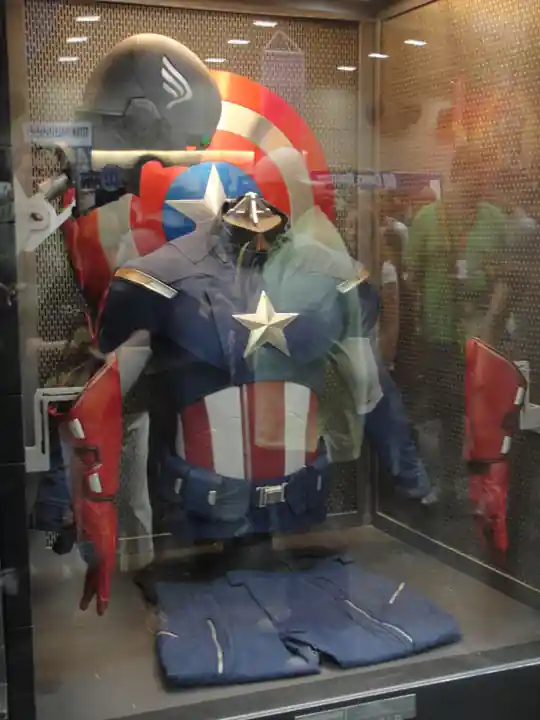
Captain America: The First Avenger (2011): America / Steve Rogers and Star Spangled SingerImage: Wikimedia Commons · The Conmunity - Pop Culture Geek from Los Angeles, CA, USA, CC BY 2.0 - #003
- #004
- #005
The comic book seen in the film bears the cover of the real first issue of Captain America Comics, dated March 1941. The cover in the film was altered from the original version to remove the depiction of Bucky, because the character's film version is considerably younger than his comic-book counterpart.
- #006
- #007
- #008
Shields made of different materials were used depending on what a shot required. Rubber shields were used when Captain America punched people. Magnets were used to hold the shield in place in scenes where he wore it on his back. In most scenes where the shield is seen being thrown, Chris Evans was miming the actions of catching and throwing it, and the shield was added later using CGI.
- #009
- #010
- #011
The comic book version of Captain America's shield is most commonly said to be a mixture of Vibranium and Adamantium. Vibranium = the shield's ability to absorb vibrations; Adamantium = the shield's (near) indestructibility. However, because Adamantium is part of the X-Men/Wolverine mythos, which film rights are owned by 20th Century Fox, the Adamantium part had to be left out of this version.
- #012
Even though the vial of serum stolen by the HYDRA agent is broken, more of it turned up in The Incredible Hulk (2008), where it was injected into Emil Blonsky (turning him into the Abomination), a leftover from the Weapon Plus program that also gave Isaiah Bradley superhuman strength. You can even see the words "Vita-Ray" on the refrigerated storage container. In Captain America: Civil War (2016), it is revealed that several other super soldiers were created during the Cold War (with a similar-looking serum stolen from Howard Stark) and that even more were later created using a serum developed by Dr. William Nagel while working for the CIA and later for the Power Broker, but this left the subjects aggressive and impossible to control. According to canon, many attempts were made to replicate the super-soldier experiment, but it only worked successfully on Steve Rogers.
- #013
- #014
- #015
(Around 1 hour 2 minutes) During the escape from HYDRA, Timothy "Dum Dum" Dugan (Neal McDonough) and Gabe Jones (Derek Luke) steal a tank at the facility. As they drive off, you can hear Dugan shout "Wahoo!" In the comics, this is the battle cry of the Howling Commandos, of which both men are members.
- #016
The shield Captain America first uses in the film's early stages, while selling bonds and making films to promote the war effort, is similar to the one used in the first issue of the 1940 Captain America comic. After MLJ, the publisher of the comic character The Shield, complained that Captain America's shield was too similar, the shield was changed in the comics.
- #017
- #018
- #019
Johann Schmidt/Red Skull's (Hugo Weaving's) car was built from scratch on a modified truck chassis. It was twenty-five feet long and eight feet wide. Its design was inspired by the Mercedes 540K and Mercedes G4 and included an exposed "supercharger" between the front wheels. A 700-horsepower Drexler engine moved the car. Director Joe Johnston actually took it for a drive: "I drove it myself and it has about a thirty-eight-foot turning radius. So it's not much fun to use. But it looked magnificent. Just a beautiful car."
- #020
(at around 1h 13 mins) When the commando team is put together, Jacques Dernier (Bruno Ricci) said: ''Moi, je combattrai jusqu'à ce que le dernier de ces bâtards soient morts, enchaînés ou bien pleurent comme un petit bébé.'' Translated, it means: "I will fight until the last of those bastards are dead, chained, or cry like a little baby." Then Gabe Jones (Derek Luke) replied: ''J'espère que ce sera tous les trois." ("I hope it will be all three.'') ''Moi aussi'' (''Me too'') the first one concludes.
- #021
At the start of the film, while looking at the tesseract, Johann Schmidt says, "… And the Führer digs for trinkets in the desert." This is a reference to another Paramount Pictures film, Raiders of the Lost Ark (1981). Director Joe Johnston was part of Industrial Light & Magic's (ILM) Academy Award-winning visual effects team on that film.
- #022
Hugo Weaving went on record saying he was indifferent to the film. He said he was happy with the experience but that it was not normally the kind of film he would choose. He also stated he had very little interest in reprising the role of Red Skull because of the difficulty of the makeup process. In fact, when Red Skull (or a version of him) reappeared in Avengers: Infinity War (2018), he was played by a different actor.
- #023
After Joss Whedon was hired to direct The Avengers (2012), he was given a copy of this movie's script, and made a few re-writes to tie it more closely to the Marvel Cinematic Universe: "I just got to make some character connections. The structure of the thing was really tight and I loved it, but there were a couple of opportunities to find his voice a little bit, and some of the other characters, and make the connections, so that you understood exactly why he wanted to be who he wanted to be, and progressing through the script to flesh it out a little bit."
- #024
(at around 8 mins) Summary of patient health issues (for skinny Steve Rogers): Asthma, Scarlet fever, Rheumatic fever, Epilepsy, Sinusitis, Chronic or frequent colds, High blood pressure, Palpitations or pounding in heart, Easy fatiguability, Heart Trouble, Nervous trouble of any sort, Has had household contact with tuberculosis patient, Parent/Sibling with diabetes, cancer, stroke or (?).
- #025
(At about the 39th minute) While chasing H.Y.D.R.A. Agent, after being injected with the super soldier serum, Steve opens the door of a taxi. The taxi company is the "Lucky Star Cab Company," and its name is arranged around a star for a logo that resembles and foreshadows the iconic shield Steve will eventually use as Captain America.
- #026
(At about 50 minutes) During Captain America's war bond drive, the burning tank in the background of the black-and-white film is an M5 Stuart tank painted with a German emblem. This is accurate for 1940s Hollywood filmmaking, since there were no real German tanks, so they would paint US vehicles with the German seal.
- #027
(At about 1 hour 2 minutes) In the tank, Gabe Jones (Derek Luke) tells Timothy "Dum Dum" Dugan (Neal McDonough) that he studied German for three semesters at Howard and then switched to French because the girls were much prettier. He was referring to Howard University, a historically all-black private university founded in Washington DC in 1867. In the German version, he says he studied mechanical engineering at Harvard but did not last long because the girls were too ugly.
- #028
The film shares several similarities with Raiders of the Lost Ark (1981), on which director Joe Johnston worked as art director: Red Skull's consumption of the Tesseract in his hand closely resembles the way the Ark of the Covenant kills the Nazis; Captain America throws a HYDRA soldier into an aircraft propeller; and after taking the Cosmic Cube, Johann Schmidt/Red Skull remarks on Adolf Hitler's habit of "searches for trinkets in the desert."
- #029
- #030
Baron Zemo and Baron von Strucker initially appeared as secondary villains working under Red Skull, but the writers removed them from the script for fear they would be wasted in such small roles. Strucker was used in the post-credits scene of Captain America: The Winter Soldier (2014) and had a brief role in Avengers: Age of Ultron (2015), while Zemo became the villain of Captain America: Civil War (2016), though not as a HYDRA agent.
- #031
At roughly 1 hour 18 minutes, when Steve discovers the round metal shield in Howard Stark's development office, he asks what it is made of. Vibranium is a fictional element in the Marvel universe that comes from the country of Wakanda, home to another Marvel Comics superhero, Black Panther. Black Panther first appeared in the Marvel Cinematic Universe in Captain America: Civil War (2016) before starring in Black Panther (2018); since the Panther suit is also made of vibranium, he was the only one who could damage Steve's shield.
- #032
The special forces unit Captain America assembles and leads is a mix of characters from Marvel Comics' World War II-era titles: the 1960s war title "Sergeant Fury and his Howling Commandos," about an elite special forces infantry unit, and the 1970s "The Invaders," about a superhero team operating under Captain America's command during the war. The first title contributes most of the soldier characters, while the second includes Captain America, Bucky and James Montgomery Falsworth, who appears in the comics as the British superhero Union Jack.
- #033
- #034
- #035
At around the 17th minute, Arnim Zola's first appearance, as an image of his face on a television screen, evokes the "classic" comic-book Zola. Zola's body was a headless hulk containing his preserved consciousness, with a display screen on its chest showing an image of his face. As Zola gathers his papers before the Red Skull's base self-destructs (at about 1 hour 3 minutes), the schematic of that robotic body can be seen as he packs it, suggesting the possibility of his reappearance in modern times (which is what happened in Captain America: The Winter Soldier (2014)). In this film he appears on a computer screen in an abandoned SSR base.
- #036
The giant aircraft at the end is known as a "flying wing"; it is all wing, with no fuselage or tail. Companies began experimenting with them in 1910, and during World War II Americans, Canadians, Germans, Russians and Britons tried prototypes, but none ever truly reached operational status. The first genuinely operational flying wing was Northrop Grumman's "B2 Spirit" stealth bomber.
- #037
- #038
Until a very late stage of pre-production, H.Y.D.R.A. would have been an overtly Nazi paramilitary organization, with swastikas on its uniforms. That outcome is nevertheless still present in the final version. A deleted scene also shows an H.Y.D.R.A. tank openly attacking the Wehrmacht, in addition to the Allies' 107th Infantry Regiment at Allonzo in Umbria, Italy.
- #039
- #040
- #041
At around 1 hour 35 minutes, Colonel Phillips (Tommy Lee Jones), Peggy (Hayley Atwell) and Captain America (Chris Evans) are chasing H.Y.D.R.A. In the plane, in Schmidt's (Hugo Weaving's) car, Colonel Phillips presses a red button marked "K" surrounded by the German words "Gefahr Nicht Drucken," which translates into English as "Danger Do Not Press," sending the car speeding faster down the runway. In Men in Black (1997), Tommy Lee Jones' character "K" warns "J" never to touch the red button, and later in the film tells him to press the little red button, sending their car speeding down a tunnel. Coincidentally, his character's name in that movie was "K," while the button he pushes to make the car go faster in this movie has the letter "K" on it.
- #042
Joe Simon and Jack Kirby, both Jewish, created Captain America as a direct response to their disgust with the actions of Nazi Germany. The character is considered to be inspired by the folkloric Golem, a super-strong being created by a rabbi as a protector from antisemitic violence. Simon originally named the character "Super American," but decided, "No, it didn't work. There were too many 'Supers' around. 'Captain America' had a good sound to it. There weren't a lot of captains in comics. It was as easy as that. The boy companion was simply named Bucky, after my friend Bucky Pierson, a star on our high school basketball team." He debuted in Captain America Comics #1 (Mar. 1941), famously punching Adolf Hitler. Though the comic was an instant success, selling nearly a million copies, Simon and Kirby received numerous written threats over the character, and police were posted outside the office of Timely Comics (later Marvel) for protection. According to Kirby's longtime assistant Mark Evanier, Kirby was notified that three thugs were in Timely's lobby "to show him what real Nazis would do to his Captain America," so Kirby "rolled up his sleeves and headed downstairs," by which time the men had fled. New York Mayor Fiorello LaGuardia personally contacted Simon and Kirby to voice his support. MLJ Magazines (later Archie Comics) felt that Cap's original triangular shield was too similar to the costume of their own star-spangled character The Shield, so Simon and Kirby replaced it with the now-iconic circular shield in the second issue. Eighteen-year-old Stanley Lieber (later known as Stan Lee) got his first writing job on the third issue, which was the first to show Cap using his shield as a throwing weapon. Cap became the most successful patriotic superhero during World War II, with his comics continuously selling nearly a million copies each month, outselling the likes of Time magazine and inspiring numerous imitators. The character, and the superhero genre in general, fell out of favor after the war, and his comic was canceled after issue #78 (Sep. 1954). Lee and Kirby reintroduced Cap in The Avengers #4 (Mar. 1964), earning him admiration among a new generation of fans.
- #043
- #044
- #045
At around the 11th minute, in the room where Stark demonstrates his Reversion technology, you can see a red rocket model hanging from the ceiling behind the audience, with a black-and-white checkered stripe in its center. This is the rocket from the Belgian comic books "Tintin: Objectif Lune" and "Tintin: On a marché sur la Lune," written by Georges Prosper Remi (a.k.a. Hergé).
- #046
- #047
During the bond rally musical numbers, Captain America repeatedly "knocks out" an actor playing Adolf Hitler by throwing a fake punch at his chin. This was inspired by the cover of the first issue of "Captain America Comics" (published in December 1940, a year before the attack on Pearl Harbor), which depicted Captain America flooring Hitler with a single punch. In the film this is reversed, so that the musical numbers inspired the first "Captain America" comic book cover.
- #048
- #049
The film's final scene shows Captain America waking up and questioning where he is, then attempting to escape from S.H.I.E.L.D. The facility, where he learns he is in a very different world, adapts story elements from Ultimates #3 (May 2002), in which the Ultimate Marvel counterpart does the same after waking up, and Nick Fury appears in both versions.
- #050
- #051
- #052
- #053
- #054
In the final post-credits scene, the baseball game on the radio in S.H.I.E.L.D.'s waiting room — the game Steve Rogers says he attended — was played on Sunday, May 25, 1941. The Brooklyn Dodgers beat the Philadelphia Phillies 8-4, and Pete Reiser's inside-the-park grand slam in the sixth inning provided the margin of victory.
- #055
Chris Evans admitted that one reason he initially hesitated to play Captain America was his thinning hair. He explained: "I'm afraid this [role] could last up to 10 years, so I could be playing this character until I'm 40. I have to be like this superior man. He can't be bald. How horrible would it be if this superior man had male pattern baldness?"
- #056
- #057
Early in the film, Steve Rogers (Chris Evans) is beaten up outside a cinema. During this fight, he is seen holding a trash can lid as a shield, a not-so-subtle nod to his future role as Captain America. We also hear the MCU's first use of Captain America's signature catchphrase, "I can do this all day."
- #058
The idea that Red Skull was an original test subject for the Super Soldier Serum and that it horribly disfigured him actually comes from Captain America (1990). In the comics, the Skull did not have the Super Soldier Serum in his body until his mind was transferred by Zola into a clone of Steve Rogers' body (Captain America Vol. 1 #350).
- #059
- #060
- #061
- #062
- #063
- #064
- #065
- #066
Chris Evans said the hardest part of gaining weight to play Captain America was the high caloric intake required: "Just eating all the time. It sounds good, but it's not like cheeseburgers. You have to eat these bland, plain pieces of chicken and rice. You're so full that it's a pretty uncomfortable feeling."
- #067
When Cap frees the "Howling Commando Squad" from the HYDRA base in Italy, Timothy "Dum Dum" Dugan (Neal McDonough) turns as everyone leaves the cell, sees Morita and says, "What, now we release everyone?!" Morita (Kenneth Choi) replies, "I'm from Fresno, ace!" The entire US Army, especially those serving in Italy, knew that the battalion of Japanese-American soldiers stationed in Italy was the most decorated battalion of World War II. As a Howling Commando, Dugan should have known this.
- #068
- #069
- #070
John Hinckley Jr. claimed that in 2011, while periodically receiving unsupervised leave from the psychiatric hospital where he had been confined since his 1981 assassination attempt on then-President Ronald Reagan, he went to see the film at a local movie theater. However, after he was dropped off at the theater, Secret Service agents observed him secretly going to a bookstore to look at books about Reagan and assassins. To maintain the illusion that he had watched the film, he later told several people how much he had enjoyed it. The film he claimed to have seen was Captain America.
- #071
- #072
- #073
- #074
At the start of the film, Red Skull wears a mask version presumed to be his normal human appearance before taking the Super Soldier serum. He later removes the mask to reveal his red flesh. He had mentioned at the start of the film that he already had "burns." Hugo Weaving appeared in V for Vendetta (2005) as V, an anarchist who wears a Guy Fawkes mask for various reasons, including to conceal the burns covering his body.
- #075
- #076
- #077
Kevin Feige said several different methods were proposed for creating the skinny Steve Rogers. Marvel considered having Chris Evans physically lose then gain the weight, in the vein of Cast Away (2000), but the schedule did not allow for it. A fully CGI Evans was created, but it was also deemed "creepy."
- #078
- #079
The Tesseract does not damage the wooden crate Red Skull finds it in in Norway, but at the end of the film it melts the metal floor of the Valkyrie, causing it to fall into the ocean. This is not just a plot device to send the cube to the bottom of the sea; it follows the logic of the state of the Infinity Stones: in the ancient temple the Tesseract was inert or dormant, while aboard the ship, after Zola's energy-extraction machine collapsed and it interacted directly with Red Skull, it entered a state of overload and critical reaction and released massive thermal radiation capable of melting the hull.
- #080
Colonel Phillips (Tommy Lee Jones) is responsible for administering a series of tests to select the ideal candidate for a special government program, and despite his own doubts, he is reluctantly persuaded by a subordinate to choose Steve Rogers. In Men in Black (1997), Zed is responsible for administering a series of tests to select the ideal candidate for a special government program, and despite his own doubts, he is reluctantly persuaded by his subordinate Agent K (Tommy Lee Jones) to choose James Edwards.
- #081
The initial reaction to Chris Evans being cast as Captain America was negative. Many fans thought he was too skinny and still remembered him as Johnny Storm from the Fantastic Four films. Among the names fans preferred were Channing Tatum, Mark Valley, Sam Worthington, Milo Ventimiglia and Mike Vogel.
Behind the Scenes (2)
- #082
At around the 37th minute, after returning to Captain America, Hayley Atwell (Peggy Carter) touches Chris Evans's chest as he emerges from the chamber. It was largely improvised and the surprise on her face was genuine; in interviews she admitted she was so taken with Chris's physique that she nearly broke character and almost ruined the take that ended up in the film.
- #083
Paul Warren (an experienced film stuntman and actor, known mostly for roles requiring prosthetics) was used in pre-production, along with CGI supervisor Christopher Townsend, as one of the on-set stand-ins for "skinny Steve," to help develop the "skinny Steve Rogers" effect. Leander Deeny, a British Shakespeare-trained stage actor, was used on set as the double for "skinny Steve" when Chris Evans was seated or lying down or when minimal physical movement was required.
Characters & Cast (3)
- #084
Wyatt Russell's first audition was for Captain America in this film, but he lost out to Chris Evans. Years later, Russell played John Walker/Captain America in The Falcon and the Winter Soldier (2021), and in the comics Walker replaced Steve Rogers as Captain America. Wyatt's father, Kurt Russell, also appeared in the MCU, in Guardians of the Galaxy: Vol. 2 (2017).
- #085
Marvel Studios was so determined to cast Chris Evans as Captain America that it offered him a nine-film deal without an audition. Kevin Feige recalled, "He took a weekend to decide. That weekend was tough." Evans turned it down twice, so Marvel reduced the commitment from nine films to six (three Captain America films and three Avengers films). Evans finally accepted after some persuasion from Robert Downey Jr.
- #086
Easter Eggs & References (6)
- #087
(Around 11 minutes) In the exhibition there is a mannequin in a red jumpsuit under a glass dome. This is a reference to the original Human Torch android, the first superhero created by Timely Comics (October 1939), which eventually became Marvel Comics. He was also part of The Invaders alongside Namor and Captain America. Marvel Comics recycled the name and powers for Johnny Storm of the Fantastic Four (1961). Chris Evans played Johnny Storm/the Human Torch in Fantastic Four (2005) and Fantastic Four: Rise of the Silver Surfer (2007).
- #088
Louis Leterrier looked at some concept art for this film and was impressed enough to offer his services, but Marvel Studios turned him down. Nevertheless, his film The Incredible Hulk (2008) contains a small appearance by Captain America: in a deleted scene set in the Arctic, his body is seen hidden beneath a sheet of ice.
- #089
Steve Rogers draws costume designs for Howard Stark and is caught defacing his own drawings of himself as a circus monkey, a reference to the comics' depiction of Cap's second identity as an artist since 1979. He even worked on the fictional Captain America comic published in the Marvel Earth. In the 1991 mini-series "The Adventures of Captain America," there is a very similar scene detailing his origin, in which Steve draws costumes and sketches his own cartoons. That series appears to have been influential in other ways as well. For example, the character of Peggy Carter in this film (very different from the comics) recalls Lieutenant Cynthia Glass, Steve's love interest in the mini-series, who is ultimately revealed to be a German spy.
- #090
In the "Modern Marvels" exhibition, Steve (Chris Evans) and Bucky (Sebastian Stan) walk past a man in a red suit submerged in water. The sign above includes the name "Doctor Phineas Horton." This is a reference to the original android Human Torch, one of the three major heroes of 1940s Atlas Comics (later Marvel Comics) alongside Captain America and the Sub-Mariner. Chris Evans also played the Human Torch in Fantastic Four (2005) and Fantastic Four: Rise of the Silver Surfer (2007).
- #091
- #092
Just as the Captain is about to use the zipline, Montgomery amuses him with "Mind the gap." This is a reference to the London Underground system, where signs and later recorded announcements tell passengers to be careful not to step into the gap between the platform and the train. The Tube gap is about eight inches. In this instance the gap is about a thousand yards. The joke is actually an anachronism, since the "mind the gap" warning was not introduced until 1968.
Deeper Meaning (4)
- #093
The song playing in the background of the London pub while Steve recruits the Howling Commandos is Rudy Vallee's "The Drunkard Song" (There Is a Tavern in the Town). This is also where Peggy finds Steve mourning Bucky's death. Apparently, however, much of the pub was bombed during the Blitz and is therefore very different from the happy meeting place early in the film. This may be an allegory for how war changes not only places but people. Steve is a different person at the end of the film than he was at the start, before experiencing war firsthand. This is true for many people who have lived through the horrors of war.
- #094
The HYDRA plane crash involving Cap comes down in Newfoundland, Canada (far from dense population) and is broadly based on a real-life event. In 1985 a US Army jet crashed in Gander, Newfoundland, killing everyone on board. The casualties were members of the 101st Airborne Division "Screaming Eagles" and were the inspiration for the "Howling Commandos." The aircraft, which had been refueling, was ironically en route to Fort Campbell, Kentucky, from a deployment in Germany. After the deaths, memorials were erected both at the destination in America and near the crash site in Canada.
- #095
Casting director Sarah Finn explained why she chose Chris Evans to play Captain America: "He was American. We gave a lot of Brits to the cast, but we wanted to cast an American. And he's a great actor, funny, attractive and likable and all of that. But beyond the obvious qualities, I think there were other things that were a little harder to notice: his humility, a sense of having a moral compass, very relatable. He has vulnerability as well as strength, so we can bring him along with us. From skinny Steve to Captain America."
- #096
In March 1942, at the Brooklyn facility where Steve Rogers (Chris Evans) is transformed by the Super Soldier Serum, Colonel Chester Phillips (Tommy Lee Jones) is shown in uniform wearing paratrooper jump wings and the Combat Infantryman Badge, along with the Purple Heart and Silver Star medals for being wounded and for heroism in combat. However, although it could be awarded for combat from December 6, 1941, the CIB was not introduced until November 1943. Unless Phillips was at Pearl Harbor, he would not yet be eligible to wear the CIB, despite prior bravery implied to have occurred in World War I. Even if he had been at Pearl Harbor, the award would not yet have existed at the point when Steve Rogers successfully received the serum injection.
Career & Awards (1)
Related pages
- The Martian — Captain America: The First Avenger comes up in the facts on that page
- Avengers: Endgame — Captain America: The First Avenger comes up in the facts on that page
Sources & editorial notes
Reference databases
- Wikipedia
- IMDb
Information from external sources is independently selected, consolidated and edited by Arka Evren. Sources are listed for verification and further reading. Encyclopedia text is used under its licence (CC BY-SA). How we work