

FILM · 1960 · USA
The Apartment
- Directed by
- Billy Wilder
- Runtime
- 126 min
- Studio
- The Mirisch Company
226 archived facts 6 topics 1 source Last reviewed Nov 2026
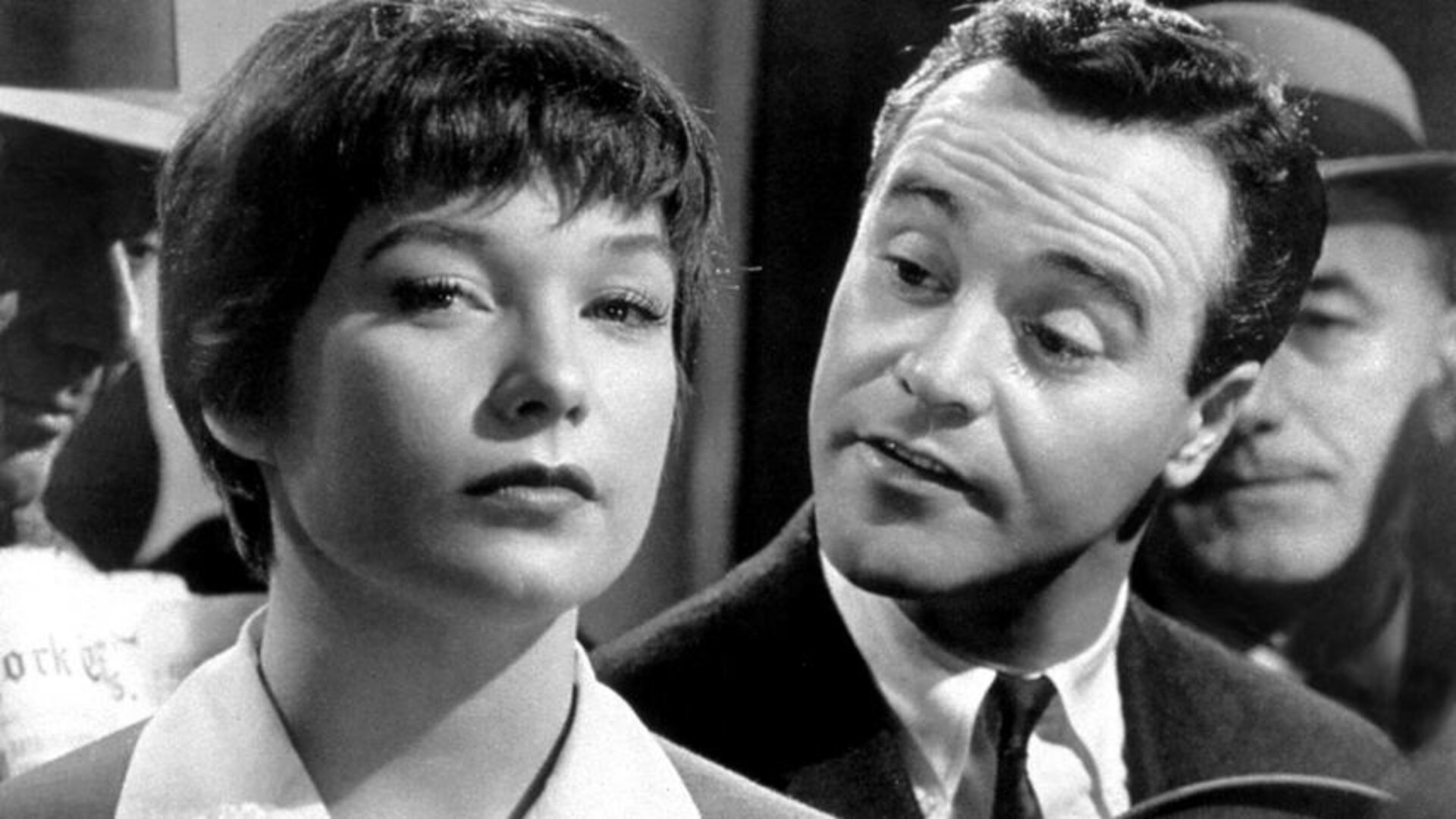
Bud Baxter is a minor clerk in a huge New York insurance company, until he discovers a quick way to climb the corporate ladder. He lends out his apartment to the executives as a place to take their mistresses. Although he often has to deal with the aftermath of their visits, one night he's left with a major problem to solve.
226 Interesting Facts About The Apartment
Interesting Facts (18)
- #001
Designers Alexandre Trauner and Edward G. Boyle developed an unusual technique to create the effect of a vast sea of faces working stiffly and impersonally at desks in the big insurance company office. The desks in the foreground seated large actors, the smaller desks behind them used children in suits, and beyond those came even smaller desks with cut-out figures operated by wires. It created the impression of a far larger space than could be achieved within the limited studio area.
- #002
In the scene where Fran takes an overdose of sleeping pills, doctors were on set to advise on how she would be revived. The hard slaps the doctor gives Fran to keep her from losing consciousness were all real. After the scene, however, the doctors told Billy Wilder that the actor should slap Shirley MacLaine harder. Wilder, after looking at MacLaine's red cheeks from being slapped repeatedly, refused to shoot it again.
- #003
- #004
- #005
- #006
- #007
Later in life, Jack Lemmon recounted how Billy Wilder always kept his film editor Doane Harrison beside him on set as associate producer, and that the two would not shoot anything until they had discussed it. As a result, Wilder was able to shoot economically, cutting the film in the camera and eliminating costly setups that could never be used.
- #008
Jack Lemmon was playing in the dressing room with a nasal spray and discovered that if squeezed sharply it would squirt three meters. To make the liquid visible in the black-and-white film, he filled the container with milk, and when Fred MacMurray scolded him for creating a problem over the use of the apartment, Lemmon squeezed the container. The milk squirted out and passed just by MacMurray's nose. Billy Wilder kept the take.
- #009
- #010
Billy Wilder and I. A. L. Diamond based the film partly on a Hollywood scandal in which high-powered agent Jennings Lang was shot by producer Walter Wanger for having an affair with Wanger's wife, the actress Joan Bennett. During the affair, Lang had used a low-level employee's apartment. Another element of the plot was based on the experience of a friend of Diamond's who came home after breaking up with his girlfriend and found that she had killed herself in her girlfriend's bed.
- #011
- #012
- #013
- #014
- #015
- #016
- #017
- #018
Both C. C. Baxter and Fran Kubelik raise four fingers at different times but say three. At the Christmas party, Baxter says he has had only three drinks but holds up four fingers, and Fran says she has had only three boyfriends but holds up four fingers. This is probably an implicit comment by Fran on Baxter's earlier mistake.
Production Story (114)
- #019
After Billy Wilder saw David Lean's 1945 film Brief Encounter, he became curious about the story of an unnamed character in the film—the person who lends out his apartment for extramarital affairs—and the idea for The Apartment was born. Shirley MacLaine was given only forty pages of the script; Wilder did not want the actress to know the ending. MacLaine, however, assumed this was because the script was unfinished.
- #020
- #021
- #022
- #023
Wilder and I.A.L. Diamond based the film partly on a real Hollywood scandal: the powerful agency executive Jennings Lang had been shot by the producer Walter Wanger because of Wanger's wife, the actress Joan Bennett, and her relationship with Lang. During the affair, Lang was using the apartment of a low-level employee. Another element of the story was that one of Diamond's friends had returned home after breaking up with his girlfriend and found her in his bed, having committed suicide.
- #024
According to Shirley MacLaine's official website, much of the film was written as shooting progressed. The gin rummy game was added because she was learning the game at the time from her friends in the Rat Pack. Her starting to philosophize about love during a lunch break also made it into the script.
- #025
- #026
- #027
- #028
- #029
- #030
- #031
In 1968, the playwright Neil Simon adapted the screenplay for the Broadway musical Promises, Promises. The musical produced two hit songs: the title song and 'I'll Never Fall in Love Again,' composed by Burt Bacharach and Hal David and performed by Dionne Warwick. (Promises, Promises rose to number 19 on the Billboard Hot 100 in 1968, and the other song to number 6 in 1970.) The musical premiered on December 1, 1968, at the Shubert Theatre and ran for 1281 performances. Its first Broadway revival opened on April 25, 2010, at the Broadway Theatre with Sean Hayes and Kristin Chenoweth.
- #032
- #033
- #034
- #035
- #036
- #037
After watching the 1945 film Brief Encounter, Billy Wilder developed the idea for this film by wondering about the situation of a character who never appears on screen—the person who lends out his apartment for illicit love meetings. Shirley MacLaine was given only forty pages of the script because Wilder did not want her to know how the story would end. MacLaine, however, assumed this was because the script was unfinished.
- #038
To create the crowded effect of employees working at their desks in a ruthless and impersonal manner in the vast insurance company office, designers Alexandre Trauner and Edward G. Boyle developed an unusual technique. Full-sized actors sat in the front rows, while children in suits sat at small desks behind them, and even further back were smaller desks with cut-out figures moved by wires. This gave the impression of a space far larger than could be achieved within the limited studio area.
- #039
Jack Lemmon said he learned a great deal about filmmaking from Billy Wilder, especially the director's use of 'hooks' (small details that audiences remember long after they have forgotten other aspects of the film). One of these hooks was the key to Baxter's apartment being passed from hand to hand. Lemmon recounted that even years after the film's release, people would come up to him and say, 'Hey Jack, can I have the key?'
- #040
The film was praised by Soviet bloc critics as a critique of the American system and as a story that could only take place in a capitalist city like New York. At a dinner held in his honor in East Berlin, Billy Wilder said the film 'could take place anywhere, like Hong Kong, Tokyo, Rome, Paris, London.' When Wilder said the only place the film could not take place was Moscow, the East Germans erupted in applause and cheers. When the applause died down, Wilder continued: 'The reason this film could not take place in Moscow is that no one in Moscow has their own apartment.' This remark was met with a cold silence.
- #041
- #042
During the scene in which Fran overdoses on sleeping pills, doctors were present on set to ensure accuracy in how she would be brought back to life. The hard slaps the doctor gives Fran to rouse her from unconsciousness were real. However, after the scene, the doctors told Billy Wilder that the actor needed to hit Shirley MacLaine harder. Wilder looked at MacLaine's cheeks, reddened from being slapped repeatedly, and refused to shoot the scene again.
- #043
- #044
- #045
- #046
- #047
- #048
Jack Lemmon later recounted that Billy Wilder kept his film editor Doane Harrison on set constantly as co-producer, and that the two never shot a take without discussing it. As a result, he was able to shoot economically, cutting the film in the camera and eliminating expensive shots that might never be used.
- #049
Jack Lemmon was playing with a nasal spray device in his dressing room and discovered that with a sharp squeeze it sprayed ten feet away. He filled it with milk so it would be visible in the black-and-white film, and when Fred MacMurray scolded him for creating a problem with the use of the apartment, Lemmon squeezed the device. The milk squirted out and passed right by MacMurray's nose. Billy Wilder kept this take in the film.
- #050
- #051
- #052
Billy Wilder claimed that Fred MacMurray was a very stingy man in real life and loved to tell a funny incident from the film's shoot. In one scene, MacMurray was supposed to tip a shoeshine man, and the script told him to toss a quarter. When MacMurray could not do it correctly during the take, Wilder suggested using a larger fifty-cent piece. MacMurray objected: 'I would never give him fifty cents - I can't play the scene!'
- #053
- #054
- #055
Jack Lemmon said of his character: 'As I saw him, [Baxter] was ambitious; a good guy but naive, easily digested and quick to excuse his own behavior. He changes in the end because he confronts the fact that he has rationalized his morality. He realizes he was a stupid kid, that he was fooled.'
- #056
- #057
Billy Wilder generally wanted his actors to stick to the script, but he allowed Jack Lemmon to improvise in two scenes: in one he squirted a bottle of nose drops across the room, in the other he sang while making spaghetti (straining the pasta through the strings of a tennis racket). Lemmon did not change the dialogue.
- #058
Wilder and I.A.L. Diamond based the film partly on a real Hollywood scandal: agency president Jennings Lang was shot by producer Walter Wanger for having an affair with Wanger's wife, Joan Bennett, and Lang was said to have used a low-level employee's apartment for the affair. Another source for the story was Diamond's friend, who came home after breaking up with his girlfriend and found her in his bed, having committed suicide.
- #059
- #060
- #061
- #062
- #063
This film is the first Best Picture winner to reference a previous Oscar winner; in fact, two of them. The film Baxter tries to watch on television is Grand Hotel (1932), constantly interrupted by commercials. Bud's boss mentions spending a 'lost weekend' in Bud and Fran's apartment, a nod to Wilder's previous Oscar winner The Lost Weekend (1945).
- #064
- #065
Wilder wrote the role of Dr. Dreyfuss for Lou Jacobi, but the producers of Jacobi's Broadway play would not release him. Jack Kruschen took the role and received an Oscar nomination. Wilder repaid his debt to Jacobi by giving him the role of 'Moustache' in the 1963 production Irma la Douce.
- #066
- #067
- #068
- #069
- #070
- #071
- #072
In the opening, Baxter explains that if the entire population of New York City (8,042,783) were of average height, 1.68 meters, and laid head to toe, they would stretch from Times Square to the outskirts of Karachi, Pakistan. They really would, and 1,200 miles farther, almost to the southern tip of India.
- #073
- #074
- #075
- #076
Shirley MacLaine recounted meeting the interpreter of Soviet Premier Nikita Khrushchev, who was in the United States to speak at the United Nations. The interpreter said, "The Premier sends his greetings, says he wants to be remembered to you, and says he saw your new film The Apartment and that you have improved." Khrushchev was probably referring to Can-Can, the 1960 film MacLaine hated.
- #077
C.C. Baxter and Fran Kubelik each hold up four fingers at different times but say three. Baxter says he has had only three drinks at the Christmas party but holds up four fingers; Fran says she has had only three boyfriends but holds up four fingers. This may be an oblique comment by Fran on Baxter's earlier mistake.
- #078
In addition to the two original Tiffany lamps in Baxter's apartment (one in the Daffodil pattern, the other in the Spider pattern; they now sell for between $20,000 and $40,000 each), there is a Periwinkle-pattern leaded glass shade made by the Unique Art Glass and Metal Company. That shade is worth roughly $1,500–2,000 today. The film was shot before antique leaded glass shades became collectible; in the early 1960s such items could be found cheaply at flea markets.
- #079
- #080
- #081
- #082
- #083
- #084
- #085
- #086
- #087
- #088
- #089
- #090
- #091
C.C. Baxter is given tickets to 'The Music Man' and asks Fran Kubelik to meet him at the Majestic Theatre on 44th Street. 'The Music Man' ran at the Majestic from December 19, 1957, to October 22, 1960. It moved to the Broadway Theatre from October 24, 1960, to April 15, 1961. It won the Tony Award for Best Musical at the 1958 Tonys.
- #092
Neil Simon adapted the screenplay into the Broadway musical Promises, Promises in 1968. It included two hit songs composed by Burt Bacharach and Hal David and sung by Dionne Warwick: the title song and I'll Never Fall in Love Again. The former reached number 19 on the Billboard Hot 100, and the latter number 6 in 1970. The musical premiered at the Shubert Theatre on December 1, 1968, and ran for 1,281 performances. Its first Broadway revival opened on April 25, 2010, with Sean Hayes and Kristin Chenoweth.
- #093
The scene of spaghetti floating on a Spaulding tennis racket led audiences to buy large quantities of Spaulding rackets. Spaulding had not paid for product placement, but that commercial response led producers to start demanding placement fees from consumer products when they were used in films.
- #094
- #095
- #096
- #097
- #098
The period in which the film is set (1959/1960) is easy to understand. Period references include television programs such as The Music Man playing at the Majestic, The Ed Sullivan Show, The Dinah Shore Chevy Show, The Perry Como Show and The Untouchables with Robert Stack on Thursday nights, Mrs. Lieberman's mention of Cape Canaveral, Fidel Castro's revolution, beatniks and references to King Farouk.
- #099
- #100
- #101
- #102
- #103
- #104
Besides the Tiffany lamps (which may oddly have come with the apartment), Baxter appears to be a cultured man. Authentic Spider Tiffany lamps, like the one beside the bed, sold at auction for $60,000-$100,000. In his apartment there are many reproductions of well-known modern art, including a Piet Mondrian in the living room and Henri Rousseau's The Sleeping Gypsy above his bed.
- #105
- #106
- #107
- #108
The first stage of the mechanization of the Manhattan office space can be seen on Baxter's desk: the huge, state-of-the-art Friden calculator. Founded in 1934 east of the San Francisco Bay Area, Friden was highly innovative and was the equivalent of ATT and later IBM. It was bought by Singer about six years after this film, and the machines (later manufactured by Hitachi) remained in demand for a decade. Mainframe computers and handheld calculators finally eliminated them.
- #109
- #110
- #111
- #112
- #113
- #114
- #115
- #116
- #117
- #118
- #119
After Fran wakes up and calls her sister from Baxter's living room, Ella Fitzgerald's album The First Lady Of Song is visible under her left shoulder. The lyrics of one of the songs, 'Blue Lou,' go: 'So blue and brokenhearted / Before her romance got started / Cryin', sighin' is all she'll ever do / Forgettin' regrettin' the love she never knew.'
- #120
- #121
- #122
C.C. Baxter says that if we laid New York's population of 8,042,783 end to end at an average height of 1.68 meters, we would reach the outskirts of Karachi, Pakistan. Interestingly, a year earlier MIT students had created a non-standard unit called the 'Smoot,' based on Oliver R. Smoot's height of 1.70 meters, to measure the Harvard Bridge.
- #123
According to C.C. Baxter's calculation, on November 1, 1959, New York's population was 8,042,783 and the average height was 1.68 meters. Laid end to end, they would form a distance of 11,685 kilometers from Times Square to the outskirts of Karachi. The calculation: 1.68 m x 8,042,783 = 13,511,875 m; 13,511,875 / 0.3048 = 44,570,422.5 feet; 44,570,422.5 / 5,280 = 8,441 miles (13,584 km). So the distance Baxter stated was correct, even a little more than correct.
- #124
- #125
- #126
- #127
- #128
- #129
- #130
- #131
- #132
Behind the Scenes (31)
- #133
- #134
Although Billy Wilder generally required his actors to stick exactly to the script, he allowed Jack Lemmon to improvise in two scenes: in one he squirted a bottle of nasal drops into the room, and in the other he sang while preparing a spaghetti meal (straining it through the grid of a tennis racket). In neither case did Lemmon change the dialogue.
- #135
- #136
The massive crowd effect in the office scenes was created through a clever trick by designers Alexandre Trauner and Edward G. Boyle: real actors in the front rows, children in suits behind them, and cut-out figures moved with wires at the very back. This layered setup gave a sense of impossible width within the studio's limited space.
- #137
Real doctors were on set for Fran's overdose scene, and the resuscitation procedure was medically accurate. The hard slaps the doctor delivered were real; although after the shoot the doctors told Billy Wilder he should have hit harder, Wilder refused to reshoot the scene when he saw Shirley MacLaine's reddened cheeks.
- #138
- #139
- #140
Jack Lemmon recounted that Billy Wilder kept his film editor Doane Harrison on set as co-producer at all times, and that the two never shot anything until they had argued it out. This allowed Lemmon to shoot economically, cut the film in camera and eliminate unnecessarily expensive setups.
- #141
While playing with a nose spray in his dressing room, Jack Lemmon discovered that when pressed hard it squirted ten feet. To make it visible in the black-and-white film, he filled the spray with milk and gave a rude squeeze while Fred MacMurray was scolding him; the milk passed right by MacMurray's nose. Wilder kept this take in the film.
- #142
- #143
- #144
Although Billy Wilder generally wanted his actors to follow the script exactly, he allowed Jack Lemmon to improvise in two scenes: in one he squirted the nose drops across the room, in the other he strained the spaghetti through the strings of a tennis racket. In both cases Lemmon did not change the dialogue.
- #145
- #146
- #147
- #148
- #149
Although Adolph Deutsch received the sole screen credit for the music score, the very popular 'Theme from The Apartment' was actually a pre-existing piece of music by British composer Charles Williams (originally 'Jealous Lover', 1949). Williams was known for his compositions for British films and BBC radio dramas.
- #150
In addition to the two genuine Tiffany lamps in Baxter's apartment (one in the Daffodil pattern, the other in the Spider pattern; each now sells for between $20,000 and $40,000), there is a leaded glass shade in the Periwinkle pattern made by the Unique Art Glass and Metal Company. This shade is currently worth about $1,500-$2,000. This film was made before antique leaded glass lampshades became collectible; in the early 1960s such items could be found cheaply at flea markets.
- #151
- #152
- #153
- #154
- #155
- #156
- #157
- #158
- #159
- #160
- #161
- #162
The massive Friden calculating machine on Baxter's desk symbolizes the first phase of mechanization in the Manhattan office world. Founded in 1934, Friden was an innovative company on par with AT&T and IBM; it was acquired by Singer six years after the film, and the machines (manufactured by Hitachi) remained in demand for another decade, until mainframe computers and handheld calculators wiped them out.
- #163
Characters & Cast (56)
- #164
- #165
- #166
Jack Lemmon said he learned a great deal from Billy Wilder's use of small details, which Wilder called "hooks," in filmmaking. The key to Baxter's apartment being passed from hand to hand was one of these hooks. Even years later, people would tease Lemmon with "Hey Jack, can I have the key?"
- #167
- #168
- #169
- #170
Billy Wilder claimed that Fred MacMurray was very stingy in real life. In one scene, MacMurray was supposed to tip a shoeshine man a quarter, but when he couldn't do it right, Wilder suggested a fifty-cent piece. MacMurray objected, saying, "I'd never give him fifty cents - I can't play the scene!"
- #171
- #172
Jack Lemmon said the following about his character: "Baxter was ambitious; he was a good man but naive, easily digestible, and quick to excuse his own behavior. In the end he changes because he confronts the fact that he rationalized his morality. He realizes he was a foolish kid, that he was fooled."
- #173
- #174
Billy Wilder wrote the role of "Dr. Dreyfuss" for Lou Jacobi. However, the producers of Jacobi's Broadway play would not release him for the film. So Jack Kruschen played the role and received an Oscar nomination. After the previously announced Charles Laughton died, Wilder made it up to Jacobi by casting him as "Moustache" in Irma la Douce (1963).
- #175
- #176
- #177
- #178
- #179
- #180
Shirley MacLaine recounted meeting the interpreter of Soviet Premier Nikita Khrushchev, who was in the United States to give a speech at the United Nations. The Russian interpreter told the actress, "The Premier sends his greetings, says he wants to be remembered to you, and says he has seen your new film The Apartment and that you have improved." Khrushchev was probably referring to the 1960 film "Can-Can," which MacLaine famously hated.
- #181
- #182
- #183
- #184
- #185
- #186
- #187
- #188
- #189
- #190
- #191
Soviet bloc critics praised the film as an indictment of the American system; they argued that the story could only take place in a capitalist city like New York. At a dinner in East Berlin, Billy Wilder said the film could take place anywhere — Hong Kong, Tokyo, Rome, Paris, London. When he added that it could not take place in Moscow, the East Germans burst into applause. As silence fell, Wilder said, 'Because in Moscow nobody has his own apartment.'
- #192
- #193
- #194
- #195
- #196
- #197
- #198
Both Baxter and Fran hold up four fingers at different times but say three. Baxter says he has had only three drinks at the Christmas party but holds up four fingers; Fran says she has had only three boyfriends but holds up four fingers. This may be a silent nod by Fran to Baxter's mistake.
- #199
- #200
- #201
- #202
The film's period (1959/1960) is established through contemporary references: 'The Music Man' playing at the Majestic, The Ed Sullivan Show, The Dinah Shore Chevy Show, The Perry Como Show, The Untouchables (1959) with Robert Stack on Thursday night, Mrs. Lieberman's mention of Cape Canaveral, Fidel Castro's revolution, beatniks and King Farouk.
- #203
- #204
- #205
- #206
- #207
- #208
- #209
- #210
- #211
- #212
- #213
- #214
- #215
- #216
- #217
- #218
- #219
Deeper Meaning (4)
- #220
Billy Wilder first conceived of the film after watching Brief Encounter (1945) and wondering about the plight of a character never seen in that film: the person who lends out his apartment for an extramarital tryst. Shirley MacLaine was given only forty pages of the script because Wilder did not want her to know how the story ended. He believed this was because the screenplay was not yet finished.
- #221
- #222
- #223
According to Shirley MacLaine on the film's official website, much of the film was written as shooting progressed. The gin rummy game was added because she was learning how to play at the time from her friends in the Rat Pack. Likewise, when she began philosophizing about love one day during the lunch break, that too was added to the script.
Career & Awards (3)
- #224
- #225
- #226
Billy Wilder wrote the role of "Dr. Dreyfuss" for Lou Jacobi. However, the producers of Jacobi's Broadway play would not release him to make the film. Jack Kruschen therefore took the role and received an Oscar nomination. Wilder later made it up to Jacobi by giving him the role of "Moustache" in Irma la Douce (1963), after the previously announced Charles Laughton died.
Continue through the archive


Sources & editorial notes
Reference databases
- Wikipedia
- IMDb
Information from external sources is independently selected, consolidated and edited by Arka Evren. Sources are listed for verification and further reading. Encyclopedia text is used under its licence (CC BY-SA). How we work