

DIRECTOR · BORN 1906 · DIED 2002
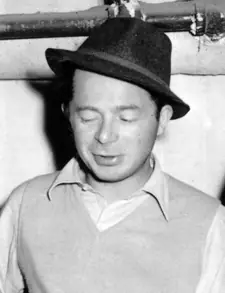
Billy Wilder
- Born
- 22 June 1906, Sucha, Galicia, Austria-Hungary
- Died
- 27 March 2002
- Known for
- The Lost Weekend (1945), Witness for the Prosecution (1957), Sunset Boulevard (1950), The Apartment (1960)
36 archived facts 6 topics 1 source Last reviewed Nov 2026
Billy Wilder (22 June 1906 – 27 March 2002) was a director and screenwriter best known for The Lost Weekend, Witness for the Prosecution and Sunset Boulevard.
36 Interesting Facts About Billy Wilder
Interesting Facts (17)
- #001
"Isn't it Romantic?" crops up again and again in Wilder's films, not out of any particular love for the song but because, as he put it, it was "cheap": he'd struck such a good licensing deal the first time that he could keep using it, a sign of his budget-conscious practicality.
- #002
Wilder hated writing alone and almost always worked with a partner in the room, but most of them complained that he could be cruel and humiliating when he disliked an idea, and many writers couldn't take it and quit, a reflection of his perfectionism and harsh critical style.
Billy Wilder: a sceneImage: Wikimedia Commons · unknown (Paramount Pictures), Public domain - #003
Tom Cruise and Cameron Crowe begged Wilder to take a small part in Jerry Maguire (1996), but he flatly refused, having no wish to step in front of the camera even in retirement.
- #004
In the early 1950s, Wilder planned a film with Stan Laurel and Oliver Hardy, opening with Stan and Ollie asleep in the "o"s of the Hollywood sign, with a story about a woman who comes between them, but Hardy's failing health meant it was never made.
- #005
Wilder greatly admired the British film Brief Encounter (1945), which inspired The Apartment (1960), the story of a man who lends his apartment to a friend and doesn't care what happens there while he's out.
- #006
When Wilder was offered The Sound of Music (1965), he quipped that he'd focus on the Nazis, a joke that captured his dark sense of humor.
- #007
Around 1960, Wilder agreed to direct a film in which the Marx Brothers would run the United Nations, but the project died with Chico Marx's death in 1961 and then Harpo Marx's in 1964.
- #008
Wilder loved clothes all his life, and at 83 he still owned more than 60 cashmere sweaters.
- #009
Wilder wrote "Cum Deo" (With God) on the first page of his scripts, a habit he said he picked up from Pauline Kael, explaining, "It doesn't hurt anyway, and it might corrupt the guy up there."
- #010
In his later years, Wilder was patron of the Billy-Wilder-Institut in Germany, a film school devoted solely to training producers and screenwriters, but it closed just two years later after the death of its founder and dean, Lothar Rhode.
- #011
Wilder built a renowned modern art collection over his lifetime, and in 1989 he sold just part of it for 32.6 million dollars.
- #012
During the shooting of The Spirit of St. Louis, Wilder took a bet with Jimmy Stewart and rode as a wing walker on top of a biplane.
- #013
Wilder was far from happy that Buddy Buddy (1981) turned out to be his last film; he once said that when he died he expected to meet the "spirits" of all his films, would be glad to see most of them and polite to some, but would "try to avoid Buddy Buddy."
- #014
Wilder appears as a character in Gaylord Larsen's 1988 murder mystery "A Paramount Kill," set in 1940s Hollywood, whose hero is Raymond Chandler and in which Wilder is cast as his enemy, drawing on the bad blood between them while making Double Indemnity (1944).
- #015
As a young journalist, Wilder worked with Erich Maria Remarque and tried to talk him out of writing "All Quiet on the Western Front."
- #016
Wilder's spy film "Five Graves to Cairo" accidentally inspired a real intelligence operation: British officers noticed how much actor Miles Mander resembled Field Marshal Montgomery and decided to find a real-life Montgomery double, who was used to keep the Germans guessing about the location of the D-Day landings.
- #017
In 1945, Wilder was made a colonel in the U.S. Army and tasked with helping edit and direct a documentary about the Holocaust, which Austrians and Germans were required to watch, having to show proof that they'd seen it to get their food rations.
Behind the Scenes (6)
- #018
Because of his round face and endless energy, people generally imagined Wilder as short and slight. In reality, however, he stood 5'11", making him slightly taller even than his favorite star, Jack Lemmon.
- #019
Wilder always felt uneasy around children and was an indifferent father to the two children from his first marriage. He and his second wife, Audrey, had agreed not to have children. This shows the distant attitude in his personal life and his intense commitment to his career.
- #020
Wilder appears on the American Film Institute's list of the 100 Funniest Films with five films: Some Like It Hot (1959) at No. 1, The Apartment (1960) at No. 20, The Seven Year Itch (1955) at No. 51, Ninotchka (1939) at No. 52 and Ball of Fire (1941) at No. 92. All of these films are filled with the sharp dialogue and timeless sense of humor that bear his signature.
- #021
Wilder was the father of twins Victoria and Vincent, born in 1939. The children's mother was Judith. Vincent died shortly after birth. This loss shows the difficulties and personal pain in Wilder's first marriage.
- #022
At least three of Wilder's films were adapted into Broadway musicals. The Apartment (1960) inspired the 1968 musical "Promises, Promises." Some Like It Hot (1959) was turned into the 1973 musical "Sugar." Sunset Boulevard (1950) was adapted for the stage by Andrew Lloyd Webber in 1993.
- #023
Wilder met Audrey Young on the set of The Lost Weekend (1945) at Paramount Studios. At the time, his divorce from Judith was still ongoing and he was in a relationship with the actress Doris Dowling. This complicated personal life lays bare the ups and downs of Wilder's private life.
Characters & Cast (1)
- #024
Jerry Lewis asked Wilder to direct The Bellboy (1960), but Wilder said no and told Lewis to direct it himself, which he did.
Deeper Meaning (2)
- #025
Wilder's idol and mentor was German director Ernst Lubitsch, and a sign in his office always asked, "How would Lubitsch do it?"
- #026
Wilder liked the name "Sheldrake" so much he used it in three films, The Apartment (1960), Sunset Boulevard (1950) and Kiss Me, Stupid (1964), a small recurring touch.
Career & Awards (5)
- #027
Wilder tried to enter the United States from Mexico but was turned away by American officials for months; just as he was about to give up, a new immigration officer asked him what he did, and when Wilder said he made films, the officer stamped his papers and told him, "Then make good films."
- #028
Wilder once told Billy Bob Thornton he was too ugly to be an actor and should write a script that made use of his imperfect face, advice Thornton took, writing Sling Blade (1996) and winning an Oscar for it.
- #029
Wilder had two main writing partners: early on, Charles Brackett, an older man who provided a strong argumentative counterweight, and later I.A.L. Diamond, whose outlook better suited Wilder's cynical humor.
- #030
Wilder directed some of cinema's most iconic female performances, Barbara Stanwyck in Double Indemnity (1944), Gloria Swanson in Sunset Boulevard (1950), Marilyn Monroe in Some Like It Hot (1959) and Shirley MacLaine in The Apartment (1960), yet none won an Oscar for them; Swanson, Monroe and MacLaine won Golden Globes instead.
- #031
Seven films Wilder directed have been chosen for the Library of Congress's National Film Registry as "culturally, historically or aesthetically" significant, Double Indemnity (1944), The Lost Weekend (1945), Sunset Boulevard (1950), Ace in the Hole (1951), Sabrina (1954), Some Like It Hot (1959) and The Apartment (1960), as have three he wrote, Midnight (1939), Ninotchka (1939) and Ball of Fire (1941).
Life & Family (5)
- #032
Wilder's mother, Gitla Siedlisker, was killed at the Plaszow concentration camp in 1943, his stepfather, Bernard (Berl) Siedlisker, died at the Belzec concentration camp in 1942, and his grandmother Balbina Baldinger died in the Nowy Targ ghetto in 1943, losses that cast a deep shadow over his life.
- #033
In 1933 Wilder left to make films and never saw his mother or stepfather again; serving with the American army in war-torn Europe during World War II, he learned after long searching that they had been killed in concentration camps and his grandmother had died in a Polish ghetto. He rarely spoke of it, but once, when an actor expressed sympathy for the Nazi he was playing, Wilder shouted, "Those bastards killed my mother!"
- #034
Wilder worked closely with Steven Spielberg on the Schindler's List (1993) script and was one of several possible directors, after Roman Polanski and Martin Scorsese turned it down; he seriously considered it but gave up because of his age (he'd retired) and because the subject was almost too personal (his mother, stepfather and grandmother had been killed in the Holocaust), and in the end it was he who told Spielberg he had to direct it himself.
- #035
Wilder was born Samuel Wilder, but his mother called him "Billie" from infancy and the name stuck; some say it came from her admiration for Buffalo Bill Cody, others that she simply liked how American it sounded, given her obsession with America.
- #036
As a journalist in the 1920s, Wilder was sent to interview Sigmund Freud, but the father of psychoanalysis hated journalists and ended the interview before it began, telling him, "Mr. Wilder, the door is there."
Related pages
- Baby Boom — Billy Wilder comes up in the facts on that page
- José Ferrer — Billy Wilder comes up in the facts on that page
- Peter O'Toole — Billy Wilder comes up in the facts on that page
Sources & editorial notes
Reference databases
- Wikipedia
- IMDb
Information from external sources is independently selected, consolidated and edited by Arka Evren. Sources are listed for verification and further reading. Encyclopedia text is used under its licence (CC BY-SA). How we work