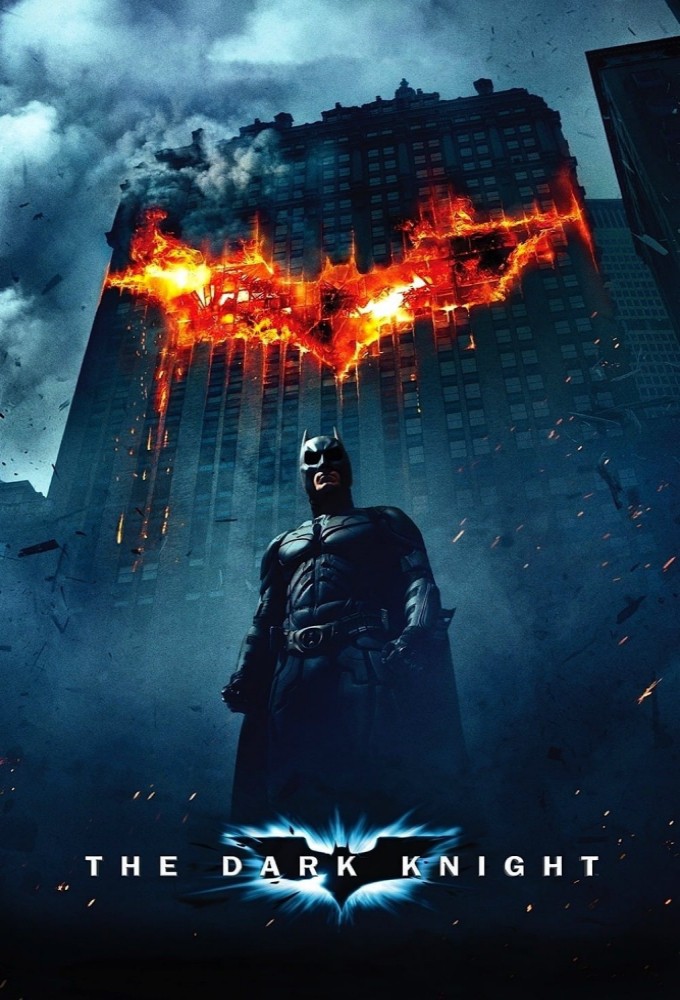
FILM · 2008 · UK
The Dark Knight
- Directed by
- Christopher Nolan
- Runtime
- 152 min
- Studio
- Warner Bros. Pictures, Legendary Pictures, Syncopy
37 archived facts 4 topics 1 source Last reviewed Sep 2026
Batman raises the stakes in his war on crime. With the help of Lt. Jim Gordon and District Attorney Harvey Dent, Batman sets out to dismantle the remaining criminal organizations that plague the streets. The partnership proves to be effective, but they soon find themselves prey to a reign of chaos unleashed by a rising criminal mastermind known to the terrified citizens of Gotham as the Joker.
Summary: TMDB

All facts (37)
- #001
Warner Bros. Pictures prioritized a sequel to Batman Begins (2005) after that film achieved critical and financial success.
- #002
Christopher Nolan did not plan a sequel to Batman Begins and was unsure the film would succeed enough to justify one, even though its closing scene shows Batman receiving a joker playing card.
- #003
Christopher Nolan and co-writer David Goyer discussed sequel ideas while filming Batman Begins, and Goyer developed an outline for two sequels, but Nolan was unsure how to continue the narrative consistently and relevantly while remaining interested in using the Joker in the grounded, realistic style of Batman Begins.
- #004
Discussions between Warner Bros. Pictures and Christopher Nolan began shortly after Batman Begins was released theatrically, and development started after Nolan finished producing The Prestige (2006).
- #005
Christopher Nolan and Goyer spent three months working together to develop the core plot points of The Dark Knight.
- #006
The Dark Knight was built around the theme of escalation: Batman's extraordinary efforts against common crime would provoke an opposing escalation by criminals and draw in the Joker, who uses terrorism as a weapon.
- #007
Goyer and Nolan avoided deliberate real-world parallels to terrorism, the war on terror and related United States laws, believing overt political statements would detract from the story; they wanted The Dark Knight to resonate with and reflect contemporary audiences.
- #008
Nolan said The Dark Knight represented his own fear of anarchy, with the Joker standing for somebody who wants to tear down the world around him.
- #009
Jonathan Nolan developed the story for The Dark Knight into a draft screenplay over six months with help from his brother Christopher Nolan.
- #010
After sending the draft to Warner Bros., Jonathan Nolan spent two more months refining it while Christopher Nolan completed directing The Prestige, and the brothers then worked together on the final script for six months during pre-production on The Dark Knight.
- #011
Jonathan Nolan considered the ending of The Dark Knight the script's most interesting aspect; it had always shown Batman fleeing police, but the escape was changed from leaping across rooftops to riding the Batpod.
- #012
The line Jonathan Nolan deemed most important, "you either die a hero or you live long enough to see yourself become the villain", arrived late in development, and the finished script for The Dark Knight, influenced by The Godfather and Heat and keeping the tone of Batman Begins, resembled a crime drama more than a traditional superhero film.
- #013
The Dark Knight drew on comic-book influences including Frank Miller's 1980s works, which present characters in a serious tone, and the limited series Batman: The Long Halloween (1996–1997), which examines the relationship between Batman, Dent and Gordon.
- #014
Christopher Nolan said the title of The Dark Knight refers to Dent as much as to Batman.
- #015
Christopher Nolan saw Dent as sharing a duality with Batman, which he considered to offer interesting dramatic potential.
- #016
The Dark Knight's writers, Christopher and Jonathan Nolan, made Bruce Wayne / Batman a largely static figure because the story focused on Harvey Dent, so the character did not undergo drastic development.
- #017
Christopher Nolan found the Joker the easiest part of The Dark Knight script to write, drawing on the villain's comic-book incarnations and on Dr. Mabuse from Fritz Lang's films.
- #018
Alan Moore's graphic novel Batman: The Killing Joke (1988) did not shape the main narrative of The Dark Knight, but Christopher Nolan's reading of its Joker as someone partly driven to show anyone can become like him helped give purpose to an otherwise purposeless character.
- #019
Christian Bale said that in The Dark Knight, Bruce Wayne had evolved from a young, naive and angry man seeking purpose into a hero burdened by the realization that his war on crime is seemingly endless.
- #020
Because the new Batsuit gave him greater agility, Christian Bale did not add as much muscle mass for The Dark Knight as he had for Batman Begins.
- #021
Christopher Nolan deliberately obscured combat in Batman Begins to show Batman from the criminals' point of view, and the improved Batsuit design in The Dark Knight let him display more of Christian Bale's Keysi-fighting method training.
- #022
Heath Ledger was cast as the Joker in The Dark Knight in August 2006, a choice that drew criticism from some industry professionals and members of the public who felt he was wrong for the part.
- #023
Executive producer Charles Roven stated that Heath Ledger was the only person seriously considered for the Joker, and that the positive reception of Batman Begins would help ease concerns about the casting.
- #024
Heath Ledger described his Joker as a psychopathic, mass-murdering, schizophrenic clown with zero empathy, avoided humanizing the character, and drew influence from Alex in A Clockwork Orange and musicians Johnny Rotten and Sid Vicious.
- #025
Heath Ledger secluded himself in a hotel room for roughly a month to read comic books relevant to his role.
- #026
Heath Ledger built the Joker's voice by blending high and low pitches, drawing on ventriloquist performances, and shaped a fighting style meant to look improvised and erratic.
- #027
Heath Ledger spent an additional four months assembling a "Joker diary" of images and elements he felt would resonate with his character, including finding the disease AIDS humorous.
- #028
Heath Ledger described playing the Joker as the most fun he had ever had with a character, while also calling it an exhausting process that left him unable to move or talk at the end of the day; in a November 2007 interview he said committing to any role made it hard to sleep, and during filming he often slept only two hours a night.
- #029
For Harvey Dent, Christopher Nolan sought an actor with an all-American heroic presence comparable to Robert Redford but carrying an undercurrent of anger or darkness. Josh Lucas, Ryan Phillippe and Mark Ruffalo were considered, while Matt Damon could not commit because of scheduling conflicts.
- #030
According to Christopher Nolan, Aaron Eckhart brought the all-American charm and an aura of a good man pushed too far to the role of Harvey Dent.
- #031
Aaron Eckhart said the difference between Harvey Dent and Batman lies in how far each will go for his cause, and that after Dent's corruption he keeps fighting crime but pushes it to an extreme because he dislikes the law's restrictions.
- #032
Aaron Eckhart's portrayal of Harvey Dent drew on the Kennedy family, especially Robert F. Kennedy, who fought organized crime with a similarly idealistic view of the law. For Dent's transformation into Two-Face, Eckhart and Christopher Nolan agreed to set aside Tommy Lee Jones's colorful version in Batman Forever (1995) in favor of a more realistic, slightly burnt, neutral-toned suit.
- #033
Gary Oldman described his character GCPD Lieutenant James Gordon as the "moral center" of The Dark Knight, an honest and incorruptible figure who struggles with the limits of his morality.
- #034
Maggie Gyllenhaal took over the role of Rachel Dawes in The Dark Knight from Katie Holmes, who opted instead to star in the crime comedy Mad Money (2008). Gyllenhaal treated Rachel as a new character and did not draw on Holmes's earlier performance.
- #035
Christopher Nolan described Rachel as the emotional link between Wayne and Dent, a connection that ultimately becomes a further personal loss driving Wayne's character. Gyllenhaal worked with Nolan on how Rachel was portrayed because she wanted the character to be important and meaningful despite her relatively minor role.
- #036
Musician Dwight Yoakam declined a role in The Dark Knight as either the bank manager or a corrupt police officer because he was recording his album Dwight Sings Buck (2007). Hong Kong actor Edison Chen appeared in the film, but most of his part was cut after his involvement in a sex photo scandal.
- #037
Christopher Nolan selected Chicago as a filming location for The Dark Knight because he liked the area and felt its architecture was interesting without being as recognizable as that of better-known cities such as New York City.
Sources & editorial notes
Reference databases
Sources for the entries on this page
- Wikipedia The Dark Knight — Wikipedia
Information from external sources is independently selected, consolidated and edited by Arka Evren. Sources are listed for verification and further reading. Encyclopedia text is used under its licence (CC BY-SA). How we work