
FILM · 1993 · USA
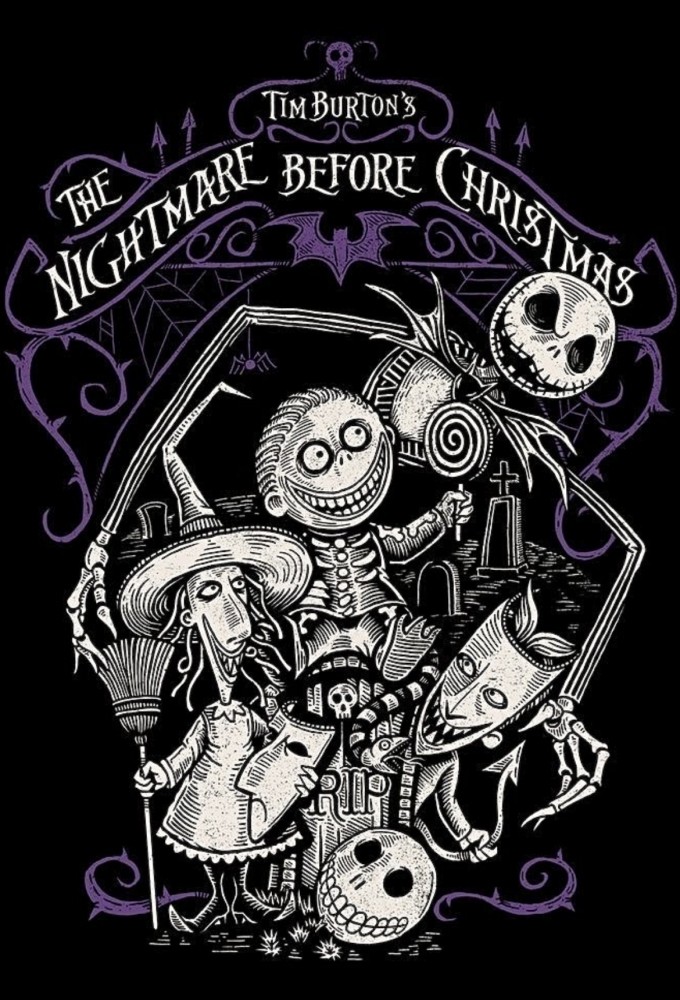
Tim Burton's the Nightmare Before Christmas
23 archived facts 5 topics 1 source Last reviewed Oct 2026

23 Interesting Facts About Tim Burton's the Nightmare Before Christmas
Interesting Facts (18)
- #001
- #002
Danny Elfman was cast to voice Jack Skellington, but while his singing was considered wonderful, his speaking voice was thought to be too harsh and hard. Chris Sarandon was later chosen as Jack's speaking voice because he sounded very much like Elfman's singing voice.
- #003
- #004
- #005
- #006
(At about 1 hour 10 minutes) In the final test shot of the vampires playing hockey on the frozen pond, they initially used a head resembling that of the film's creator and producer, Tim Burton. However, one of the producers told director Henry Selick that Burton probably would not like it, so it was changed at the last moment and reshot with a lantern instead of the head. Selick later said he believed Burton would have liked the idea and regretted not asking him.
- #007
- #008
- #009
Two devices were invented to make shooting easier. One was a "light alarm" that alerted the animators if any of the stage lights went out. The other was a system that allowed the puppeteer to switch smoothly to a new puppet if the puppet broke during a shot. Before this, either situation would have ruined a shot.
- #010
- #011
- #012
In the first few seconds after the title is shown, seven Holiday Doors can actually be seen. The doors, going counterclockwise, are: a pumpkin (for Halloween), a decorated Christmas tree (for Christmas), a turkey (for Thanksgiving), a brightly colored egg (for Easter), a green four-leaf clover (for St. Patrick's Day), a red heart (for Valentine's Day), and a red, white and blue firework that is initially visible for only a few seconds. This door may be for American Independence Day or Guy Fawkes Night.
- #013
The trailer stated that the film was originally planned for release under the Walt Disney Pictures banner and was to be presented as a new generation of filmmaking largely following Walt Disney's proud tradition. However, Disney was worried the film would not be suitable for children, so it was first shown to an audience of confused schoolchildren. When the trailer was released, Michael Eisner, then CEO and Chairman of The Walt Disney Company, had decided the film was "too dark for children." To reach a teenage audience, it was moved to Disney's sister company Touchstone Pictures and marketed under the new title Tim Burton's The Nightmare Before Christmas. This led to the long-standing misunderstanding that the film was directed by Burton rather than Henry Selick. In October 2006, the film was re-released in 3D under the Walt Disney Pictures banner.
- #014
- #015
Composer Danny Elfman wrote the film's songs before a script existed, because hired screenwriter Michael McDowell was still working without having made much progress. Elfman wrote the iconic songs after Tim Burton told him parts of the story. "Tim would show me sketches and drawings, and he would tell me the story, tell it to me in sentences and words, and I'd go, 'Yeah, I got it,'" Elfman told the Los Angeles Times in 2015, adding that three days later he had a song. McDowell was ultimately forced to be fired because of his cocaine addiction. Burton's search for a new screenwriter proved easier than expected: Elfman was then living with his girlfriend Caroline Thompson, who already knew Burton because she had written the screenplay for Edward Scissorhands (1990), and who had become deeply absorbed in the film after hearing Elfman singing the songs all day. Her biggest contribution was linking Elfman's songs together and redeveloping the character of Sally, originally conceived as a femme fatale, which is why she based Sally on herself.
- #016
- #017
- #018
According to Ken Page, Oogie's vocal performance was a blend of Bert Lahr's portrayal of the Cowardly Lion in the 1939 film adaptation The Wizard of Oz (1939) and Mercedes McCambridge's performance as the demon Pazuzu in the 1973 film The Exorcist (1973). Because songwriter Danny Elfman drew on "St. James Infirmary Blues" when writing Oogie's song, Page himself was largely inspired by Cab Calloway.
Production Story (2)
- #019
Despite Disney's objections, Tim Burton and Henry Selick opposed animating Jack Skellington with eyes. According to a 2018 Mouseplanet report, Burton said, "The first rule of drawn animation is that you need eyes for expression. I thought it would be great to bring these characters who have no eyes to life." He added, "Disney really fought for us to give Jack these friendly eyes instead of black holes, but we didn't back down."
- #020
Tim Burton wrote a three-page poem titled The Nightmare Before Christmas in the early 1980s, while he was an animator at Walt Disney Animation Studios. Burton drew inspiration from Rudolph the Red-Nosed Reindeer (1964), How the Grinch Stole Christmas! (1966) and Junhee Kwon's poem A Visit from St. Nicholas. He also began writing a story and making sketches for a film adaptation, while sculptor Rick Heinrichs made three-dimensional images of Burton's drawings. However, Disney believed Burton's style was too dark for its usual output, so he continued his career elsewhere. When Batman (1989) was a big box-office success and Burton tried to get his story and ideas back from Disney, they were eager to work with him and gave him $18 million and free rein to develop the film. Because he was contractually obliged to make Batman Returns (1992) for Warner Bros., he asked Henry Selick, with whom he had worked at Disney, to direct while he stayed on as producer. Heinrichs was working double shifts while making Batman Returns and also worked on Nightmare on weekends. Burton's original poem can be heard on the 2008 Special Edition Blu-ray/DVD release, narrated by Christopher Lee with new animated visuals.
Easter Eggs & References (1)
- #021
Some of the gifts Jack gives the children reference Tim Burton's films. The snake resembles the Sandworm from Beetlejuice (1988), and the shrunken head comes from the same film's afterlife waiting room. The cat and the duck appear in Batman Returns (1992); the cat resembles the mascot of Shreck's store, and the duck resembles a vehicle driven by the Penguin.
Deeper Meaning (1)
- #022
Director Henry Selick wanted to change the film's ending and reveal that Oogie Boogie was actually Finkelstein in disguise. After his defeat, Finkelstein would have confessed that he did it out of jealousy over Sally choosing Jack instead of him. This implies that Sally may initially have been Finkelstein's love rather than his daughter. Tim Burton, who was aware of this change, came to Selick and told him that he did not approve of the change in any way, that it came out of nowhere with a serious lack of setup, and that it made Sally and Finkelstein's relationship unnecessarily creepy. They apparently got into such a heated argument that Burton punched a hole in the wall. The hole was later cut out and framed by the crew. When screenwriter Caroline Thompson later said she could write a better ending, Burton reportedly lost it and had a screaming fit, so the subject was never raised again.
Career & Awards (1)
- #023
According to Henry Selick, Vincent Price was initially cast as Santa Claus and recorded all of his dialogue. However, after the death of Price's wife (Coral Browne), his own health began to decline and his vocal performance was very weak and thin. The recordings were deemed unusable, which, to Selick's regret, led to the role being recast. The film premiered at a film festival on October 9, only 16 days before Price's death, and had its limited premiere four days later. The film's first nationwide release in the United States came on October 29, four days after Price's death.
Sources & editorial notes
Reference databases
- IMDb
Information from external sources is independently selected, consolidated and edited by Arka Evren. Sources are listed for verification and further reading. Encyclopedia text is used under its licence (CC BY-SA). How we work