
ArkaEvren
Wall Street

FILM · 1987 · USA

Wall Street

Directed by
Oliver Stone
Runtime
126 min
Studio
20th Century Fox, Pressman Film

108 archived facts 7 topics 1 source Last reviewed Nov 2026

A young and impatient stockbroker is willing to do anything to get to the top, including trading on illegal inside information taken through a ruthless and greedy corporate raider, who takes the youth under his wing.

  • Wall Street — production image

108 Interesting Facts About Wall Street

Interesting Facts (10)

  1. #001

    Michael Douglas was working on the film Fatal Attraction (1987) at the same time as this film. To avoid a schedule conflict, Douglas would alternate between each film during the week.

    INTERESTING FACTS · SOURCED

  2. #002

    Tom Cruise wanted the part of Bud Fox, but Oliver Stone had already cast Charlie Sheen.

    INTERESTING FACTS · SOURCED

  3. #003

    In the Wall Street scenes the camera is deliberately jittery and always prowling. It becomes calmer and stationary in the more grounded scenes with Bud's father.

    INTERESTING FACTS · SOURCED

  4. #004

    The only Oliver Stone film to have a sequel.

    INTERESTING FACTS · SOURCED

  5. #005

    Gordon Gekko's "Greed is good" speech was inspired by Ivan Boesky's speech at the University of California's commencement ceremony in 1986. Boesky was a Wall Street arbitrageur who paid a $100 million penalty to the SEC later that year to settle insider trading charges. In his speech, Boesky said "Greed is all right, by the way. I want you to know that. I think greed is healthy. You can be greedy and still feel good about yourself."

    INTERESTING FACTS · SOURCED

  6. #006

    When Bud Fox brings a birthday gift to Gekko's office, Gordon's secretary says "Five minutes" to keep the unscheduled meeting as short as possible, and the film keeps its word: from that line to the moment Bud walks out, exactly 5 minutes go by.

    INTERESTING FACTS · SOURCED

  7. #007

    With a Directors Guild strike on the horizon, Oliver Stone put in 14-hour days through the final weeks of production and wrapped five days early.

    INTERESTING FACTS · SOURCED

  8. #008

    The soundtrack includes several David Byrne/Talking Heads songs. Bud Fox's secretary is played by Adelle Lutz, David Byrne's ex-wife, who was also assistant director on Byrne's video for Talking Heads: This Must Be the Place (Naive Melody) (1983), a song heard in the film.

    INTERESTING FACTS · SOURCED

  9. #009

    Oliver Stone liked the "stiffness" in Charlie Sheen's acting and put it to work as Bud's naivety.

    INTERESTING FACTS · SOURCED

  10. #010

    As the doors swing open for Bud Fox's first entrance into Gekko's office, you can hear a wolf howl.

    INTERESTING FACTS · SOURCED

Production Story (29)

  1. #011

    Oliver Stone planned to feature a Fortune magazine cover in exchange for promotional ads, then Forbes magazine offered a similar deal. Stone stayed with Fortune, which annoyed Forbes publisher Malcolm Forbes enough that he later refused a request to use his private yacht.

    PRODUCTION STORY · SOURCED

  2. #012

    Oliver Stone was already thinking about a film like this in 1981, inspired by his father, Lou Stone, who had been a broker at Hayden Stone during the Great Depression. His first pitch was about two investment partners drawn into shady financial dealings, using each other, with a prosecutor on their tail as in Crime and Punishment.

    PRODUCTION STORY · SOURCED

  3. #013

    The hero was first written as a young Jewish broker named Freddie Goldsmith; Oliver Stone renamed him Bud Fox to avoid feeding the stereotype that Jews controlled Wall Street.

    PRODUCTION STORY · SOURCED

  4. #014

    The film carries the dedication "Dedicated to Louis Stone, stockbroker 1910-1985"

    PRODUCTION STORY · SOURCED

  5. #015

    Hal Holbrook's character, Lou, takes his name from director Oliver Stone's real father, Louis Stone, a Wall Street stockbroker who died a year before the film was released.

    PRODUCTION STORY · SOURCED

  6. #016

    Charlie Sheen got to choose who would play his father, Jack Lemmon or Martin Sheen; Oliver Stone left it to him, and Charlie went with his dad.

    PRODUCTION STORY · SOURCED

  7. #017

    Charlie Sheen's character started out as Joe Fox, but a real Wall Street trader with that name wouldn't allow it, so it was changed.

    PRODUCTION STORY · SOURCED

  8. #018

    Oliver Stone said the bosses at 20th Century Fox weren't keen on the film's release prospects, awards chances or hard-to-embrace subject, and put their energy into Broadcast News (1987) instead. Both came out in December 1987 and made similar profits (even though Wall Street had a more limited release), and both were Oscar-nominated: seven nominations for the James L. Brooks film, just one for Stone's. Broadcast News (1987) went home empty-handed, while this film won its only nomination.

    PRODUCTION STORY · SOURCED

  9. #019

    Stanley Weiser says Gekko's way of talking came from Oliver Stone himself: "When I was writing some of the dialogue I would listen to Oliver on the phone and sometimes he talks very rapid-fire, the way Gordon Gekko does".

    PRODUCTION STORY · SOURCED

  10. #020

    In a 2015 interview, Oliver Stone said Jerry Goldsmith was originally hired to score the film, but Stone didn't like what he heard and fired him; Stewart Copeland took over.

    PRODUCTION STORY · SOURCED

  11. #021

    Ivan Boesky, the stock trader later disgraced, told students at UC Berkeley in 1985 "I think greed is healthy", and that speech fed straight into Gordon Gekko's famous one.

    PRODUCTION STORY · SOURCED

  12. #022

    Michael Douglas was then better known as a producer, and Oliver Stone was warned that he would micromanage the film and undercut him. Stone cast him anyway, and Douglas never did.

    PRODUCTION STORY · SOURCED

  13. #023

    The name "Bud" Fox was Charlie Sheen's idea. Oliver Stone thought it sounded like "Butt Fox" but used it anyway.

    PRODUCTION STORY · SOURCED

  14. #024

    Michael Douglas recalls his first read of the screenplay: "I thought it was a great part. It was a long script, and there were some incredibly long and intense monologues to open with. I'd never seen a screenplay where there were two or three pages of single-spaced type for a monologue. I thought, whoa! I mean, it was unbelievable". He prepared by reading profiles of corporate raiders T. Boone Pickens and Carl Icahn.

    PRODUCTION STORY · SOURCED

  15. #025

    The plot is loosely based on the junk bond and insider trading scandals of the 1980s.

    PRODUCTION STORY · SOURCED

  16. #026

    In the scene where Bud Fox brings a birthday gift to Gekko's office, Gordon's secretary says "Five minutes" to keep the unscheduled meeting short. From that exact moment until Bud leaves the office, exactly five minutes really do pass in the film.

    PRODUCTION STORY · SOURCED

  17. #027

    In his DVD commentary, Oliver Stone explains that the scenes shot on the Wall Street trading floor were completed with real brokers in just one day, in 45 minutes. The brokers played themselves.

    PRODUCTION STORY · SOURCED

  18. #028

    In the Wall Street scenes, the camera is deliberately shaky and constantly moving. In contrast, in the more static scenes with Bud and his father, the camera calms down and becomes fixed.

    PRODUCTION STORY · SOURCED

  19. #029

    The scene where Bud corners Gekko in his office consists largely of two long takes. Apart from the reverse-angle cut where he shouts "Because it's destroyable!", the scene is a single uninterrupted shot.

    PRODUCTION STORY · SOURCED

  20. #030

    Oliver Stone gave Charlie Sheen the chance to choose between Jack Lemmon and Martin Sheen to play his father. Charlie chose his own father.

    PRODUCTION STORY · SOURCED

  21. #031

    The film implies which university Gordon Gekko and Bud Fox attended, but neither of their academic degrees is mentioned. Gekko refers to himself as a 'City College boy', implying the City College of New York, while Bud's father mentions his son's student loans from NYU, pointing to New York University.

    PRODUCTION STORY · SOURCED

  22. #032

    At the time, Michael Douglas was better known as a producer. Oliver Stone was warned that Douglas would micromanage the film and overshadow him. Nevertheless, Stone brought him on board, and Douglas did not interfere excessively in any way.

    PRODUCTION STORY · SOURCED

  23. #033

    Oliver Stone later admitted that everyone told him Daryl Hannah was not right for the role, but that he was too proud to replace her. This led to tension on set, especially between her and Sean Young, who wanted the role.

    PRODUCTION STORY · SOURCED

  24. #034

    Gordon Gekko's "Greed is good" speech was inspired by a speech Ivan Boesky gave at a University of California graduation ceremony in 1986. Boesky was a Wall Street arbitrageur who that year paid the SEC a $100 million fine to settle insider trading charges. In his speech he said, "By the way, greed is good. I want you to know that. I think greed is healthy. You can be greedy and still feel good about yourself."

    PRODUCTION STORY · SOURCED

  25. #035

    In a 2015 interview, Oliver Stone said that the film's original composer was Jerry Goldsmith, but that he was unhappy with the music he heard and fired him. Stewart Copeland replaced him.

    PRODUCTION STORY · SOURCED

  26. #036

    Oliver Stone planned to use the cover of Fortune magazine in exchange for promotional ads, but Forbes magazine made a similar offer. When Stone settled on Fortune, Forbes publisher Malcolm Forbes was upset and later refused his request to use his private yacht.

    PRODUCTION STORY · SOURCED

  27. #037

    In an interview with Ain't It Cool News, James Woods revealed that he met with director Oliver Stone, with whom he had previously worked on Salvador, about an unspecified role in this film. He ultimately declined to take part and shortly afterward made his own personal project, Cop. Although it is unknown which role he would have played, it was most likely the role of Gordon Gekko.

    PRODUCTION STORY · SOURCED

  28. #038

    At about the 40th minute of the film, the U.S. Customs House is briefly visible. Two years later, this building would become famous for being used as the fictional Manhattan Museum of Art, where the Vigo painting is kept, in "Ghostbusters II."

    PRODUCTION STORY · SOURCED

  29. #039

    In the opening credits, director Oliver Stone's name appears in front of the World Trade Center. Stone would go on to direct 'World Trade Center,' a 2006 film about the September 11 attacks.

    PRODUCTION STORY · SOURCED

Behind the Scenes (24)

  1. #040

    Sean Young lobbied Oliver Stone from the start to give her Darien and fire Daryl Hannah. She also showed up late and unprepared, one reason her part is so small.

    BEHIND THE SCENES · SOURCED

  2. #041

    Early in the shoot, Michael Douglas says, Oliver Stone tested him by stoking his "repressed anger". At one point Stone walked into Douglas' trailer and asked if he was on drugs, because "you look like you haven't acted before". Shaken, Douglas did more research and drilled his lines over and over, pushing himself harder than ever before, and all that work came to a head in the "Greed is good" speech.

    BEHIND THE SCENES · SOURCED

  3. #042

    Oliver Stone also consulted Carl Icahn, Asher Edelman, convicted inside trader David Brown, several government prosecutors and Wall Street investment bankers. Traders were brought on set to coach the actors on holding phones, writing tickets and talking to clients, and Stone asked Lipper to design a six-week course to expose Charlie Sheen to a cross section of young Wall Street professionals. Sheen said, "I was impressed and very, very respectful of the fact that they could maintain that kind of aggressiveness and drive".

    BEHIND THE SCENES · SOURCED

  4. #043

    One of the technical advisers was "Mad Dog", a star investment banker at Drexel Burnham Lambert, who also plays the man speaking at the Bluestar breakup meeting. Kenneth Lipper, investment banker and former deputy mayor of New York for Finance and Economic Development, was hired as chief technical adviser after initially turning Oliver Stone down, fearing a one-sided attack. At Stone's urging he read the script and replied with a 13-page critique; it was unrealistic, he said, for all the characters to be "morally bankrupt". Lipper told Stone what computers traders used, how many women would really be at a business meeting, and what sort of extras belonged at the annual shareholders meeting where Gekko delivers his "Greed is good" speech. Stone agreed and had him rewrite the script, and that balance helped get permission to film on the floor of the New York Stock Exchange during trading hours. Their one big disagreement was Lou Mannheim. Stone filmed the honest Mannheim succumbing to insider trading; Lipper warned that audiences would conclude all of Wall Street was corrupt and insisted on one unimpeachable character, and Stone cut the scene.

    BEHIND THE SCENES · SOURCED

  5. #044

    Racing a looming Directors Guild strike, Oliver Stone worked 14-hour days in the last weeks of the shoot and finished five days ahead of schedule.

    BEHIND THE SCENES · SOURCED

  6. #045

    Martin Sheen modeled his reading of "I never judged a man's success by the size of his WALLET" on George C. Scott in The Hustler (1961).

    BEHIND THE SCENES · SOURCED

  7. #046

    On the DVD commentary Oliver Stone explains that the trading-floor scenes, shot on location on Wall Street, took just one day, 45 minutes of filming, with real brokers as themselves.

    BEHIND THE SCENES · SOURCED

  8. #047

    Charlie Sheen found the hospital scene by remembering what he went through when Martin Sheen had a heart attack during Apocalypse Now (1979).

    BEHIND THE SCENES · SOURCED

  9. #048

    Bud's showdown with Gekko in his office is mostly two long takes, split only by the reverse-angle cut to Gordon shouting "Because it's wreckable!" Everything else in the scene plays out in one unbroken take.

    BEHIND THE SCENES · SOURCED

  10. #049

    Charlie Sheen and Sean Young got on so badly that Sheen eventually stuck a piece of paper reading "I am a c***" on her back. Nobody said a word to her.

    BEHIND THE SCENES · SOURCED

  11. #050

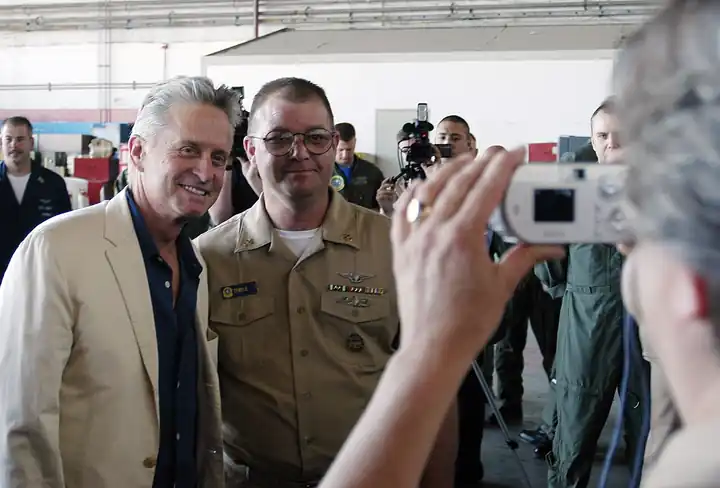
    With a speech instructor, Michael Douglas trained his breath control to keep up with the rapid-fire dialogue, all while smoking 40 cigarettes a day.
    Wall Street (1987) — Gordon Gekko, behind the scenes
    Wall Street (1987): Gordon Gekko, behind the scenesImage: Wikimedia Commons · Public domain

    BEHIND THE SCENES · SOURCED

  12. #051

    Years later Charlie Sheen said that when he watches the film, all he can see from one scene to the next is how "hammered" he was.

    BEHIND THE SCENES · SOURCED

  13. #052

    Daryl Hannah has never watched the film. She has called it a "rough experience" and said she and Oliver Stone had an "unhealthy working relationship"; during the shoot she accused him of misogyny. In her words: "film is a collaborate medium. Sometimes you hook up with people you don't collaborate well with."

    BEHIND THE SCENES · SOURCED

  14. #053

    Oliver Stone later admitted that everyone involved told him Daryl Hannah was miscast, but he was too proud to replace her. This caused tension on set, particularly with Sean Young who wanted the role herself.

    BEHIND THE SCENES · SOURCED

  15. #054

    In the montage scene where deals are made, the person talking on the phone is actually director Oliver Stone.

    BEHIND THE SCENES · SOURCED

  16. #055

    Oliver Stone uses food in an early scene to symbolize Gordon Gekko's insatiable nature. At an exclusive restaurant, Gekko invites Bud Fox to share his off-menu favorite dish, steak tartare served with a raw egg on top.

    BEHIND THE SCENES · SOURCED

  17. #056

    Oliver Stone later admitted that everyone told him Daryl Hannah was wrong for the role, but that he was too proud to replace her. This led to tension on set, especially between her and Sean Young, who wanted the part.

    BEHIND THE SCENES · SOURCED

  18. #057

    Oliver Stone originally wanted to make a film about the quiz show scandals of the 1950s. While exchanging ideas with his friend Stanley Weiser, the idea of making a film about Wall Street instead emerged. Weiser was initially hesitant because he knew little about financial markets. Stone suggested he read Crime and Punishment and The Great Gatsby so he could grasp the moral dimension he wanted to bring to the story, and Weiser threw himself into the world of finance over the following months. The pair spent three weeks visiting brokerage firms and meeting with investors.

    BEHIND THE SCENES · SOURCED

  19. #058

    Charlie Sheen's character was originally named Joe Fox. The name was changed after a real-life Wall Street investor with the same name refused to allow its use.

    BEHIND THE SCENES · SOURCED

  20. #059

    Oliver Stone stated that the studio executives at 20th Century Fox were not very enthusiastic about the film's release, its awards prospects or its theme, which was hard for audiences to embrace, and that they focused their attention on Broadcast News (1987) instead. Both were released the same month (December 1987), earned similar profits (Wall Street despite a more limited release than the other film) and were nominated for Oscars; James L. Brooks's film received seven nominations while Stone's film received only one. Broadcast News (1987) won no Oscars at all, while this film turned its single nomination into an award.

    BEHIND THE SCENES · SOURCED

  21. #060

    Oliver Stone also consulted Carl Icahn, Asher Edelman, convicted insider trader David Brown, various government prosecutors and Wall Street investment bankers. In addition, stockbrokers were brought in to coach the actors on how to talk on the phone, how to write trade slips and how to communicate with clients. Stone asked Lipper to design a six-week course to introduce Charlie Sheen to a cross-section of young Wall Street businessmen. The actor said, "I was impressed and had a lot, a lot of respect that they could maintain that kind of aggressiveness and ambition."

    BEHIND THE SCENES · SOURCED

  22. #061

    Originally the main character was a young Jewish stockbroker named Freddie Goldsmith, but Oliver Stone changed it to Bud Fox to avoid the stereotype that Wall Street is controlled by Jews.

    BEHIND THE SCENES · SOURCED

  23. #062

    In a 2015 interview, Oliver Stone said that the film's original composer was Jerry Goldsmith, but that he was unhappy with the music he heard and fired him. Stewart Copeland came in his place.

    BEHIND THE SCENES · SOURCED

  24. #063

    Oliver Stone planned to use the cover of Fortune magazine in exchange for promotional ads, but Forbes magazine made a similar offer. When Stone settled on Fortune, Forbes publisher Malcolm Forbes was upset by this and later turned down his request to use his private yacht.

    BEHIND THE SCENES · SOURCED

Characters & Cast (14)

  1. #064

    What Oliver Stone liked in Charlie Sheen was the "stiffness" of his acting, which he used to show Bud's naivete.

    CHARACTERS & CAST · SOURCED

  2. #065

    Playing Bud's materialistic girlfriend Darien never sat well with Daryl Hannah; it clashed with everything she stood for as an actress and activist.

    CHARACTERS & CAST · SOURCED

  3. #066

    For Gekko, Michael Douglas took his cues from his friend Pat Riley, then head coach of the Los Angeles Lakers.

    CHARACTERS & CAST · SOURCED

  4. #067

    Sir Larry Wildman, the British takeover artist played by Terence Stamp, is widely believed to be modeled after Sir Gordon White of Hanson PLC, a company that does only acquisitions, liquidations, and wholesale deconstruction of companies.

    CHARACTERS & CAST · SOURCED

  5. #068

    Director Oliver Stone's first two choices to play Gordon Gekko were Richard Gere and Warren Beatty.

    CHARACTERS & CAST · SOURCED

  6. #069

    Sean Stone appears both in this film and the sequel released in 2010 but playing different characters. In this one, he played Gordon Gekko's son while in Wall Street: Money Never Sleeps (2010) he played a fund trader.

    CHARACTERS & CAST · SOURCED

  7. #070

    Sir Larry Wildman, Terence Stamp's British takeover artist, is believed to be modelled on Sir Gordon White of Hanson PLC, which made its money buying up, liquidating and wholesale deconstructing other companies.

    CHARACTERS & CAST · SOURCED

  8. #071

    According to Stanley Weiser, Gekko's manner of speaking was inspired by Oliver Stone. 'While writing some of the dialogue, I would listen to Oliver on the phone; sometimes he spoke very fast, just like Gordon Gekko.'

    CHARACTERS & CAST · SOURCED

  9. #072

    Daryl Hannah never watched the film. In an interview, she said it was a 'difficult experience' and that she had an 'unhealthy working relationship' with director Oliver Stone. During filming, she accused Stone of being a misogynist. 'Filmmaking is a collaborative environment. Sometimes you end up with people you can't collaborate well with,' she said.

    CHARACTERS & CAST · SOURCED

  10. #073

    Daryl Hannah was never happy playing Bud's materialistic girlfriend Darien. The role contradicted everything the actress and activist stood for.

    CHARACTERS & CAST · SOURCED

  11. #074

    Matthew Modine turned down the film because Oliver Stone would not let him read the script, and he later regretted it.

    CHARACTERS & CAST · SOURCED

  12. #075

    William Petersen turned down the role of Gordon Gekko. He had also previously declined a role in Oliver Stone's Platoon (1986).

    CHARACTERS & CAST · SOURCED

  13. #076

    In the scene where Bud first meets Gekko, there are three actors with famous fathers: Michael, son of Kirk Douglas; Charlie, son of Martin Sheen; and Josh Mostel, son of Zero Mostel.

    CHARACTERS & CAST · SOURCED

  14. #077

    When Bud Fox moves into his private office, he is introduced to his new private security guard, 'Janet'. Janet is the name of Charlie Sheen's real-life mother.

    CHARACTERS & CAST · SOURCED

Easter Eggs & References (14)

  1. #078

    Listen as the doors open for Bud Fox on his first visit to Gekko's Office: there's a wolf howl.

    EASTER EGGS & REFERENCES · SOURCED

  2. #079

    Look over Gordon Gekko's shoulder at the Teldar Paper shareholders meeting: the man at the right end of the back row has a name card reading "Sean Stone", the name of Oliver Stone's son, who plays Rudy Gekko.

    EASTER EGGS & REFERENCES · SOURCED

  3. #080

    Gordon's secretary says 'Five minutes' when Bud Fox shows up at Gekko's office with a birthday gift, to keep the unplanned meeting brief, and from that line to Bud's exit the film runs exactly 5 minutes.

    EASTER EGGS & REFERENCES · SOURCED

  4. #081

    David Byrne/Talking Heads songs turn up several times on the soundtrack, and Bud Fox's secretary is Adelle Lutz, Byrne's former wife. Adele had also been Byrne's assistant director on the music video for Talking Heads: This Must Be the Place (Naive Melody) (1983), a song used in the film.

    EASTER EGGS & REFERENCES · SOURCED

  5. #082

    Hal Holbrook and Martin Sheen played gay lovers in "That Certain Summer." And Although the two share no scenes here, Holbrook puts his arm around Bud Fox (Charlie Sheen) exactly the way he did with his dad Martin in that film.

    EASTER EGGS & REFERENCES · SOURCED

  6. #083

    In the opening credits, director Oliver Stone's name appears in front of the World Trade Center; in 2006 he directed World Trade Center, about the events of 9/11.

    EASTER EGGS & REFERENCES · SOURCED

  7. #084

    When Bud Fox moves into his own office, he meets his new private security, "Janet", which happens to be the name of Charlie Sheen's real-life mother.

    EASTER EGGS & REFERENCES · SOURCED

  8. #085

    Early on, when Marvin reminds Bud to make his daily call to Gekko, he mentions the Space shuttle Challenger disaster. That's an odd slip, since the film is set in 1985 and the Challenger disaster didn't happen until January of 1986.

    EASTER EGGS & REFERENCES · SOURCED

  9. #086

    At the meeting where Blue Star's breakup comes out, Gekko's man tells Bud he'll have the shortest career of any executive "since that pope who got poisoned." That's clearly John Paul I, who died in 1978 after just 33 days as pope. He died of natural causes, but assassination theories still linger.

    EASTER EGGS & REFERENCES · SOURCED

  10. #087

    The fictional Anacott Steel may be a sly nod to Anaconda Copper, which collapsed in the 1929 stock market crash. Plenty of entertainers had money in Anaconda, Groucho Marx among them.

    EASTER EGGS & REFERENCES · SOURCED

  11. #088

    While Gekko bids on the James Rosenquist painting at the contemporary art auction, James Rosenquist himself can briefly be seen watching.

    EASTER EGGS & REFERENCES · SOURCED

  12. #089

    Pitching Bluestar Airlines in Gekko's office, Bud says it has 80 "Medium Body" Jets and 300 pilots. Most domestic airlines work on an average of 11 pilots per airframe (5.5 x 2 pilot "crews") to cover a full flying roster plus leave and days off, so Bluestar would realistically need about 880 pilots.

    EASTER EGGS & REFERENCES · SOURCED

  13. #090

    Visiting his dad in the hospital, Bud Fox tries to light a cigarette, which would never have been allowed: in that oxygen-rich, flammable environment it would endanger not only his father, fresh from a heart attack, but the entire hospital.

    EASTER EGGS & REFERENCES · SOURCED

  14. #091
    Contains a major spoiler — show

    At the end, when Bud Fox is dropped off at the court house, he walks past a news stand with a magazine bearing his picture. It's very hard to make out, but the headline says "Yuppie With A Conscience".

    EASTER EGGS & REFERENCES · SOURCED

Deeper Meaning (15)

  1. #092

    The film hints at where Gordon Gekko and Bud Fox went to college without ever naming their degrees. Gekko calls himself a "City College boy," pointing to the City College of New York, while Bud's father brings up Bud's student loans from NYU, suggesting New York University.

    DEEPER MEANING · SOURCED

  2. #093

    Oliver Stone said he was "making a movie about sharks, about feeding frenzies. Bob [director of photography Robert Richardson] and I wanted the camera to become a predator. There is no letup until you get to the fixed world of Charlie's father, where the stationary camera gives you a sense of immutable values." To him Wall Street was a battle zone, and he "filmed it as such": conversations shot like physical confrontations, and in group scenes a camera circling the actors "in a way that makes you feel you're in a pool with sharks."

    DEEPER MEANING · SOURCED

  3. #094

    Early on, Oliver Stone uses food to show Gordon Gekko's appetite when he takes Bud Fox to lunch at an exclusive restaurant and treats his new protégé to his favorite off-the-menu dish: Steak tartare (raw beef) topped with a raw egg.

    DEEPER MEANING · SOURCED

  4. #095

    The film, Gordon Gekko especially, has a notorious fandom that drew all the wrong lessons from it. Michael Douglas says it makes him a little sad whenever a broker tells him he got into Wall Street after seeing him as Gordon Gekko. On the DVD, Douglas and Oliver Stone pin the 2008 financial crisis on Gordon Gekko wannabes and say people should have looked up to Bud Fox instead. Despite its explicitly anti-greed message, the film is often cited as an inspiration by people who went on to earn MBAs, and some fans don't even realize the villain is supposed to be the bad guy. Many white collar criminals have said they loved Gekko and were inspired by him.

    DEEPER MEANING · SOURCED

  5. #096

    Oliver Stone had written a subplot involving Fox having an affair with Gekko's wife (which would have explained Gekko's anger towards Fox in their final confrontation), but had to abandon it due to Charlie Sheen and Sean Young's hatred of each other.

    DEEPER MEANING · SOURCED

  6. #097

    Oliver Stone wanted to make a film about the 1950s quiz show scandals. When he tossed around ideas with his friend Stanley Weiser, he hit on the notion of making a film about Wall Street instead. Weiser was reluctant because he knew very little about the financial markets. Stone encouraged Weiser to read "Crime and Punishment" and "The Great Gatsby" for an idea of the morality he wanted to put into the story, and Weiser spent the next few months immersing himself in the financial world. He and Stone spent three weeks visiting brokerage houses and interviewing investors.

    DEEPER MEANING · SOURCED

  7. #098

    The character Lou, played by Hal Holbrook, was inspired by director Oliver Stone's real father, Louis Stone. Louis Stone was a stockbroker on Wall Street and passed away a year before the film's release.

    DEEPER MEANING · SOURCED

  8. #099

    The film, and especially the character Gordon Gekko, has a notorious fan base that draws the wrong messages from it. Michael Douglas has stated that he feels a bit sad whenever he meets a stockbroker who says they went into Wall Street after watching Gordon Gekko. In the DVD commentary, Douglas and Oliver Stone say the 2008 financial crisis happened because of Gordon Gekko imitators, whereas people should have taken Bud Fox as their example. Despite its anti-greed message, the film is often cited as an inspiration for those who go on to pursue an MBA; in fact, fans sometimes fail to notice the villain and mistake Gekko for a hero. Many white-collar criminals have confessed that they loved Gekko and were inspired by him.

    DEEPER MEANING · SOURCED

  9. #100

    At the Teldar Paper shareholders' meeting, the name card of the man on the far right of the back row, seen over Gordon Gekko's shoulder, reads 'Sean Stone.' Oliver Stone's son Sean Stone plays Rudy Gekko in the film.

    DEEPER MEANING · SOURCED

  10. #101

    The film's soundtrack includes several songs by David Byrne/Talking Heads. Bud Fox's secretary is played by Adelle Lutz, David Byrne's ex-wife. Adelle also served as assistant director on the music video for Byrne's song 'This Must Be the Place (Naive Melody),' which also appears in this film.

    DEEPER MEANING · SOURCED

  11. #102

    Early in the film, when Marvin reminds Bud to call Gekko daily, he references the Space Shuttle Challenger disaster. This is an oddity, because the film is set in 1985 and the Challenger disaster did not occur until January 1986.

    DEEPER MEANING · SOURCED

  12. #103

    In the 'Betrayed' episode of the second season of 'The Streets of San Francisco,' in which Michael Douglas played a homicide detective, Martin Sheen was a guest star as a greedy stockbroker.

    DEEPER MEANING · SOURCED

  13. #104

    At the end of the film, when Bud Fox is dropped off in front of the courthouse, he passes a newsstand with a magazine featuring his own photo on the cover. Although it is hard to make out, the magazine reads 'Conscientious Yuppie.'

    DEEPER MEANING · SOURCED

  14. #105

    Hal Holbrook and Martin Sheen had played gay lovers in the film 'That Certain Summer.' Although they have no scenes together in this film, Holbrook puts his arm around Bud Fox's (Charlie Sheen) shoulder, just as he did to his father Martin Sheen in that film.

    DEEPER MEANING · SOURCED

  15. #106

    When Bud Fox visits his father in the hospital, he tries to light a cigarette. This would never happen in reality; because for his father, who had suffered a heart attack, it would not only create a fire hazard in an oxygen-rich environment but would put the entire hospital at risk.

    DEEPER MEANING · SOURCED

Career & Awards (2)

  1. #107

    This is the only movie to win both an Oscar (Best Actor- Michael Douglas) and a Razzie (Worst Supporting Actress- Daryl Hannah), not just for acting, but in any category.

    CAREER & AWARDS · SOURCED

  2. #108

    As of 2018, Michael Douglas's Oscar winning performance in this film is his only acting Academy Award nomination. Also while there have been actors and actresses nominated in many of Oliver Stone's films, Douglas is the only person to win an Oscar in an acting category for a Stone film.

    CAREER & AWARDS · SOURCED

Related pages

Sources & editorial notes

Reference databases

  • Wikipedia English Wikipedia article
  • IMDb IMDb title page (trivia)

Information from external sources is independently selected, consolidated and edited by Arka Evren. Sources are listed for verification and further reading. Encyclopedia text is used under its licence (CC BY-SA). How we work