

ACTOR · BORN 1925 · DIED 2002
Rod Steiger
- Born
- 14 April 1925, Westhampton, New York, USA
- Died
- 9 July 2002
- Known for
- On the Waterfront (1954), Doctor Zhivago (1965), The Specialist (1994), The Amityville Horror (1979)
35 archived facts 5 topics 1 source Last reviewed Nov 2026
Rod Steiger (14 April 1925 – 9 July 2002) was an actor best known for On the Waterfront, Doctor Zhivago and The Specialist.
Rod Steiger over the years


35 Interesting Facts About Rod Steiger
Interesting Facts (10)
- #001
Rod Steiger had an operatic voice, but he lacked the ear to hold the same note, which made his singing voice almost useless.
- #002
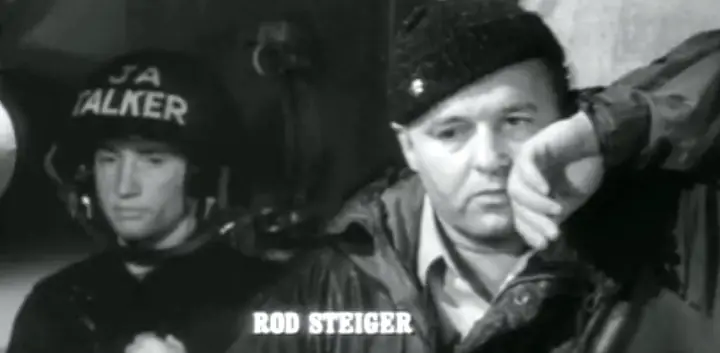
During World War II, Rod Steiger served on the destroyer USS Taussig. In December 1944, he was serving aboard that ship in the Philippine Sea on the day of the event known as Typhoon Cobra, or Halsey's Typhoon. Three destroyers sank in the storm. It formed the background of the novel and film "The Caine Mutiny" as well as the stage play "The Caine Mutiny Court-Martial."
Rod Steiger: a sceneImage: Wikimedia Commons · Darryl F. Zanuck Productions -20th Century Fox., Public domain - #003
Rod Steiger's last television appearance was on an episode of Jon Favreau's Dinner for Five (2001) broadcast on April 29, 2002. Three days before his death on July 9, 2002, Steiger made his final appearance, recorded for a career retrospective for the SAG-AFTRA Foundation's Legacy Collection.
- #004
Steiger's role as "Chief Bill Gillespie" in "In the Heat of the Night" was exactly what Joni Mitchell verbally requested on the track "Tax Free" from her 1985 album "Dog Eat Dog." Mitchell hired Steiger to play a ranting "hawk-right militant" preacher, with far-right condemnations ("Rock and roll music!" "Cast down these dope fiends and their noisy bands!" "Pot pockets!") interspersed throughout the song as Mitchell sang.
- #005
Rod Steiger was honored to be chosen as one of the AFI's 50 stars of the second half of the 20th century.
- #006
Rod Steiger initially took drama classes to meet women.
- #007
Rod Steiger grew up in Newark, New Jersey.
- #008
Steiger, Burt Lancaster and Robert Mitchum were among those considered for roles in the film Patton.
- #009
Steiger studied opera for four years but gave it up because he kept changing the notes.
- #010
Three days before his death on July 9, 2002, Steiger appeared on stage for the last time at a career retrospective held for the SAG-AFTRA Foundation's Legacy Collection.
Behind the Scenes (12)
- #011
He was offered the lead in Patton (1970) but turned the role down, saying, "I'm not going to glorify war." The role then went to George C. Scott, who won the Oscar. Steiger called this rejection the "dumbest career move" of his life.
- #012
After years of tirelessly raising his voice against the social stigma surrounding mental illness, which he had long suffered from, he received the Gift of Life Award.
- #013
He always said his favorite of all his films was The Pawnbroker (1964).
- #014
1976: He fell into a deep depression after undergoing triple heart bypass surgery.
- #015
He never knew his father.
- #016
He had a daughter with Claire Bloom and a son with Paula Ellis.
- #017
He studied drama at HB Studio in Greenwich Village, New York City.
- #018
Steiger, who played Marty in the television production Marty (1953) that bore his own name, said he turned down the role in the 1955 film version because his Hill-Hecht-Lancaster Productions contract would have bound him for years. Harold Hecht and Burt Lancaster, for their part, said they did not want to cast Steiger because they thought the public would not choose an actor they had seen for free on television.
- #019
His mother, a former actress and singer, had to give up her career after an injury and struggled with alcoholism throughout his childhood and youth.
- #020
He studied opera for 4 years but quit because he kept changing notes.
- #021
He shares his birthday with Doctor Zhivago co-star Julie Christie.
- #022
After a 2-year relationship, he married Joan Benedict in Malibu on October 10, 2000.
Characters & Cast (7)
- #023
Most of Rod Steiger's solo shots in the famous taxi scene in On the Waterfront (1954) were filmed after Marlon Brando had left for the day. Brando's contract stipulated that he could finish shooting earlier than the normal wrap time so he could keep his daily appointment with his psychiatrist. Steiger was deeply hurt and angered by Brando's rudeness and discourtesy toward a fellow actor, since it was customary in two-shots for an actor in close-up to be fed his lines by the other actor, or at least for the other actor to be present so the first could play off him. Steiger channeled his negative feelings into his performance, and while he paid tribute to Brando as a great actor, he personally hated him afterward. Director Elia Kazan took Brando's place in the back of the taxi so that Steiger would have someone to express his feelings to.
- #024
Rod Steiger was not the first choice to play Sheriff Bill Gillespie in In the Heat of the Night (1967), the film for which he won the Best Actor Oscar and which won the Academy Award for Best Picture. According to producer Walter Mirisch's memoir "I Thought We Were Making Movies, Not History," the role was first offered to George C. Scott, who accepted it. Scott backed out when his wife, Colleen Dewhurst, wanted to direct him in a Broadway play. Ironically, Steiger later turned down the lead role in Patton (1970) that went to Scott and won him the Best Actor Oscar.
- #025
Three years after reaching the peak of his profession, Rod Steiger campaigned hard in early 1971 for a role in The Godfather (1972), which began shooting that year, having won the Best Actor Oscar for his role as Sheriff Bill Gillespie in In the Heat of the Night (1967). Surprisingly, the role Steiger wanted was not that of Don Vito Corleone's lead — ultimately played by his On the Waterfront (1954) co-star Marlon Brando — but that of Don's youngest son, Michael Corleone. Paramount executives found his desire to play the part odd because he was too old for it, and they turned him down without even giving him a screen test.
- #026
After playing Jud Fry in Oklahoma! (1955), producer David O. Selznick wanted to sign Rod Steiger to a long-term contract and possibly cast him opposite Selznick's wife Jennifer Jones in a proposed remake of Ernest Hemingway's "A Farewell to Arms." "But I told him that I must have the right to choose my own mistakes," Steiger told his biographer Tom Hutchinson. "His face fell - he couldn't believe anyone would refuse him. Neither could my agents!"
- #027
Steiger won the role of Viktor Komarovsky in Doctor Zhivago (1965) only after two other actors turned it down. After a month passed without Marlon Brando answering director David Lean's written inquiry about whether he wanted to play Komarovsky, Lean offered the part to James Mason, who was a generation older than Brando, because he did not want an actor who would overshadow the character of Yuri Zhivago (particularly in showing Zhivago as the lover of Lara, played by the young Julie Christie, which the charismatic Brando could also have done). Mason initially accepted the role but eventually withdrew, and the part went to Steiger.
- #028
Steiger, who played Marty in the television production of Marty (1953) that bore his name, said he turned down the role in the 1955 film version because his Hill-Hecht-Lancaster Productions contract would have bound him for years. Harold Hecht and Burt Lancaster, however, said they did not want Steiger in the cast because they thought the public would not choose an actor they had seen for free on television.
- #029
Steiger took the lead role in the television production of "Marty," but Ernest Borgnine played the part in the 1955 film version.
Career & Awards (3)
- #030
Rod Steiger appeared in four films selected by the Library of Congress for the National Film Registry as "culturally, historically or aesthetically" significant: On the Waterfront (1954), Oklahoma! (1955), The Pawnbroker (1964) and In the Heat of the Night (1967).
- #031
Steiger appeared in two films that won the Best Picture Oscar: On the Waterfront (1954) and In the Heat of the Night (1967). He also appeared in two more films nominated for Best Picture: The Longest Day (1962) and Doctor Zhivago (1965).
- #032
On April 10, 1997, Rod Steiger was awarded a star on the Hollywood Walk of Fame at 7080 Hollywood Boulevard in Hollywood, California.
Life & Family (3)
- #033
In an interview with Robert Osborne for Turner Classic Movies, Rod Steiger said that while he was in the United States Navy during World War II, he sang when his turn came to stand watch on the ship. One night the ship's captain heard him and put an end to his impromptu performances.
Rod Steiger: Al CaponeImage: Wikimedia Commons · Burrows-Ackerman /Allied Artists, Public domain - #034
Steiger's mother, a former actress and singer, had to give up her career after an injury and struggled with alcoholism throughout his childhood and youth.
- #035
Steiger cited Harry Baur as one of his favorite actors, saying Baur had a great influence on his art and career.
Related pages
- Anthony Perkins — Rod Steiger comes up in the facts on that page
- Mars Attacks! — Rod Steiger comes up in the facts on that page
Continue through the archive
Sources & editorial notes
Reference databases
- Wikipedia
- IMDb
Information from external sources is independently selected, consolidated and edited by Arka Evren. Sources are listed for verification and further reading. Encyclopedia text is used under its licence (CC BY-SA). How we work