
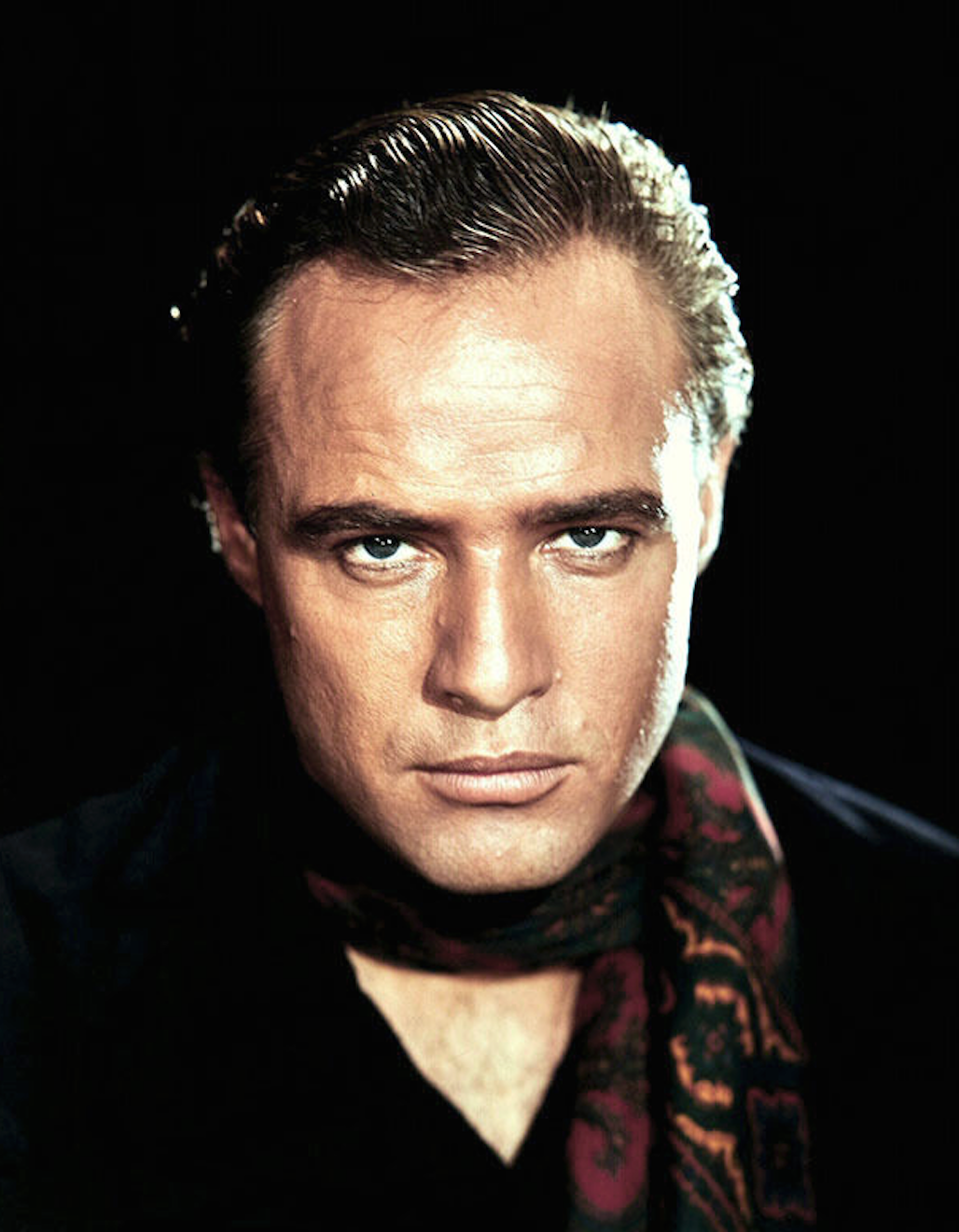
ACTOR · BORN 1924 · DIED 2004
Marlon Brando
- Born
- 3 April 1924, Omaha, Nebraska, USA
- Died
- 1 July 2004
- Known for
- The Godfather (1972), The Godfather Part II (1974), On the Waterfront (1954), A Streetcar Named Desire (1951)
155 archived facts 8 topics 1 source Last reviewed Nov 2026
Marlon Brando (3 April 1924 – 1 July 2004) was an actor best known for The Godfather, The Godfather Part II and On the Waterfront.
Marlon Brando over the years


155 Interesting Facts About Marlon Brando
Interesting Facts (21)
- #001
He and director Tony Kaye paid 350,000 pounds sterling for footage of what allegedly is the "Angel of Mons", according to The Sunday Times (March 11, 2001). The Angel of Mons was an apparition that legend holds appeared in the skies during the British Expeditionary Force's first encounter with the Imperial German army during World War I, which enabled a successful retreat by the BEF. The film allegedly was found in August 1999 in a junk-shop, which had a trunk belonging to a man called William Doidge, a World War I veteran. Doidge had been at Mons in August 1914 and knew about or possibly saw the apparition in the sky as the British army retreated before the overwhelming German advance. After the war he became obsessed by these apparitions. An American war veteran told him in 1952 that angels had appeared before some American troops were drowned during an exercise in 1944 at Woodchester Park in the Cotswolds. Doidge went there with a movie camera and supposedly captured images of them. Kaye planned to make a film of the incident, starring Brando as the American veteran, but the plans fell through when the two fell out over an acting video.
- #002
Sean Penn told writer Charles Bukowski that Brando put scripts from producers into his freezer, in order to use them as targets in skeet shooting. Brando would take the frozen scripts and have them tossed in the air into the canyon below his home at night, and then proceed to blast them into smithereens with a shotgun while they were on the fly. By freezing the scripts, the pages were stiff and made for better "clay pigeon" substitutes. The practice is mentioned in one of Bukowski's poems. Bukowski also wrote about Brando in his short story "You Kissed Lilly", in which Lilly masturbates while watching Brando in a movie on television. The story is part of the collection "Hot Water Music" (1983).
- #003
- #004
He was offered a chance to reprise his role as Vito Corleone in The Godfather Part II (1974), but turned it down partially due to his own credo that once he finished a role, he put it away and moved on. He also resented how Paramount treated him during the making of The Godfather (1972) when they threatened to fire him and sued him over delays.
- #005
- #006
- #007
He liked to box. While performing as Stanley Kowalski in the stage version of "A Streetcar Named Desire", he would often persuade a member of the stage crew to spar with him in a room underneath the stage between his acts. During one of these impromptu boxing matches, a crew member surprised him with a hard punch to the nose. Brando's nose was broken so badly that it literally was split across its bridge. He managed to go on stage and finish the play despite the fact that backstage efforts to stanch the bleeding had failed, but he was taken to the hospital immediately after. His famous broken-beak nose was the result of his having taken off his bandages in order to cover his nose with Mercurochrome to make it look particularly bad when he was visited by the play's producer, Irene Mayer Selznick. The subterfuge worked, as Selznick gave him two weeks off from the grind of the play (he was on stage with "Streetcar" for two years), but by taking the bandages off, his nose did not properly set.
- #008
- #009
- #010
Brando's eating habits were legendary even before he reached obesity. Richard Erdman, his co-star in The Men (1950), said Brando's diet in the 1950s was 'mostly junk food, often takeout Chinese food or jar after jar of peanut butter'. By the mid-1950s he was known to eat boxes of Mallomars and cinnamon rolls washed down with a quart of milk. His close friend Carlo Fiore wrote that Brando went on crash diets before filming.
- #011
In the last three years of his life, Marlon filmed a series of classes of him giving acting lessons to Sean Penn, Jon Voight and Nick Nolte. Marlon intended to call the series "Lying for a Living" and to sell DVDs of it on shopping channel QVC to raise money. The DVDs were never released publicly following his death.
- #012
- #013
Became quite friendly with Elizabeth Taylor while shooting Reflections in a Golden Eye (1967). He agreed to pick up her Best Actress Award for Who's Afraid of Virginia Woolf? (1966) from the New York Film Critics Circle. When Brando made his appearance at the NYFCC Award ceremony at Sardi's on January 29, 1967, he badgered the critics, querying them as to why they had not recognized Liz before. He then flew to Dahomey, Africa, where Taylor was shooting The Comedians (1967) with husband Richard Burton to personally deliver the award. Brando later socialized with the Burtons, visiting them on their famous yacht the Kalizma, while they plied the Mediterreanean. Brando's ex-wife Anna Kashfi, in her book "Brando for Breakfast" (1979), claimed that Brando and Burton got into a fistfight aboard the yacht, probably over Liz, but nothing of the incident appears in Burton's voluminous diaries, in which Burton says he found Brando to be quite intelligent but believed he suffered, like Liz did, from becoming too famous too early in his life. He recognized Brando as a great actor, but felt he would have been more suited to silent films due to the deficiency in his voice (the famous "mumble"). As a silent film star, Burton believed Brando would have been the greatest motion picture actor ever.
- #014
- #015
- #016
- #017
Brando had to sue Francis Ford Coppola to get all the money owed to him from his percentage of the profits of Apocalypse Now (1979). Brando characterized the people in the movie industry as "liars" to Lawrence Grobel (who conducted his 1979 Playboy interview): "Even Francis Coppola owed me one-and-a-half million and I have to sue him. They all do that, as they make interest on the money... so they delay paying... It's all so ugly, I hate the idea of having to act, but there's no other way to do it.".
- #018
- #019
Brando was openly critical of the actors and film stars who were long established in Hollywood when he arrived on the acting scene. He dismissed the likes of Humphrey Bogart and Clark Gable, claiming they were always the same in each movie. However, Brando did acknowledge and respect Paul Muni and James Cagney for their naturalistic approach to acting.
- #020
- #021
Production Story (33)
- #022
He was offered a chance to reprise his role as Vito Corleone in The Godfather Part II (1974), but turned it down partially due to his own credo that once he finished a role, he put it away and moved on. He also resented how Paramount treated him during the making of The Godfather (1972) when they threatened to fire him and sued him over delays.
- #023
- #024
- #025
Signed on to appear in director Sidney Lumet's adaptation of the play Child's Play (1972) as schoolteacher Joseph Dobbs, but backed out just before principal photography was to begin when he realized James Mason had the better role as his schoolteacher rival. According to Bob Thomas' "Brando: Portrait of the Artist as a Rebel", Brando quit the production when he realized his flagging career would soon be revitalized by the The Godfather (1972). A last-minute replacement, Robert Preston was signed to take over the role, and though a fine actor, he bombed in the performance due to over-projection of his voice (Preston had been playing mainly in the theater in the previous decade). Brando subsequently was sued by producer David Merrick. Ironically, both Brando and Mason were rivals for the role of Viktor Komarovsky in Doctor Zhivago (1965). Both were offered the role by David Lean, and both turned the role down.
- #026
Was scheduled to appear in the David Lean-directed "Nostromo" (1991), but when Lean died, the production came to a halt. Thus, the world missed the last of three chances to see one of the world's greatest actors work with one of the world's greatest directors. Producer Sam Spiegel, who had won an Oscar for On the Waterfront (1954), offered Brando the title role in Lean's Lawrence of Arabia (1962), which he turned down, saying he did not want to ride camels in the desert for two years. Brando was Lean's first choice for the male lead in Ryan's Daughter (1970), but Brando, who at that time was considered box office poison by movie studios, never was offered the role.
- #027
- #028
- #029
Originally considered too young at 23 to play Stanley Kowalski in the Broadway version of "A Streetcar Named Desire", and the producers of the show tried to get 34-year-old Burt Lancaster, newly a huge star in movies thanks to The Killers (1946). When Lancaster was unable to get permission from the film studio, Brando was given the part and became an overnight sensation.
- #030
According to co-producer Fred Roos, Brando was scheduled to make a cameo appearance in The Godfather Part II (1974), specifically in the flashback at the film's ending in which Vito Corleone comes back to his home and is greeted with a surprise birthday party. In fact, he was expected the day of shooting but did not show up due to a salary dispute. According to Francis Ford Coppola, he had not been paid for The Godfather (1972) and thus would not appear in the sequel.
- #031
The producers of the film adaptation of Sir Peter Shaffer's play Equus (1977) were interested in casting either Brando or Jack Nicholson in the lead role of Dr. Martin Dysart. The role went instead to Richard Burton, who had to "screen-test" for the role by agreeing to appear in the play on Broadway. Burton did, got rave reviews and a special Tony Award, and won his seventh and last Oscar nomination for the role. In his diary, Burton wrote that in the late 1950s, he was always one of the first actors producers turned to when Brando turned down a role.
- #032
In the summer of 1995, he started shooting a movie called "Divine Rapture" in the tiny Irish village of Ballycotton, County Cork. His co-stars were Johnny Depp, Debra Winger and John Hurt. Marlon was playing a priest in the film and he had dyed his hair red for the role. Shooting began, but was never completed due to lack of financing.
- #033
Was paid $3 million for 10 days work on The Formula (1980) (approximately $8.5 million in 2005 terms). Brando told Lawrence Grobel ("Conversations with Brando") that the movie, which he only made for the money as he was broke, was ruined in the editing room, with the humor of his scenes cut out. In his autobiography, Brando--in a caption for a picture from the film--recounts that George C. Scott asked him during the shooting of the film whether he, Brando, would ever give the same line - reading twice. Brando replied, "I know you know a cue when you hear one." The two both played chess together during waits during the shooting. Scott said that Brando was not that good a player.
- #034
- #035
Turned down the role of Vulcan in The Adventures of Baron Munchausen (1988). Director Terry Gilliam was summoned to Brando's Mulholland Dr. home in Los Angeles to discuss the role, but this became apparent that Brando really was not interested in taking the role. Nonetheless, Gilliam treasured the time he got to spend with Brando. The role later was played by Oliver Reed, who spent his time drinking and trying to seduce Uma Thurman, who was a virgin at the time.
- #036
In his later years, Brando once pitched to Paul Schrader an idea for a remake of The Invisible Man (1933). Brando hoped to play the title role and to only work for two days (with the second consisting solely of voiceover work). Schrader quickly sensed that the whole pitch was merely a ruse for Brando to get paid a large salary with minimal work and told him that he didn't think the studio would buy it. Brando agreed and quickly dropped the idea.
- #037
- #038
Brando had to sue Francis Ford Coppola to get all the money owed to him from his percentage of the profits of Apocalypse Now (1979). Brando characterized the people in the movie industry as "liars" to Lawrence Grobel (who conducted his 1979 Playboy interview): "Even Francis Coppola owed me one-and-a-half million and I have to sue him. They all do that, as they make interest on the money... so they delay paying... It's all so ugly, I hate the idea of having to act, but there's no other way to do it.".
- #039
Turned down the role of the Sundance Kid in Butch Cassidy and the Sundance Kid (1969) after Paul Newman took over the production from Steve McQueen. McQueen, who was obsessed with Newman as his rival as a movie actor and superstar, had bought the script from William Goldman, originally called "The Sundance Kid and Butch Cassidy". McQueen was slated to play "The Sundance Kid". When he dropped out and Newman took over the production, the title was reversed and Brando was offered the role. He declined in order to film Burn! (1969) with Gillo Pontecorvo. Brando earlier had dropped out of Elia Kazan's The Arrangement (1969) shortly after the assassination of Dr. Martin Luther King Jr.. Brando told Kazan he could not star in a run-of-the-mill movie after King's assassination. Instead, he opted for "Burn", which was a pro-revolutionary story about a rebellion of African slaves in the Caribbean.
- #040
- #041
- #042
- #043
- #044
His The Night of the Following Day (1969) co-star Richard Boone directed the final scenes of the film at the insistence of Brando, who could no longer tolerate what he considered the incompetence of director Hubert Cornfield. The film is generally considered the nadir of Brando's career.
- #045
Director Francis Ford Coppola wanted Brando to appear as Preston Tucker Jr. in his biopic of the maverick automotive executive he planned to make after he completed The Godfather Part II (1974). Brando was not interested but did appear in Apocalypse Now (1979), the film Coppola actually did make after finishing The Godfather (1972) sequel. When Coppola finally got around to making the film Tucker: The Man and His Dream (1988), he cast Jeff Bridges in the role.
- #046
In his September 1972 Playboy magazine interview, director Sam Peckinpah said that a problem with One-Eyed Jacks (1961) is that Brando would not play a villain. Peckinpah had worked on rewriting the script, which was based on the novel "The Authentic Death of Hendry Jones", a retelling of the Billy the Kid legend. According to Peckinpah, Billy the Kid was a genuine villain, whereas Brando's character "Rio" was not, thus lessening the dramatic impact of the story. He praised Brando for his acting comeback as Don Corleone in The Godfather (1972), both as the return of a great actor and as an example of Brando's newfound willingness to shuck off his old predilection and actually play a villain.
- #047
The news agency Reuters, in an article about about Vanity Fair magazine's upcoming Hollywood issue, reported after his death that Brando repeatedly voiced objections to appearing in The Godfather (1972). According to Brando's friend Budd Schulberg, who won an Oscar writing the screenplay for On the Waterfront (1954), Brando repeatedly told his assistant Alice Marchak that he would not be in a film that glorified the Mafia. Schulberg said that Marchak pestered him to read the bestseller, and at one point he threw the book at her, saying, "For the last time, I won't glorify the Mafia!" However, Marchak noticed that Brando subsequently began toying with the idea of a mustache to play Don Corleone, at first drawing one on with an eyebrow pencil and asking her, "How do I look?" "Like George Raft," she replied. Marchak told Schulberg this went on for awhile, with Brando trying different mustaches, until he finally won the role after agreeing to a screen test. Among the actors he beat out for the role were Laurence Olivier, who was too sick to work on the film, and Burt Lancaster, who had offered to do a screen test for the role and was looked on favorably by Paramount brass.
- #048
According to Lawrence Grobel's "Conversations with Brando" (NY: Hyperion, 1991), Brando ultimately made $14 million from Superman (1978). The Salkinds, producers of the movie, tried to buy out his share of the profits for $6 million, but Brando refused and had to file a lawsuit to recover what was owed him.
- #049
He worked for union scale on the anti-apartheid film A Dry White Season (1989) with the proviso that the producers donate $3 million (which would have been his normal fee) to charity. When Brando was interviewed by Connie Chung for her television program Saturday Night with Connie Chung (1989), broadcast on October 7, 1989, he said he was upset with the picture and mentioned the charitable gift the producers had made on his bequest to show his commitment to toppling apartheid in South Africa. Brando could be generous at that time, as he appeared to be set financially for life due to his profit participation in Apocalypse Now (1979) and the $14-million settlement he won from Superman (1978) producer Ilya Salkind. However, the defense of his son Christian Brando, who was arrested for murder on May 16, 1990, reportedly cost his father as much as $5 million, so Brando was forced to go back to work after almost a decade away from the screen, but for the anti-apartheid picture and what he intended as his career swan-song, The Freshman (1990), for which he was paid $3 million (approximately $4.7 million in 2005 dollars). When he died in 2004, Brando left an estate valued at more than $20 million.
- #050
Was offered the role of Viktor Komarovsky in Doctor Zhivago (1965) by double-Oscar winning director David Lean. However, a month went by and Brando failed to respond to Lean's written inquiry into whether he wanted to play Komarovsky, so the director offered the role to James Mason, who was a generation older than Brando. Lean decided on Mason, who initially accepted the role, as he did not want an actor who would overpower the character of Yuri Zhivago (specifically, to show Zhivago up as a lover of Lara, who would be played by the young Julie Christie, which the charismatic Brando might have done, shifting the sympathy of the audience). Mason eventually dropped out and Rod Steiger, who had just won the Silver Bear as Best Actor for his role as the eponymous The Pawnbroker (1964), accepted the role.
- #051
- #052
- #053
- #054
Behind the Scenes (16)
- #055
- #056
- #057
- #058
- #059
When cast as Colonel Kurtz in Francis Ford Coppola's Apocalypse Now (1979), Brando had promised to lose weight for the role, as well as read Joseph Conrad's novel "Heart of Darkness", on which Coppola's script was based. Coppola had envisioned Kurtz as a lean and hungry warrior; the character of Kurtz in the Conrad novellas was a wraith and weighed barely more than a child despite his great stature, due to his suffering from malaria. When the 52-year-old Brando--who had already been paid part of his huge salary--appeared on the set in the Philippines, he had lost none of the weight, so Coppola and cinematographer Vittorio Storaro were forced to put Brando's character in the shadows in most shots. In the penultimate appearance of Kurtz in the film, when he appears in silhouette in the doorway of his temple compound as the sacrificial bull is lead out, a very tall double (about 6' 5") was used to try to give the character a greater physical stature, rather than just Buddha-like belly-fat that girded the 5' 10" Brando. He did not get around to reading the novella until many years later.
- #060
When shooting The Men (1950), Brando stayed in the one bedroom apartment of actor Richard Erdman. Brando slept on the couch and was a voracious eater. Brando, who was being paid $40,000 for his role, never offered to help with expenses or restock the refrigerator for Erdman, who was being paid only $5000.
- #061
- #062
During his emotional performance in "The Men", he brought co-star Teresa Wright to tears.
- #063
- #064
The Chase (1966) producer Sam Spiegel was quite fond of Brando, who won his first Best Actor Oscar in the Spiegel-produced Best Picture winner On the Waterfront (1954). Spiegel was worried that motorcycle enthusiast Brando would kill himself like James Dean had, in an accident (Brando had had lacerated his knee while biking before filming began). Spiegel constantly queried "Chase" director Arthur Penn as to whether Brando had brought his motorcycle with him to the filming. When Brando got wind of this, he had the bike brought over to the set on a trailer and left on the lot to play a joke on Spiegel, who quickly arrived at the shooting to see that Brando did not drive it. When Spiegel found out it was all a joke, the normally taciturn producer laughed heartily. Spiegel originally had acquired the property that became "The Chase" in the 1950s and wanted Brando to play the role of Jason "Jake" Rogers and Marilyn Monroe to play his lover, Anna Reeves. By the time production began in 1965, Brando was too old to play the role of the son, and took the role of Sheriff Calder instead. Brando was paid $750,000 and his production company, Pennebaker, was paid a fee of $130,000 (Marlon's sister Jocelyn Brando was cast in the small role of Mrs. Briggs). Brando did not like the role, and complained that all he did in the picture was wander around. He began referring to himself as "The Old Lamplighter". However, many critics and cinephiles consider Sheriff Calder one of his best performances.
- #065
- #066
- #067
- #068
During an acting class, when the students were told to act out "a chicken hearing an air-raid siren", most of the students clucked and flapped their arms in a panic, while Brando stood stock-still, staring up at the ceiling. When asked to explain himself, Brando replied, "I'm a chicken - I don't know what an air-raid siren is.".
- #069
- #070
Believed that he could control stress in his life and physical pain through meditation. So sure he was of this, that he wanted to prove it. When he decided in the early 1990s to be circumcised, he wanted the doctor to do the operation with no anesthesia so that he could show off this skill. The doctor refused because of medical ethics, but Brando underwent the operation anyway after receiving a painkilling shot in his back. However, he wanted to show the doctors what he could do, and he asked them to take his blood pressure. Through meditation, he brought his blood pressure down more than 20 points.
Characters & Cast (9)
- #071
- #072
- #073
- #074
- #075
Brando was openly critical of the actors and film stars who were long established in Hollywood when he arrived on the acting scene. He dismissed the likes of Humphrey Bogart and Clark Gable, claiming they were always the same in each movie. However, Brando did acknowledge and respect Paul Muni and James Cagney for their naturalistic approach to acting.
- #076
- #077
- #078
In the summer of 1995, he started shooting a movie called "Divine Rapture" in the tiny Irish village of Ballycotton, County Cork. His co-stars were Johnny Depp, Debra Winger and John Hurt. Marlon was playing a priest in the film and he had dyed his hair red for the role. Shooting began, but was never completed due to lack of financing.
- #079
Director Francis Ford Coppola wanted Brando to appear as Preston Tucker Jr. in his biopic of the maverick automotive executive he planned to make after he completed The Godfather Part II (1974). Brando was not interested but did appear in Apocalypse Now (1979), the film Coppola actually did make after finishing The Godfather (1972) sequel. When Coppola finally got around to making the film Tucker: The Man and His Dream (1988), he cast Jeff Bridges in the role.
Easter Eggs & References (5)
- #080
His character Ken Wilcheck in his cinema debut The Men (1950) has the nickname "Bud", which was his own nickname as he was a "junior". (Brando's father, Marlon Brando Sr., later worked for his company Pennebaker Productions, which was named after his mother, the former Dorothy Pennebaker.) The only other film in which Brando goes by the name which his family and intimate friends called him is The Night of the Following Day (1969).
- #081
Both of his Oscar-winning roles have been referenced in the Oscar-winning roles of Robert De Niro. DeNiro played the younger version of his character, Vito Corleone, in The Godfather Part II (1974). Brando's first Oscar was for On the Waterfront (1954), where his famous lines were "I coulda had class. I coulda been a contender. I could been somebody." DeNiro imitates this monologue in Raging Bull (1980), which won him his second Oscar.
- #082
- #083
Was unable to raise the $10-million bail initially required of his son Christian Brando (Christian Brando) in the May 16, 1990, slaying of his sister Cheyenne's boyfriend Dag Drollet. After a two-day preliminary hearing in early August 1990, the presiding judge ruled that enough evidence had been presented to try Christian on first-degree murder charges. At that time, the judge refused to lower the $10-million bail due to what he termed evidence of the Brando family's failure to cooperate with he court, specifically citing Cheyenne's flight from the United States to avoid helping the police investigation. However, two weeks later the same judge reduced Christian's bail to $2 million, which Marlon was able to post by putting up his Mulholland Drive house as collateral. He soon accepted a cameo role in the film Christopher Columbus: The Discovery (1992) for $5 million, according to Variety magazine, the bible of the Hollywood trade papers.
- #084
According to co-producer Fred Roos, Brando was scheduled to make a cameo appearance in The Godfather Part II (1974), specifically in the flashback at the film's ending in which Vito Corleone comes back to his home and is greeted with a surprise birthday party. In fact, he was expected the day of shooting but did not show up due to a salary dispute. According to Francis Ford Coppola, he had not been paid for The Godfather (1972) and thus would not appear in the sequel.
Deeper Meaning (2)
Career & Awards (28)
- #087
- #088
- #089
- #090
- #091
- #092
In a 1989 TV interview with Connie Chung, Brando told her that he contributed his entire salary for A Dry White Season (1989) to an anti-apartheid group in South Africa with the understanding that MGM would make a similar contribution. The movie was the first Brando had made in nine years. Brando quoted his salary at $3.3 million plus 11.3% of gross. He claimed that MGM reneged on its own matching contribution to the group and that he was uncertain how much the group received from MGM because of his percentage. Brando's anger with MGM over reneging on its charitable contribution and for cutting his scenes (which he felt were a more forceful indictment of apartheid and had been done to prevent South Africa's then-apartheid government from banning the studio's films) was felt to be one of the reasons that Brando gave his first interview in many years.
- #093
- #094
In the last three years of his life, Marlon filmed a series of classes of him giving acting lessons to Sean Penn, Jon Voight and Nick Nolte. Marlon intended to call the series "Lying for a Living" and to sell DVDs of it on shopping channel QVC to raise money. The DVDs were never released publicly following his death.
- #095
Jay Kantor was a lowly mailroom clerk at Lew Wasserman's talent agency Music Corp. of America when he was sent to pick up Brando and drive him to the agency. Impressed by the young man, Brando promptly appointed him his agent (Kantor was the inspiration for the character Teddy Z on the television series The Famous Teddy Z (1989)).
- #096
- #097
Was the first male actor to break the $1-million threshold when MGM offered him that amount to star in Mutiny on the Bounty (1962), its remake of its own 1935 classic. Brando had turned down the lead role in David Lean's masterpiece Lawrence of Arabia (1962), which had been offered by producer Sam Spiegel, because he did not like the lengthy shooting schedule. Ironically, "Bounty" itself wound up with an extensive shooting schedule due to a snail-pace schedule caused by a plethora of problems due to location shooting. With overages due to the extended shoot, Brando pocketed $1.25 million for the picture (approximately $8 million in 2005 dollars). Elizabeth Taylor had previously broken the million-dollar mark for a single picture with her renegotiated contract for Cleopatra (1963). Both films went vastly over schedule and wildly over budget and wound up hemorrhaging rivers of red ink despite relatively large grosses, though Taylor's flick outshone Brando's in the area of fiscal irresponsibility and wound up bankrupting its studio, 20th Century-Fox. Seventeen years later, after almost a decade of failure that caused him to be considered "box office poison" in the late 1960s/early 1970s (a string of flops that began with the failure of the "Bounty" remake), Brando became the highest paid actor in history with a $3.7-million up-front payment against a percentage of the gross for Superman (1978), a role that required his presence on the set for 12 days, plus an additional day for looping. Steve McQueen earlier had priced his services at $3 million a picture but had gotten no takers (many in Hollywood at the time believed he had deliberately set his price that high so he could take some time off). It was the price he quoted Francis Ford Coppola for his services for Apocalypse Now (1979), but Coppola refused to meet his demands and McQueen stayed off the screen for four years. Brando later appeared in the Coppola film in what is a supporting performance for a leading man/superstar salary of at least $2 million plus 8% of the gross over the negative cost. Brando made more money from his share of "Apocalypse Now" than from any other picture he appeared in; it financed his own retirement from the screen during the 1980s. After a decade off screen, so potent was the Brando name that he reportedly was paid over $2 million (donated to charity) for a supporting role in the anti-apartheid drama A Dry White Season (1989). Even toward the end of his life, when most of his contemporaries other than Paul Newman were no longer stars (Tony Curtis's asking price reportedly had dropped to $50,000 in the early 1990s) and could no longer command big money (Newman was the exception in that the financially secure superstar did not ask for big money), Brando could still command a $3-million salary for a supporting role in The Score (2001).
- #098
- #099
Brando's friend, actor William Redfield, mentioned him prominently in the memoir he wrote about the 1964 stage production of "Hamlet" (later transferred to film as Hamlet (1964)) directed by John Gielgud and starring Richard Burton. In "Letters from an Actor" (1967, Viking Press), Redfield--who played Guildenstern--said that Brando had been considered the Great White Hope by his generation of American actors. That is, they believed that Brando's more naturalistic style, combined with his greatness as an actor, would prove a challenge to the more stylized and technical English acting paradigm epitomized by Laurence Olivier, and that Brando would supplant Olivier as the world's greatest actor. Redfield would tell Burton stories of Brando, whom the Welsh actor had not yet met. Redfield sadly confessed that Brando, by not taking on roles such as Hamlet (and furthermore, by betraying his craft by abandoning the stage, thus allowing his instrument to be dulled by film work), had failed not only as an actor, but had failed to help American actors create an acting tradition that would rival the English in terms of expertise.
- #100
In his book "The Way It's Never Been Done Before: My Friendship with Marlon Brando", George Englund relates how Brando told him a couple of years before his death that the Academy of Motion Picture Arts and Sciences offered him a Lifetime Achievement Oscar on the condition that he attend the ceremony to personally accept the award. Brando refused, believing that the offer should not be conditional, and that the condition that he appear on the televised ceremony showed that the Academy was not primarily focused on honoring artistic excellence.
- #101
- #102
At the 27th Academy Awards, held March 30, 1955, at the RKO Pantages Theatre in Hollywood, Brando chewed gum throughout the ceremony, according to columnist Sidney Skolsky. When Bette Davis came out to present the Best Actor Oscar, Brando stopped chewing. When she announced him as the winner, Brando took the gum out of his mouth and shook hands with fellow nominee Bing Crosby, who had been reckoned the favorite that night, before going on stage to accept the statuette.
- #103
- #104
After he received his first Academy Award nomination (Best Actor for A Streetcar Named Desire (1951)), Brando impishly told the Hollywood press corps that he would not attend the ceremony but would send a cab driver in his place to pick up the Oscar, should he win the award. Indeed, Brando did not attend, and some columnists claimed that a cabby actually was in attendance in Brando's seat at Los Angeles' RKO Pantages Theatre the night of ceremony of March 20, 1952. Alas, Brando was the sole "Steetcar" acting nominee not to win that night as Humphrey Bogart took home the gold, so the question can never be satisfactorily resolved.
- #105
- #106
In his book "The Way It's Never Been Done Before: My Friendship with Marlon Brando", George Englund relates how Brando told him a couple of years before his death that the Academy of Motion Picture Arts and Sciences offered him a Lifetime Achievement Oscar on the condition that he attend the ceremony to personally accept the award. Brando refused, believing that the offer should not be conditional, and that the condition that he appear on the televised ceremony showed that the Academy was not primarily focused on honoring artistic excellence.
- #107
His Sacheen Littlefeather controversy at the Oscars resulted in the Academy setting stricter rules that nominees cannot send someone else to accept the award onstage or address the audience, and only the presenter is allowed to accept on the winner's behalf. Exceptions are made in the case that the honoree genuinely could not attend due to illness or death.
- #108
Both of his Oscar-winning roles have been referenced in the Oscar-winning roles of Robert De Niro. DeNiro played the younger version of his character, Vito Corleone, in The Godfather Part II (1974). Brando's first Oscar was for On the Waterfront (1954), where his famous lines were "I coulda had class. I coulda been a contender. I could been somebody." DeNiro imitates this monologue in Raging Bull (1980), which won him his second Oscar.
- #109
- #110
At the 27th Academy Awards, held March 30, 1955, at the RKO Pantages Theatre in Hollywood, Brando chewed gum throughout the ceremony, according to columnist Sidney Skolsky. When Bette Davis came out to present the Best Actor Oscar, Brando stopped chewing. When she announced him as the winner, Brando took the gum out of his mouth and shook hands with fellow nominee Bing Crosby, who had been reckoned the favorite that night, before going on stage to accept the statuette.
- #111
- #112
After he received his first Academy Award nomination (Best Actor for A Streetcar Named Desire (1951)), Brando impishly told the Hollywood press corps that he would not attend the ceremony but would send a cab driver in his place to pick up the Oscar, should he win the award. Indeed, Brando did not attend, and some columnists claimed that a cabby actually was in attendance in Brando's seat at Los Angeles' RKO Pantages Theatre the night of ceremony of March 20, 1952. Alas, Brando was the sole "Steetcar" acting nominee not to win that night as Humphrey Bogart took home the gold, so the question can never be satisfactorily resolved.
- #113
Originally considered too young at 23 to play Stanley Kowalski in the Broadway version of "A Streetcar Named Desire", and the producers of the show tried to get 34-year-old Burt Lancaster, newly a huge star in movies thanks to The Killers (1946). When Lancaster was unable to get permission from the film studio, Brando was given the part and became an overnight sensation.
- #114
Life & Family (41)
- #115
While making Mutiny on the Bounty (1962) in Tahiti, Brando fell in love with the place. So in 1966, he purchased Tetiaroa, a small atoll located approximately 30 miles north of Tahiti. Tetiaroa is to be the site of a lavish new ecological hotel called The Brando. Consisting of 30 deluxe fares (villas), it will be the only hotel on Tetiaroa.
- #116
- #117
- #118
- #119
Took possession of friend Wally Cox's ashes from his widow in order to scatter them at sea but actually kept them hidden in a closet at his house. In his autobiography, Brando said he frequently talked to Cox. The Los Angeles Times on September 22, 2004 quoted Brando's son, Miko, to the effect that both his father's and Cox's ashes were scattered at the same time in Death Valley, California in a ceremony following Brando's death.
- #120
- #121
Became quite friendly with Elizabeth Taylor while shooting Reflections in a Golden Eye (1967). He agreed to pick up her Best Actress Award for Who's Afraid of Virginia Woolf? (1966) from the New York Film Critics Circle. When Brando made his appearance at the NYFCC Award ceremony at Sardi's on January 29, 1967, he badgered the critics, querying them as to why they had not recognized Liz before. He then flew to Dahomey, Africa, where Taylor was shooting The Comedians (1967) with husband Richard Burton to personally deliver the award. Brando later socialized with the Burtons, visiting them on their famous yacht the Kalizma, while they plied the Mediterreanean. Brando's ex-wife Anna Kashfi, in her book "Brando for Breakfast" (1979), claimed that Brando and Burton got into a fistfight aboard the yacht, probably over Liz, but nothing of the incident appears in Burton's voluminous diaries, in which Burton says he found Brando to be quite intelligent but believed he suffered, like Liz did, from becoming too famous too early in his life. He recognized Brando as a great actor, but felt he would have been more suited to silent films due to the deficiency in his voice (the famous "mumble"). As a silent film star, Burton believed Brando would have been the greatest motion picture actor ever.
- #122
Believed that he could control stress in his life and physical pain through meditation. So sure he was of this, that he wanted to prove it. When he decided in the early 1990s to be circumcised, he wanted the doctor to do the operation with no anesthesia so that he could show off this skill. The doctor refused because of medical ethics, but Brando underwent the operation anyway after receiving a painkilling shot in his back. However, he wanted to show the doctors what he could do, and he asked them to take his blood pressure. Through meditation, he brought his blood pressure down more than 20 points.
- #123
- #124
- #125
- #126
- #127
- #128
- #129
- #130
Brando tried to join the Army during World War II but was rejected due to a knee injury he had sustained while playing football at Shattuck Military Academy. After he made The Men (1950), the Korean War broke out, and he was ordered by the draft board to report for a physical prior to induction. As his knee was better due to an operation, he initially was reclassified from 4-F to 1-A, but the military again rejected him, this time for mental problems, as he was under psychoanalysis.
- #131
- #132
Was unable to raise the $10-million bail initially required of his son Christian Brando (Christian Brando) in the May 16, 1990, slaying of his sister Cheyenne's boyfriend Dag Drollet. After a two-day preliminary hearing in early August 1990, the presiding judge ruled that enough evidence had been presented to try Christian on first-degree murder charges. At that time, the judge refused to lower the $10-million bail due to what he termed evidence of the Brando family's failure to cooperate with he court, specifically citing Cheyenne's flight from the United States to avoid helping the police investigation. However, two weeks later the same judge reduced Christian's bail to $2 million, which Marlon was able to post by putting up his Mulholland Drive house as collateral. He soon accepted a cameo role in the film Christopher Columbus: The Discovery (1992) for $5 million, according to Variety magazine, the bible of the Hollywood trade papers.
- #133
- #134
- #135
Even before he let himself get obese and balloon up to over 350 lb., his eating habits were legendary. The Men (1950) co-star Richard Erdman claimed Brando's diet circa 1950 consisted "mainly of junk food, usually take-out Chinese or peanut butter, which he consumed by the jarful". By the mid-1950s, he was renowned for eating boxes of Mallomars and cinnamon buns, washing them down with a quart of milk. Close friend Carlo Fiore wrote that in the 1950s and early 1960s, Brando went on crash diets before his films commenced shooting, but when he lost his willpower he would eat huge breakfasts consisting of corn flakes, sausages, eggs, bananas and cream, and a huge stack of pancakes drenched in syrup. Fiore was detailed by producers to drag him out of coffee shops. Karl Malden claimed that, during the shooting of One-Eyed Jacks (1961), Brando would have "two steaks, potatoes, two apple pies a la mode and a quart of milk" for dinner, necessitating constant altering of his costumes. During a birthday party for Brando--the film's director as well as star--the crew gave him a belt with a card reading, "Hope it fits." A sign was placed below the birthday cake saying, "Don't feed the director." He reportedly ate at least four pieces of cake that day. His second wife Movita, who had a lock put on their refrigerator to stop pilfering by what she thought was the household staff, awoke one morning to find the lock broken and teeth marks on a round of cheese. The maid told her that Brando nightly raided the fridge. Movita also related how he often drove down to hot dog stands late at night (one of his favorite spots was the legendary Pink's Hot Dogs in Hollywood; it was open 24 hours a day, and Brando would go there at 3:00 or 4:00 in the morning and polish off a half-dozen hot dogs at a time). Mutiny on the Bounty (1962) costumer James Taylor claimed that Brando split the seat on 52 pairs of pants during the shooting of the film, necessitating that stretch fabric be sewn into his replacement duds. He split those, too. Ice cream was the culprit: Brando would purloin a five-gallon tub of the fattening dessert, row himself out into the lagoon and indulge. On the set of The Appaloosa (1966), Brando's double often had to be used for shooting after lunch, and filming could only proceed in long shots, as Brando could no longer fit into his costumes. Dick Loving, who was married to Brando's sister Frannie, said that Brando used to eat "two chickens at a sitting, and [go] through bags of Pepperidge Farm cookies." It was reported during the filming of The Missouri Breaks (1976) that the environmentally sensitive Brando fished a frog out of a pond, took a huge bite out of the hapless amphibian, and threw it back into the drink. Living on his island of Tetioroa, Brando created what he called "real-life Mounds Bars" by cracking open a coconut, melting some chocolate in the sun, then stirring it into the coconut for a tasty treat. By the 1980s, there were reports that one of his girlfriends had left him because he failed to keep his promise of losing weight. He seemed to be dieting, but to her astonishment, he never lost weight. She found out that his buddies had been throwing bags of Burger King Whoppers over the gates of his Mulholland Dr. estate late at night to relieve the hunger pangs of their famished friend. In the late 1980s, Brando was spotted regularly buying ice cream from a Beverly Hills ice cream shop--five gallons at a time. He supposedly confessed that he was eating it all himself. Finally, a reported Brando snack was a pound of cooked bacon shoved into an entire loaf of bread. When Brando became sick, he seriously cut back and lost 70 pounds on a bland diet, but never lost his love of food and especially ice cream.
- #136
- #137
Contrary to popular belief, Brando was not an atheist. At his son's trial, where he supposedly revealed his atheism and refused to swear upon a Bible, his actual words were, "While I do believe in God, I do not believe in the same way as others, so I would prefer not to swear on the Bible.".
- #138
- #139
- #140
- #141
- #142
- #143
- #144
His best friend was Wally Cox, whom he had known as a child and then met again when both were aspiring actors in New York during the 1940s. According to Brando's autobiography, there was not a day that went by when he did not think of Wally. So close did he feel to Cox, he even kept the pajamas he died in.
- #145
He attended a staging of Eugene O'Neill's autobiographical "Long Day's Journey Into Night" with an eye towards starring in a proposed film of the play. The play deals with the drug addiction of Mary Tyrone, modeled after O'Neil's own mother, which, along with her husband's miserliness and her oldest son's alcoholism, has blighted her youngest son's life. When asked his opinion of the play, Brando, whose mother was an alcoholic and had died relatively young in 1954, replied, "Lousy". Jason Robards, who originated the role of older son James Tyrone, Jr. in the original Broadway production in 1956, subsequently appeared in Sidney Lumet's 1962 movie.
- #146
- #147
- #148
- #149
- #150
- #151
- #152
- #153
- #154
- #155
Related pages
- Jojo Rabbit — Marlon Brando comes up in the facts on that page
- Rebel Without a Cause — Marlon Brando comes up in the facts on that page
- Cyberpunk 2077 — Marlon Brando comes up in the facts on that page
Continue through the archive

Sources & editorial notes
Reference databases
- Wikipedia
- IMDb
Information from external sources is independently selected, consolidated and edited by Arka Evren. Sources are listed for verification and further reading. Encyclopedia text is used under its licence (CC BY-SA). How we work