

FILM · 1989 · USA
Back to the Future Part II
- Directed by
- Robert Zemeckis
- Runtime
- 108 min
- Studio
- Universal Pictures, Amblin Entertainment
315 archived facts 8 topics 1 source Last reviewed Nov 2026
Marty and Doc are at it again as the time-traveling duo head to 2015 to nip some McFly family woes in the bud. But things go awry thanks to bully Biff Tannen and a pesky sports almanac. In a last-ditch attempt to set things straight, Marty finds himself bound for 1955 and face to face with his teenage parents -- again.

315 Interesting Facts About Back to the Future Part II
Interesting Facts (108)
- #001
In 2015, to celebrate the Back to the Future trilogy's 30th anniversary, the Pepsi Company manufactured and released 6,500 replicas of the 2015 Pepsi bottle from this movie, for the price of $20,15. However, the design of the logo and the shape of the bottle were slightly modified. Also, the bottle contained the original Pepsi.
- #002
The day Marty time travels to the year 2015, October 21, 2015, happened to be the day the Chicago Cubs were eliminated from the playoffs. In the film, there is a joke stating the Cubs finally win the World Series. In reality, the Cubs were swept 0-4 in a series against the New York Mets, knocking them out of the playoffs and the chance to win the World Series, although the team eventually won the World Series one year later against the Cleveland Indians by 4-3.
- #003
The t-shirt that Doc wears during most of the film, that has the train and horse design, was manufactured as part of the attire for the attendants when "Back to the Future: The Ride" was running at Universal Studios Hollywood and Universal Studios Orlando. Since the ride is no longer at these theme parks, the shirts have been widely distributed, and costs on the average go well beyond $200 on eBay.
- #004
- #005
To commemorate the release of a 30th anniversary Back to the Future trilogy Blu-ray and DVD release, a short movie called Back to the Future: Doc Brown Saves the World (2015) was filmed with Christopher Lloyd reprising his role of Doc Brown. In the movie, Doc tapes a video message, explaining that he traveled to the 2040s in a rebuilt DeLorean, and discovered that inventions such as the Hoverboard and dehydrated food will cause people to become massively overweight; even worse, a simultaneous glitch in every nuclear Mr. Fusion device on the planet will cause a nuclear holocaust that decimates the world's population. He subsequently travels back in time, and successfully prevents such dangerous devices from ever being invented, thus explaining why the future 2015 as seen in this movie did not come true in reality.
- #006
- #007
According to Michael J. Fox, he found out there was going to be a sequel to Back to the Future (1985) when he watched the VHS version and the words "To be continued" were added at the end. He immediately called his agent to make sure he was going to be in the sequel.
- #008
- #009
Director Robert Zemeckis stated that the high school dance scene from 1955 had to have the same costumes because it would be shot from a different angle. The production was nearly delayed because Lorraine's (Lea Thompson) dress couldn't be found even though they had three versions of it made in 1985. Lea Thompson then revealed to Zemeckis that she still had one of the original dresses and had to drive back home to get it.
- #010
When 1985 Jennifer discovers herself in her 2015 house, her daughter Marlene (played by Michael J. Fox) appears at the top of the stairs, saying, "Mom? Mom, is that you?" This is the exact line spoken by Marty (also played by Fox) in each film of the trilogy when he is knocked out, waking up in an unfamiliar place.
- #011
Robert Zemeckis and Bob Gale have admitted on the DVD commentary that they were originally not interested in doing a sequel to their success hit Back to the Future (1985), and that the open ending of the first movie was simply meant as a final joke. However, when plans for a sequel were made by the studio, they chose to remain involved in the continuation of their creation, and even extended it to two sequels. Zemeckis has claimed that if he knew that he was going to make a sequel, he would have made sure that Marty's girlfriend Jennifer wasn't in the car at the end of the first film. Since the movie would concentrate on Marty, there was not much for her to do, and she would even get in his way. This is why Jennifer is knocked out by Doc and left behind so early in the movie.
- #012
The biggest effect the picture employs is a camera system called the VistaGlide. There are four scenes that use the effect of the same actor interacting with him/herself. The four scenes that were shot were Griff and 2015 Biff in the Cafe 80's, the McFly dinner sequence in 2015, 1955 Biff talking to 2015 Biff in the garage, and 1955 Doc talking with 1985 Doc. In order to create the dinner sequence with VistaGlide, the camera had to be divided into thirds and Michael had to come in three different times to play his older self, Marty Jr. and his daughter Marlene. This is the first film to accomplish interaction between the same actor on the screen twice as two different characters. If you watch closely, you'll see that 2015 Biff's hand disappears during the scene in the garage. And during the scene between 1955 Doc and 1985 Doc there is a trembling on the 1955 Doc part of the screen, after giving the tool (that was a hand and arm double) when the camera starts zooming in.
- #013
Griff's "Pit Bull" Hoverboard was originally to be called "Mad Dog", to foreshadow his ancestor set to appear in Back to the Future Part III (1990).
- #014
- #015
Astrophysicist Carl Sagan considered this the greatest time travel movie ever made. He praised the accuracy in handling the multiple time lines as what would really happen if time travel were possible. In Back to the Future: The Game, Carl Sagan is the alias used by Doc Brown when visiting Hill Valley in 1931.
- #016
Some of the items displayed in the front window of the Blast from the Past antique store: * Apple Macintosh (with keyboard) * Black & Decker DustBuster * Black & Decker clothes iron * Jaws 2 (1978) VHS box * Dragnet (1987) VHS box * National Lampoon's Animal House (1978) VHS box * Barbie and Ken dolls * NES game BurgerTime (1982) * Roger Rabbit plush doll * Lava lamp * JVC television * JVC camcorder * bottles of Perrier water (still with water inside) * the comedy album "Trust Me" by Hans Petersen, featuring Peterson impersonating President Jimmy Carter * The Bee Gees album * The President's Album: Freedom's Finest Hour picture disc LP, narrated by Ronald Reagan * Pac-Man lunchbox * Mendocino box * smiley faces from 1972 * Sanyo Orange Phonosphere record player * Jimmy Carter peanut bank * Gray's 1950 - 2000 Sports Almanac * John F. Kennedy bust * rounded white telephone * Magnavox Weekender AM-62 transistor radio * R.C. Pro-Am video game box * Marty's denim jacket (with "Art in Revolution" pin).
- #017
In this movie a disguised "1985 Doc Brown" holds a conversation with his 1955 counterpart. 1985 Doc is wearing a brown trench coat and hat. If you look carefully in Back to the Future (1985), you can see a man dressed exactly like this (and therefore, presumably Doc) walking away shortly before the clock tower scene. In the DVD commentary, it is explained that this was not intentional, as the script for Back to the Future Part II (1989) hadn't even been written at the time that they filmed the first one.
- #018
Robert Zemeckis was very unhappy about the way that Universal marketed the film. He wanted it to be made quite clear that this film was ultimately a set-up to Back to the Future Part III (1990) but Universal wanted to advertise it as its own independent movie. This ultimately backfired as Back to the Future Part II (1989) ends with a 'To Be Concluded" title that frustrated many audiences, resulting in bad word of mouth and a dramatic fall-off in the film's box office receipts in its second week.
- #019
When "Hill Valley" was created for Back to the Future (1985), they built the town in the pristine 1955 condition, and shot the middle of the movie, then damaged it for the 1985 town, and shot the beginning and end of the movie. When they decided to shoot Back to the Future Part II (1989), they had to clean the set up and restore it to the same condition it was in 1955. It cost more to rebuild than it cost to build it from scratch.
- #020
- #021
In promotional material, such as Back to the Future Part II Behind-the-Scenes Special Presentation (1989), director Robert Zemeckis explained that "hoverboards float on magnetic energy". He also added, "they've been around for years, it's just that parent groups haven't let toy manufacturers make them. But we got our hands on some and put them in the movie." He was only joking, of course, but interestingly enough, Mattel (whose logo appeared on the hoverboard props) soon found themselves overwhelmed with callers asking where they could buy one. Although they looked pretty convincing in the movie, the hoverboards were simply wooden props attached to the actors' feet. To make the boards fly, the actors were suspended by cables, which were then erased during post-production.
- #022
Terry the auto mechanic from 2015 who wishes he had bet on the Cubs. Fleischer also plays his younger self in 1955, in addition to providing the voice for Biff's off-screen grandmother, Gertrude. Fleischer voiced the title character in Robert Zemeckis' previous film Who Framed Roger Rabbit (1988), also starring Christopher Lloyd.
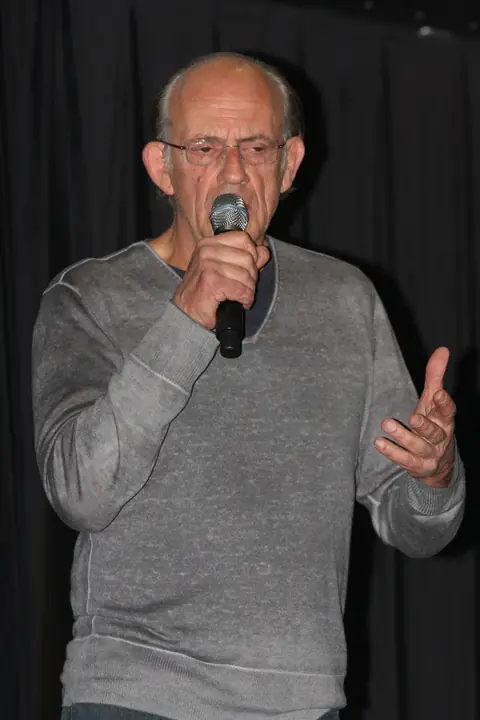
Back to the Future Part II (1989): Emmett Brown speaking into a microphoneImage: Wikimedia Commons · Eva Rinaldi, CC BY-SA 2.0 - #023
- #024
- #025
- #026
One initial idea for the sequel had the first two acts the same, but the third act had Biff giving his younger self the almanac in the 1960s, not in 1955. When Marty went back to stop him, he ran into his parents again (who were now hippies) and almost stopped his own conception. Robert Zemeckis decided that it was too similar an idea to the first film, and George and Lorraine would have been too old to be hippies. He came up with the idea of revisiting the original Back to the Future (1985) from different angles with the two Martys in 1955.
- #027
In the scene where Marty watches a documentary on the life of Biff in front of the casino, there is a still photo of Buford "Mad Dog" Tannen. According to Bob Gale in the DVD commentary, this was a still of an early make-up test for Mad Dog's look in the third film. The look was changed when Back to the Future Part III (1990) began production.
- #028
- #029
In the original script, Pa Peabody was to have been evaluated at a mental institution for claiming to have seen a spacecraft (the DeLorean in the first film). As soon as he is released, he sees a flying DeLorean and fires his shotgun at it, damaging the time circuits. This is the reason the destination time display flickers over to read JAN 01 1855 12 AM. On the region one DVD commentary, Bob Gale mentions the scene was dropped when Will Hare was not available to return for the sequel.
- #030
- #031
- #032
- #033
- #034
A fake promotional trailer for the nonexistent "Jaws 19" was released on October 21, 2015. It recounts all nineteen films as follows: * Jaws (1975) "made you afraid to go into the water." * Jaws 2 (1978) "made you afraid to go back into the water." * Jaws 3-D (1983) (which also starred Lea Thompson) was "a new dimension in terror." * Jaws: The Revenge (1987) was "personal." * "Jaws 5" was "just business." * "Jaws 6" was "pure pleasure" (suggesting a romantic subplot). * "Jaws 7" was "cyber-Jaws" (indicating the shark went digital). * "Jaws 8" is "Robo-Jaws" (a RoboCop (1987) spoof). * "Jaws 9" featured Chief Brody's grandson "assembling a super team of shark hunters." * "Jaws 10" was "man versus shark versus all the terrors of the deep" (suggesting giant squids). * "Jaws 11" took place in "outer space." * "Jaws 12" was a prequel. * "Jaws 13" was "Jaws 12: Part 2, a sequel to the prequel." * "Jaws 14" had "starting a family." It had jaws. * "Jaws 15" "battled a Russian shark named Ivan Sharkovsky" (a Rocky IV (1985) spoof). * "Jaws 16" "Jaws took a bite out of the Big Apple." * "Jaws 17: 50 Scales of Grey," in which "Jaws learns about love from a mysterious stranger" (a Fifty Shades of Grey (2015) spoof). * "Jaws 18" was "the mind-blowing reboot." * And finally, "Jaws 19," in which "the oceans are disappearing, and to save their home, the sharks must attack. This time it's really, REALLY personal!"
- #035
- #036
When the unconscious Jennifer is taken home by the two officers in 2015, it looks as if great pains were taken to conceal the identity of the one officer (Reese). Her face is kept in the dark, and her cap is even kept to where the bill is hiding her eyes. The actress portraying Officer Reese was Mary Ellen Trainor, who was Robert Zemeckis' wife at the time.
- #037
The Cafe 80's restaurant in 2015 is a conglomeration of the storefront's two previous incarnations in Back to the Future (1985). In 1955, it was the home of "Lou's Cafe", and in 1985, it was a fitness and workout club. While the Cafe 80's is primarily a restaurant, there are people seen working out on the exercise bikes (seen when Griff tells the riders "Keep peddling, you two").
- #038
Several elaborate sequences were deleted through various revisions of the script, including: During the 2015 hoverboard chase, Marty grabs on to a flying car that actually pulls him into the sky to a very high altitude. When Marty loses his grip, he is rescued by Doc in a flying van. Marty and Doc, after learning when Biff received the almanac, have to escape in the DeLorean during a police shoot-out. When the car's flying circuits are damaged by gunfire, Doc plunges the time machine straight toward the ground in order to reach eighty-eight miles per hour. While Marty and Doc try to recover the almanac, the fusion generator (and in later revisions, the time circuits) is damaged by Farmer Peabody (a character Marty encountered in the first film) who still thinks the DeLorean is a space ship. With Mr. Fusion and the flight circuits heavily damaged, Marty and Doc fly the DeLorean into an array of power lines over the Grand Canyon to generate enough power to return to 1985.
- #039
- #040
- #041
The motivation for writing a scene with an automatic food hydrating device in the future was due to product placement needs to receive Pizza Hut's sponsorship. Pizza Hut provided a professional food stylist and pizza kitchen to be at the set of the 2015 McFly house to make hot, attractive pizzas for each take.
- #042
The Wild Gunman (1984) video game in Cafe 80's was specially made for the film. Wild Gunman was an actual light gun game for the Nintendo Entertainment System, but was never a dedicated arcade cabinet. It was, however, included in many of Nintendo's Play Choice 10 machines, hence why a lightgun was on the cabinet. The sound effects heard in the movie are from the game, but, the on-screen graphics are entirely new, drawn to resemble what appeared. Ironically, the actual game itself had far better animation.
- #043
- #044
- #045
- #046
- #047
- #048
- #049
Flea was touring with the Red Hot Chili Peppers and according to him, flew really far away to film his scenes, and had slept for two hours the night before. Flea shot his scenes in one day, and then flew back to the tour that night. Flea said that much of the time was a blur, save for having lost a sweater his grandmother knitted for him on the way to shooting his scenes, and that other than seeing them premiere, he hasn't seen the trilogy since.
- #050
- #051
- #052
When Marty and Needles are talking, Needles finally convinces Marty to interface in the deal by calling him chicken. After Marty scans his card in, you see Needles looking off to the left and raising his eyebrows. It is highly obvious that he's secretly sitting across from the CusCo supervisor, Ito T. Fujitsu --- i.e., "The Jitz" --- and falsely making it seem like Marty was the main one behind the idea. So this is a sort of double irony, in that NEEDLES was the one who had actually "done a sting operation" on MARTY by coercing him into scanning his card, whereas Marty later fibbingly claimed --- after scanning his card and then getting fired --- that HE was trying to set NEEDLES up for a sting by seemingly accepting the challenge and going along with Needles' scam. Probably the implication is that the shameless Needles had HIMSELF gotten caught attempting to pull off the scam that he'd been trying to pressure Marty into joining, and so the only way that he could escape getting sacked himself was to falsely tell "The Jitz" that MARTY had been the one who had suggested the scam to HIM, and thus Needles was being allowed "snitching privileges" if he got Marty to consent to the scam while "The Jitz" was listening.
- #053
According to the book "We Don't Need Roads: The Making of the Back to the Future Trilogy" by Caseen Gaines, the original plan for Marty's hoverboard was to have the name of Swiss watch company Swatch on it (implying the company branched out into other products by 2015). These plans changed when a deal was struck with Mattel.
- #054
Michael Jackson was a big fan of Back to the Future (1985), and he was very cooperative with letting his likeness be recreated for the Cafe 80s scene. He was portrayed by E'Casanova (credited as E. Casanova Evans), a professional Michael Jackson impressionist, who wore a rubber mask. According to Bob Gale, ironically, E'Casanova naturally resembled Jackson more without the mask than with it.
- #055
- #056
- #057
- #058
In the beginning of the film, Biff intends to show Marty new matchbooks he has to advertise his auto detailing company before witnessing the flying DeLorean. Later, in 1985A, Marty takes a matchbook from Biff's office with the words PLEASURE PARADISE on the back. Finally, when Marty burns the almanac, the matchbook changes to read AUTO DETAILING.
- #059
- #060
According to the revised six dollar USA Today newspaper article (which formerly featured Marty McFly, Jr. arrested for theft, and was changed to feature Griff Tannen's gang arrested for destruction of the Hill Valley courthouse's doors), the real names of Griff's gang members - who are listed in the closing credits as Data, Spike, and Whitey - are Rafe Unger, Leslie O'Malley, and Chester Nogura respectively.
- #061
During the early stages of production, Crispin Glover was coming around to the idea appearing in the film. Bob Gale tried to sweeten the deal by offering him double what he made from the first film and also offered him the role of Seamus McFly in Back to the Future Part III (1990). However, Glover responded by hiring new agents who demanded more money.
- #062
Doc tells Marty, "Just say 'no'" to Griff Tannen, when they first arrive in 2015. That phrase was the popular Reagan Administration slogan for peer pressure among youth in the '80s. Not only was Ronald Reagan spoofed in this film, but Fox's Alex P. Keaton from Family Ties (1982) was a supporter of the President.
- #063
- #064
- #065
The t-shirt that Doc wears during most of the film, that has the train and horse design, was manufactured as part of the attire for the attendants when "Back to the Future: The Ride" was running at Universal Studios Hollywood and Universal Studios Orlando. Since the ride is no longer at these theme parks, the shirts have been widely distributed, and costs on the average go well beyond $200 on eBay.
- #066
- #067
- #068
The futuristic looking cab that takes "old Biff" to the DeLorean, while it is parked near Marty and Jennifer's 2015 house, is a Citroen DS. This car went into production in October 1955, so it could, conceivably, have appeared in the original Back to the Future (1985). The same car appears as a wreck in the "alternative" 1985.
- #069
- #070
- #071
The day Marty time travels to the year 2015, October 21, 2015, happened to be the day the Chicago Cubs were eliminated from the playoffs. In the film, there is a joke stating the Cubs finally win the World Series. In reality, the Cubs were swept 0-4 in a series against the New York Mets, knocking them out of the playoffs and the chance to win the World Series, although the team eventually won the World Series one year later against the Cleveland Indians by 4-3.
- #072
- #073
- #074
- #075
The movie features scenes with Doc, Biff and Jennifer interacting with younger/older versions of themselves. In the interactions between older and younger Doc, and between the older and younger Biff, only the older versions are aware of the younger versions' identities, and the younger versions don't recognize their older counterparts. On the other hand, in the encounter between the older and younger Jennifer, both versions recognize each other's identities.
- #076
One of the inspirations to film the second and third installments back-to-back were issues Richard Lester had faced with The Three Musketeers (1973) and The Four Musketeers (1974). The two Musketeers films had started out as only one movie, but because of the long running time it was split into two. When it became known that this was happening, the actors of the Musketeers films, backed by the Screen Actors Guild, demanded to be paid for two films and not just one. For the Back to the Future sequels, Zemeckis originally planned them as two separate productions, but shooting them back-to-back proved more cost-effective.
- #077
- #078
In alternate 1985, Doc couldn't figure out why old Biff went back to November 12, 1955 to give his younger self the sports almanac. It's easy to explain: Old Biff chose to go back to that date because that was when young Lorraine told young Biff she wouldn't go out with him even if had a million dollars and old Biff had still remembered that statement due to his lifelong infatuation with Lorraine. Young Biff made his first bet and became a millionaire on his 21st birthday, as mentioned on the documentary Marty watches in alternate 1985 before he discovered alternate middle aged Biff was married to alternate middle aged Lorraine. Thus Biff proved her wrong.
- #079
You can see Michael Jackson posters on the wall of the African-American family's house when Marty enters. One of them is "Off The Wall", and the other one is "Thriller". You can also hear the song "Beat It" in the Cafe 80's, where an animated figure of Michael Jackson on a video screen tells customers about the menu.
- #080
- #081
- #082
- #083
Match says, "We can do this the hard way or the easy way," and then hits Marty on the head. The screen goes dark and you hear a deep, echoing voice saying "the easy way." It is probably Marty speaking, because if you use an audio editor to raise the pitch by 25%, the voice sounds just like Michael J. Fox.
- #084
- #085
- #086
- #087
- #088
- #089
The hoverboard chase scene is similar to famous skateboard chase scene in the first movie. Marty attempts to give the hoverboard back to the little girl, but she rejects it after obtaining the most powerful air skateboard "The Pit Bull". In the first movie, Marty was able give the skateboard back to the little boy.
- #090
- #091
- #092
The opening titles feature visuals of flying through clouds. The sequence begins in the daytime and ends with flying through dark, stormy clouds. This foreshadows the trip to the future during which they depart in the bright sunshine and arrive in the future in extremely dark weather. Incidentally, when they land, it is raining but clears up instantly, thanks to weather control.
- #093
- #094
- #095
When Marty walks past the antique store in the future a copy of "Jaws" on Nintendo can be seen in the window. The Nintendo game "Jaws" was produced by a company called LJN which is also the same company that would later produce the "Back to the Future" series of games that later appeared on Nintendo and Sega.
- #096
- #097
- #098
FRANCHISE TRADEMARK: In each of the three films, a common theme is that Marty always ends up in a public drinking place shortly after arriving at his time destination, and is confronted by a Tannen shouting "Hey McFly!" This is then followed by a physical altercation where Marty ends up in a chase through the town with that particular Tannen member and his three goons.
- #099
- #100
- #101
When Biff sees the DeLorean being parked near the Café 80's, he says, "A flying DeLorean? I haven't seen one of those in 30 years." However, by the end of the film, Biff will have seen a flying DeLorean three times in his life: * In the first time at the beginning of the film in 1985, when he leaves the house to show Marty his box of matches. * The second time in 2015, when he leaves the Café 80's, and sees Doc parking the flying DeLorean next to Marty. * The third time in 1955, in the scene of Biff chasing Marty in the tunnel. When Marty is holding on to the flag rope that Doc threw to him from the flying DeLorean, Biff looks up and sees it while driving his car before crashing into the manure truck.
- #102
While driving to the dance, 1955 Biff listens to Perry Como's song "Papa Loves Mambo" on the radio. Robert Zemeckis originally wanted that to be the song that played when Marty first arrived in 1955 Hill Valley in Back to the Future (1985), but it was replaced by The Four Aces' rendition of "Mr. Sandman."
- #103
The special effect of the self-lacing shoes was achieved by attaching the shoes to a fake floor, underneath which was a crew member who pulled the laces and turned on the Nike logo light. Similarly, the auto-fitting jacket effect was achieved by rigging the jacket with cables, which were pulled from off-screen by crew members.
- #104
- #105
- #106
- #107
Needles' name is significant in three ways: * It is a pun on the fact that he is often poking and prodding Marty verbally (i.e., "needling" him) by calling him "chicken" and otherwise belittling him * given his wild and unhealthy "spaced out" appearance, he is obviously on illegal psychedelic drugs that he self-injects (i.e., using hypodermic "needles") * his middle initial "J" references that of Michael J. Fox, the actor who plays Marty.
- #108
Contains a major spoiler — show
After Biff gets his cane stuck in the DeLorean upon returning to 2015, he starts to thrash around in pain, but the reason is never explained. Robert Zemeckis has stated that Biff was experiencing the same thing Marty did near the end of the first movie: fading out of history. The idea was that, by going back in time to give the sports almanac to his younger self, Biff had somehow altered his own future so that he no longer existed in the year 2015. According to script drafts, it was Lorraine who had shot and killed the abusive Biff in 1996. A deleted scene makes this much clearer as we actually see Biff vanish.
Production Story (41)
- #109
- #110
In the alternate, dystopic 1985, Marty's siblings Dave and Linda are implied to be an offender and in massive debt respectively, but neither one appears in the movie. A scene was filmed in which Marty briefly meets Dave (played by Marc McClure), now a drunk lowlife, while a scene was planned with Linda working as a prostitute to settle her debts. However, the latter scene could not be filmed because Wendie Jo Sperber could not reprise her role at the time as she was pregnant, so it was decided to also delete Dave's only scene. Both actors were available again for Back to the Future Part III (1990), where Marty meets his entire family near the end and notes that "Thank God, you guys are all back to normal." Given that Marty only ever meets his alternate 1985 mother in Part II, this scene from Part III was likely filmed early in the production schedule of both sequels (shot back to back), and not re-shot to accommodate the changes made to Part II.
- #111
- #112
Robert Zemeckis was very unhappy about the way that Universal marketed the film. He wanted it to be made quite clear that this film was ultimately a set-up to Back to the Future Part III (1990) but Universal wanted to advertise it as its own independent movie. This ultimately backfired as Back to the Future Part II (1989) ends with a 'To Be Concluded" title that frustrated many audiences, resulting in bad word of mouth and a dramatic fall-off in the film's box office receipts in its second week.
- #113
When Officer Reese talks about Hilldale being a breeding ground for "tranks, lobos and zipheads", she is using invented 2015 future slang written by screenwriters Robert Zemeckis and Bob Gale. The goal was to quickly show the audience how much Hilldale - a prestigious, upscale neighborhood in 1985 - had decayed into a rough, crime-ridden area by the future. The terms break down based on the movie's lore and context: * Tranks / Tranked: Short for "tranquilizers." In the movie's version of 2015, "tranks" are people who abuse future chemical tranquilizers, and being "tranked" means being high or heavily under the influence. When the officers find Jennifer unconscious in the alley and say she "got a little tranked," they assume she's passed out from drugs. This is why one officer sniffs her ear (a bizarre future police test for drug use) and why Marty Jr. later yells "Don't drive tranked!" at a passing car. * Lobos: This is a play on the word lobotomy. It refers to people who are crazy, mindless, or have fried their brains from either street drugs or sci-fi technology. * Zipheads: While never explicitly defined on screen, it follows the pattern of derogatory slang for people with altered mental states. Within the movie's universe, it likely refers to people addicted to a future stimulant called "zip," or tech-addicts who have messed with their own brains. By tossing all three words together, the police officers are essentially saying that Hilldale has become a breeding ground for drug addicts, criminals, and degenerates.
- #114
- #115
- #116
- #117
- #118
Originally, only one sequel was planned. The script for this sequel, known as "Paradox" included all the elements of this movie and Back to the Future Part III (1990), but compressed to fit into one movie. However, it was revealed with the release of the DVD set that there was an even earlier script which involved Marty meeting up with his parents while they're college students in the sixties. (This was probably dropped because no matter how you cut it, George and Lorraine wouldn't have been in college during the "Protest Era", they were too old.)
- #119
The principal actors and actresses had committed to the sequels before any scripts were written. However, there was a stumbling block in negotiations with Crispin Glover (George McFly in Back to the Future (1985)), who stated that he was offered a monetary amount less than half of what Lea Thompson and Tom Wilson were being paid to return. Glover believed this was due to producer Bob Gale taking exception to his voicing his disapproval of the original ending of the first film (where the McFlys viewed money and material possessions as rewards), causing a script change. During sequel negotiations, his agent expressed to producers that Glover wanted fair compensation, in addition to a script approval clause in his contract. Bob Gale refused to give in to either of these requests, instead offering a lower salary amount than the first offer. After Glover turned down the low-ball offer of $125,000, Gale re-wrote the sequel script to lessen George McFly's screen time. Jeffrey Weissman was cast as George and, using molds of Glover made on the set of the first film, was dressed in facial prosthetics to look like him, so that they could incorporate excerpts from the original movie. All shots of Weissman either show him from behind, at a distance, upside down or with sunglasses, in effect fooling audiences into believing that Crispin Glover had taken part in the sequel. Those dishonest actions would later come back to bite Bob Gale when Crispin Glover successfully sued on the grounds that the studio had used his likeness without permission, as well as not even having paid him for the reuse of the footage from the original film.
- #120
- #121
According to the book "We Don't Need Roads: The Making of the Back to the Future Trilogy" by Caseen Gaines, the original plan for Marty's hoverboard was to have the name of Swiss watch company Swatch on it (implying the company branched out into other products by 2015). These plans changed when a deal was struck with Mattel.
- #122
- #123
- #124
A fake teaser trailer for the non-existent "Jaws 19" was released on October 21, 2015. It describes all nineteen movies as follows: * Jaws (1975) "made you afraid to go into the water." * Jaws 2 (1978) "made you afraid to go back into the water." * Jaws 3-D (1983) (which also starred Lea Thompson) was "a new dimension in terror." * In Jaws: The Revenge (1987), it was "personal." * "Jaws 5" was "just business." * "Jaws 6" was "pure pleasure" (suggesting a romantic subplot). * "Jaws 7" was "cyber-Jaws" (suggesting the shark had gone digital). * "Jaws 8" was "Robo-Jaws" (spoof of RoboCop (1987)). * "Jaws 9" featured Chief Brody's grandson "assembling a super team of shark hunters." * "Jaws 10" was "man versus shark versus all the terrors of the deep" (suggesting giant squids). * "Jaws 11" took place in "outer space." * "Jaws 12" was a prequel. * "Jaws 13" was "Jaws 12: Part 2, a sequel to the prequel." * "Jaws 14" had Jaws "starting a family." * In "Jaws 15," Jaws "battled a Russian shark named Ivan Sharkovsky" (spoof of Rocky IV (1985)). * In "Jaws 16," "Jaws took a bite out of the Big Apple." * "Jaws 17: 50 Scales of Grey," "Jaws learns about love from a mysterious stranger" (spoof of Fifty Shades of Grey (2015)). * "Jaws 18" was "the mind-blowing reboot." * And finally, in "Jaws 19," "the oceans are disappearing, and to save their home, the sharks must attack. This time it's really, REALLY personal!"
- #125
Crispin Glover, who had played George McFly in Back to the Future (1985) and had passed on the opportunity to reprise the role due to the low salary, found that the studio had used footage of him without his permission, and was billed as "George McFly in footage from Back to the Future" in the closing credits. He successfully sued the producers on the grounds that they had used his likeness without permission, as well as not having paid him for the reuse of the footage from the original film. The case was resolved outside of court and Glover was awarded a reported $760,000. As a result of the lawsuit, clauses in the Screen Actors Guild collective bargaining agreements now state that producers and actors are not allowed to use such methods to reproduce the likeness of other actors without consent. Despite not setting a legal precedent, the lawsuit is often evoked in cases for actors involving the misuse of their likeness through digital recreation and other technological methods to replicate their appearance without their permission. This was a landmark case and therefore the brave actions of Crispin Glover, which affected his future career after that, have been critical in curtailing what was beginning to be the widespread abuse of actors by the major Hollywood studios.
- #126
In the original script, Pa Peabody was to have been evaluated at a mental institution for claiming to have seen a spacecraft (the DeLorean in the first film). As soon as he is released, he sees a flying DeLorean and fires his shotgun at it, damaging the time circuits. This is the reason the destination time display flickers over to read JAN 01 1855 12 AM. On the region one DVD commentary, Bob Gale mentions the scene was dropped when Will Hare was not available to return for the sequel.
- #127
- #128
- #129
Several elaborate sequences were deleted through various revisions of the script, including: During the 2015 hoverboard chase, Marty grabs on to a flying car that actually pulls him into the sky to a very high altitude. When Marty loses his grip, he is rescued by Doc in a flying van. Marty and Doc, after learning when Biff received the almanac, have to escape in the DeLorean during a police shoot-out. When the car's flying circuits are damaged by gunfire, Doc plunges the time machine straight toward the ground in order to reach eighty-eight miles per hour. While Marty and Doc try to recover the almanac, the fusion generator (and in later revisions, the time circuits) is damaged by Farmer Peabody (a character Marty encountered in the first film) who still thinks the DeLorean is a space ship. With Mr. Fusion and the flight circuits heavily damaged, Marty and Doc fly the DeLorean into an array of power lines over the Grand Canyon to generate enough power to return to 1985.
- #130
The original theatrical and premium cable television versions of the film end with the phrase "To Be Concluded", and a teaser for Back to the Future Part III (1990). Russ Meyer and Richard Lester are the only other filmmakers to have ended a movie with a trailer before this release. (Recent 2009 premium cable television versions have dropped the teaser.)
- #131
Robert Zemeckis and Bob Gale have admitted on the DVD commentary that they were originally not interested in doing a sequel to their success hit Back to the Future (1985), and that the open ending of the first movie was simply meant as a final joke. However, when plans for a sequel were made by the studio, they chose to remain involved in the continuation of their creation, and even extended it to two sequels. Zemeckis has claimed that if he knew that he was going to make a sequel, he would have made sure that Marty's girlfriend Jennifer wasn't in the car at the end of the first film. Since the movie would concentrate on Marty, there was not much for her to do, and she would even get in his way. This is why Jennifer is knocked out by Doc and left behind so early in the movie.
- #132
Bob Gale, a baseball fan in real life, said he came up with the scene referencing a World Series Championship by the Chicago Cubs upon personally brainstorming about the most unlikely scenarios he could come up with. Gale also said he based the timing of the 2015 World Series on the usual World Series scheduling at the time of the movie's production and release. He admitted he erred in not foreseeing MLB expanding its playoff schedule by the mid 1990s and pushing the World Series until later in October, and in the case of 2015, early November.
- #133
- #134
One initial idea for the sequel had the first two acts the same, but the third act had Biff giving his younger self the almanac in the 1960s, not in 1955. When Marty went back to stop him, he ran into his parents again (who were now hippies) and almost stopped his own conception. Robert Zemeckis decided that it was too similar an idea to the first film, and George and Lorraine would have been too old to be hippies. He came up with the idea of revisiting the original Back to the Future (1985) from different angles with the two Martys in 1955.
- #135
The motivation for writing a scene with an automatic food hydrating device in the future was due to product placement needs to receive Pizza Hut's sponsorship. Pizza Hut provided a professional food stylist and pizza kitchen to be at the set of the 2015 McFly house to make hot, attractive pizzas for each take.
- #136
While driving to the dance, 1955 Biff listens to Perry Como's song "Papa Loves Mambo" on the radio. Robert Zemeckis originally wanted that to be the song that played when Marty first arrived in 1955 Hill Valley in Back to the Future (1985), but it was replaced by The Four Aces' rendition of "Mr. Sandman."
- #137
Director Robert Zemeckis said that he felt this film suffered slightly because he was far too busy dedicating his time to filming it and Back to the Future Part III (1990) at the very same time. Additionally Michael J. Fox later said he preferred making Part III over Part II simply for the reason it was a lot more relaxing in comparison as this film had a lot more technicality and special effects. The film was one of the biggest hits of the year but fell dramatically short of its predecessors gross and Part III released six months later grossed even less and was not even in the top ten films of its year as its predecessors had been. Zemeckis has said the sequels most likely did less business than the first film because audiences were disappointed that the franchise ended on a cliffhanger note and had to wait six months after Part II to see the conclusion in Part III.
- #138
Doc mentions that he left Einstein in a suspended animation kennel in 2015. This line was written to explain why Einstein was not with Doc when he came back to 1985 to pick up Marty and Jennifer, since in Back to the Future (1985), Einstein had gone with Doc into the future, but was not there when Doc came back at the end of that film and the beginning of this one.
- #139
One of the inspirations to film the second and third installments back-to-back were issues Richard Lester had faced with The Three Musketeers (1973) and The Four Musketeers (1974). The two Musketeers films had started out as only one movie, but because of the long running time it was split into two. When it became known that this was happening, the actors of the Musketeers films, backed by the Screen Actors Guild, demanded to be paid for two films and not just one. For the Back to the Future sequels, Zemeckis originally planned them as two separate productions, but shooting them back-to-back proved more cost-effective.
- #140
- #141
Elisabeth Shue was cast as Jennifer, and all the closing shots of Back to the Future (1985) were re-shot for the beginning of this film. Claudia Wells (Jennifer in the first film) was unable to reprise her role as she had stopped acting, because her mother had been diagnosed with breast cancer. She returned to acting for the independent film Still Waters Burn (2008). An interesting point was that during the years between the first and second film, people had forgotten what Jennifer looked like, and when the unknown Shue replaced her virtually no one noticed the change. For the anniversary in 2015, a fan film was made with a Zoom chat featuring all the main cast except Tom Wilson, and with both "Jennifers." By this time, Wells was running a very successful high-end used-clothing store in Los Angeles.
- #142
Crispin Glover sued the filmmakers, as he had not granted permission to use his likeness in this film. He ended up dropping the lawsuit after the case was settled out of court for $765,000 by Universal's insurance company, who decided it would be cheaper to pay Glover than to go to trial. The Screen Actors Guild subsequently introduced new rules about illicit use of actors.
- #143
- #144
- #145
A deleted scene involving Wendie Jo Sperber appearing as a hooker was canceled due to her being pregnant at the time. As she could not appear, it was also decided that an adjacent scene with brother Dave McFly as a drunk would not be included because fans would wonder what happened to her.
- #146
The Jaws (1987) video game seen in the antique store window was made by LJN for the early releases on the Nintendo Entertainment System. LJN would go on to make video games based on this movie and Back to the Future Part III (1990). LJN also made the NES game based on Who Framed Roger Rabbit (1988). A doll of Roger also appears in that same window with the Jaws game.
- #147
Contains a major spoiler — show
In early scripting, the DeLorean's malfunctioning time circuits were due to a police shoot-out's or Old Man Peabody's having damaged the car from gunfire. These scenes were later rejected, and so the time display's flickering was presumably attributed to merely the amateur "prototypical" construction of the time machine (Doc had been the first one to successfully create time travel, after all, and so his initial invention, the somewhat cobbled-together sports-car rig, rather than the subsequently-constructed and more-professionally-designed steam-locomotive machine, would understandably be fairly primitive and experimental, and thus more prone to malfunctions), and to all the stress and battering about that it endured (especially during the periods with the inexperienced Marty, and the clumsy or infirm Biff at the controls) during its life up to that time.
- #148
Contains a major spoiler — show
The original draft of the script had Doc and Marty travelling to 1967 instead of back to 1955 to stop Biff. Marty once again encounters his mother, and accidentally prevents her from going on vacation with his father, thus stopping his own conception, and endangering his existence once more. Throughout the 1967 scenes, the 1985 Doc is continuously hiding from his 1967 counterpart, but the duo requires the younger version's help, since the "Mr. Fusion" is broken.
- #149
Behind the Scenes (39)
- #150
- #151
Director Robert Zemeckis stated that the high school dance scene from 1955 had to have the same costumes because it would be shot from a different angle. The production was nearly delayed because Lorraine's (Lea Thompson) dress couldn't be found even though they had three versions of it made in 1985. Lea Thompson then revealed to Zemeckis that she still had one of the original dresses and had to drive back home to get it.
- #152
Casey Siemaszko, who plays one of Biff's cronies, is named "3-D" because he wears 3-D glasses. In 1955, he wears the paper kind issued at 1950s style 3-D movies, but for his scenes in 1985, a pair of real sunglasses with red and blue lenses were made to better suit the era. By 2015, Griff's goons wear holographic-type shades.
- #153
According to Jeffrey Weissman, he was mistreated on set by several cast mates while working on Part II and III. They referred to him as "the guy playing Crispin." Additionally, when Michael J. Fox first saw Weissman in the George McFly makeup, he stated, "Crispin ain't gonna like this." However, the cast has since reconciled, and are now good terms with Weissman.
- #154
Michael Jackson was a big fan of Back to the Future (1985), and he was very cooperative with letting his likeness be recreated for the Cafe 80s scene. He was portrayed by E'Casanova (credited as E. Casanova Evans), a professional Michael Jackson impressionist, who wore a rubber mask. According to Bob Gale, ironically, E'Casanova naturally resembled Jackson more without the mask than with it.
- #155
An earthquake struck during filming of the cut sequence where the 2015 McFly family gathers around the table, and the crew was afraid the props may have moved around too much to edit the scene seamlessly. To their surprise, everything was exactly where it was supposed to be for the sequence.
- #156
Cheryl Wheeler Duncan, stunt double for Darlene Vogel, was injured during filming of the hoverboard sequence when, due to a technical mishap, instead of flying through the fake glass in the courthouse, she careened into the concrete pillar and then dropped thirty feet on to the concrete below. They didn't re-shoot the scene, and you can clearly see her hitting the pillar and falling to the ground in the final film.
- #157
When "Hill Valley" was created for Back to the Future (1985), they built the town in the pristine 1955 condition, and shot the middle of the movie, then damaged it for the 1985 town, and shot the beginning and end of the movie. When they decided to shoot Back to the Future Part II (1989), they had to clean the set up and restore it to the same condition it was in 1955. It cost more to rebuild than it cost to build it from scratch.
- #158
Filmed at the same time as Back to the Future Part III (1990). It was claimed at the time that in the four years since Back to the Future (1985) was made, Michael J. Fox had forgotten how to ride a skateboard. However, motor skills are not so easily lost (as in riding a bicycle), and Michael J. Fox has since stated that this was an early symptom of his Parkinson's Disease, although the medical diagnosis was not made until 1991.
- #159
When the unconscious Jennifer is taken home by the two officers in 2015, it looks as if great pains were taken to conceal the identity of the one officer (Reese). Her face is kept in the dark, and her cap is even kept to where the bill is hiding her eyes. The actress portraying Officer Reese was Mary Ellen Trainor, who was Robert Zemeckis' wife at the time.
- #160
In the scene where Marty watches a documentary on the life of Biff in front of the casino, there is a still photo of Buford "Mad Dog" Tannen. According to Bob Gale in the DVD commentary, this was a still of an early make-up test for Mad Dog's look in the third film. The look was changed when Back to the Future Part III (1990) began production.
- #161
- #162
- #163
In promotional material, such as Back to the Future Part II Behind-the-Scenes Special Presentation (1989), director Robert Zemeckis explained that "hoverboards float on magnetic energy". He also added, "they've been around for years, it's just that parent groups haven't let toy manufacturers make them. But we got our hands on some and put them in the movie." He was only joking, of course, but interestingly enough, Mattel (whose logo appeared on the hoverboard props) soon found themselves overwhelmed with callers asking where they could buy one. Although they looked pretty convincing in the movie, the hoverboards were simply wooden props attached to the actors' feet. To make the boards fly, the actors were suspended by cables, which were then erased during post-production.
- #164
- #165
The biggest effect the picture employs is a camera system called the VistaGlide. There are four scenes that use the effect of the same actor interacting with him/herself. The four scenes that were shot were Griff and 2015 Biff in the Cafe 80's, the McFly dinner sequence in 2015, 1955 Biff talking to 2015 Biff in the garage, and 1955 Doc talking with 1985 Doc. In order to create the dinner sequence with VistaGlide, the camera had to be divided into thirds and Michael had to come in three different times to play his older self, Marty Jr. and his daughter Marlene. This is the first film to accomplish interaction between the same actor on the screen twice as two different characters. If you watch closely, you'll see that 2015 Biff's hand disappears during the scene in the garage. And during the scene between 1955 Doc and 1985 Doc there is a trembling on the 1955 Doc part of the screen, after giving the tool (that was a hand and arm double) when the camera starts zooming in.
- #166
This film and Back to the Future Part III (1990) were filmed back-to-back. After filming the scene where Doc and Marty return from the future to "1985A" and drop Jennifer off on her front porch swing, the cast and crew waited for daylight and filmed the scene in Part III where she is awakened.
- #167
- #168
- #169
- #170
In an interview, Lea Thompson said that during filming of the dystopian 1985 scene, she went back to her trailer while still wearing her "fake boobies" and removed her dress to cool off. A technician came in, saw her "topless" and ran back out. She yelled, "It's all right! They aren't real!"
- #171
The special effect of the self-lacing shoes was achieved by attaching the shoes to a fake floor, underneath which was a crew member who pulled the laces and turned on the Nike logo light. Similarly, the auto-fitting jacket effect was achieved by rigging the jacket with cables, which were pulled from off-screen by crew members.
- #172
Flea was touring with the Red Hot Chili Peppers and according to him, flew really far away to film his scenes, and had slept for two hours the night before. Flea shot his scenes in one day, and then flew back to the tour that night. Flea said that much of the time was a blur, save for having lost a sweater his grandmother knitted for him on the way to shooting his scenes, and that other than seeing them premiere, he hasn't seen the trilogy since.
- #173
- #174
- #175
Playing multiple characters (including Griff, Biff and his older versions) in this film was more challenging for Tom Wilson than the original Back to the Future (1985). He noted the older characters required up to six hours of prosthetic makeup time, which added significantly to his daily routine.
- #176
- #177
The Wild Gunman (1984) video game in Cafe 80's was specially made for the film. Wild Gunman was an actual light gun game for the Nintendo Entertainment System, but was never a dedicated arcade cabinet. It was, however, included in many of Nintendo's Play Choice 10 machines, hence why a lightgun was on the cabinet. The sound effects heard in the movie are from the game, but, the on-screen graphics are entirely new, drawn to resemble what appeared. Ironically, the actual game itself had far better animation.
- #178
A deleted scene involving Wendie Jo Sperber appearing as a hooker was canceled due to her being pregnant at the time. As she could not appear, it was also decided that an adjacent scene with brother Dave McFly as a drunk would not be included because fans would wonder what happened to her.
- #179
- #180
- #181
An earthquake struck during filming of the cut sequence where the 2015 McFly family gathers around the table, and the crew was afraid the props may have moved around too much to edit the scene seamlessly. To their surprise, everything was exactly where it was supposed to be for the sequence.
- #182
Cheryl Wheeler Duncan, stunt double for Darlene Vogel, was injured during filming of the hoverboard sequence when, due to a technical mishap, instead of flying through the fake glass in the courthouse, she careened into the concrete pillar and then dropped thirty feet on to the concrete below. They didn't re-shoot the scene, and you can clearly see her hitting the pillar and falling to the ground in the final film.
- #183
In the alternate, dystopic 1985, Marty's siblings Dave and Linda are implied to be an offender and in massive debt respectively, but neither one appears in the movie. A scene was filmed in which Marty briefly meets Dave (played by Marc McClure), now a drunk lowlife, while a scene was planned with Linda working as a prostitute to settle her debts. However, the latter scene could not be filmed because Wendie Jo Sperber could not reprise her role at the time as she was pregnant, so it was decided to also delete Dave's only scene. Both actors were available again for Back to the Future Part III (1990), where Marty meets his entire family near the end and notes that "Thank God, you guys are all back to normal." Given that Marty only ever meets his alternate 1985 mother in Part II, this scene from Part III was likely filmed early in the production schedule of both sequels (shot back to back), and not re-shot to accommodate the changes made to Part II.
- #184
In an interview, Lea Thompson said that during filming of the dystopian 1985 scene, she went back to her trailer while still wearing her "fake boobies" and removed her dress to cool off. A technician came in, saw her "topless" and ran back out. She yelled, "It's all right! They aren't real!"
- #185
Playing multiple characters (including Griff, Biff and his older versions) in this film was more challenging for Tom Wilson than the original Back to the Future (1985). He noted the older characters required up to six hours of prosthetic makeup time, which added significantly to his daily routine.
- #186
- #187
According to Jeffrey Weissman, he was mistreated on set by several cast mates while working on Part II and III. They referred to him as "the guy playing Crispin." Additionally, when Michael J. Fox first saw Weissman in the George McFly makeup, he stated, "Crispin ain't gonna like this." However, the cast has since reconciled, and are now good terms with Weissman.
- #188
Characters & Cast (9)
- #189
- #190
- #191
- #192
- #193
Near the end of the film, when Marty is attempting to steal the almanac back from Biff, they approach and eventually drive through a tunnel. This is the same tunnel private investigator Eddie Valiant drives through to reach Toontown in Who Framed Roger Rabbit (1988), which was likewise directed by Robert Zemeckis and starred Christopher Lloyd (Doc Brown).
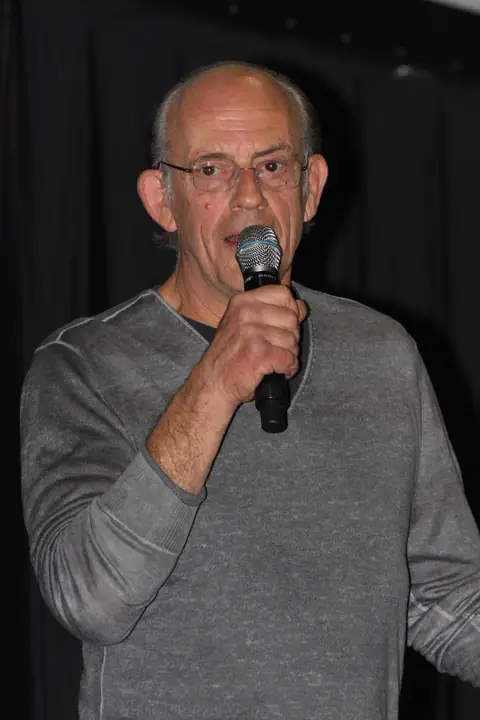
Back to the Future Part II (1989): Emmett Brown speaking into a microphoneImage: Wikimedia Commons · Eva Rinaldi, CC BY-SA 2.0 - #194
When the future Marty McFly attempts to play his guitar, he plays part of the main riff of "Power of Love" by Huey Lewis and The News, the theme song for Back to the Future (1985). This was the song that he had played in the first movie when auditioning for the high school dance. The guitar he was playing was an early Paul Reed Smith Standard, which was fairly rare due to the limited production at the time.
- #195
According to Bob Gale, during negotiations, Crispin Glover's agents told producers that Crispin would only agree to appear in the sequels if he was given script approval and $1 million. The producers asked Crispin's agents to come back with a more reasonable offer, or they would assume he was not interested in being in the film. Crispin refused to budge on his conditions, so Gale re-wrote the script to lessen George McFly's screentime, and recast the role with a lookalike. Crispin disputes this, saying he was offered less than Lea Thompson for a similar sized role, due to his complaints about the ending of the original film. This led to a falling out with Gale, followed by a lawsuit over the unsanctioned use of Crispin's likeness, which was settled out of court in the latter's favor. Despite all this, Crispin's rapport with director Robert Zemeckis apparently improved enough for him to appear in his later film Beowulf (2007).
- #196
FRANCHISE TRADEMARK: In every film in the trilogy, Marty passes out. He always wakes up and asks "Mom? Is that you?," after which a character played by Lea Thompson tells him to "just relax/there, there now" and mentions for exactly how long he's been out cold. He then believes that the preceding events were a "horrible nightmare", after which the Thompson character tells him that he is "safe and sound now" in whatever place or time he is, making Marty realize that it was no dream. He then gets up and is puzzled by the appearance of his "mom".
- #197
Easter Eggs & References (91)
- #198
[46:04] Match says, "We can do this the hard way or the easy way", then hits Marty on the head. The screen goes black and you hear a deep voice with an echo saying, "the easy way". This is presumably Marty saying it because if you use a sound editor to raise the pitch by 25%, it sounds just like Michael J. Fox.
- #199
- #200
- #201
You can see Michael Jackson posters on the wall of the African-American family's house when Marty enters. One of them is "Off The Wall", and the other one is "Thriller". You can also hear the song "Beat It" in the Cafe 80's, where an animated figure of Michael Jackson on a video screen tells customers about the menu.
- #202
Doc tells Marty, "Just say 'no'" to Griff Tannen, when they first arrive in 2015. That phrase was the popular Reagan Administration slogan for peer pressure among youth in the '80s. Not only was Ronald Reagan spoofed in this film, but Fox's Alex P. Keaton from Family Ties (1982) was a supporter of the President.
- #203
- #204
In all three Back To The Future films, a member of the Tannen family is always threatening a member of the McFly Family with "Hey, McFly! I thought I told you never to come in here!" just after they have entered the hot hangout spot of the time period. Additionally, in all three films Marty believes he is being addressed but he never is: in the first film it's his father George. In the second it's his son Marty Jr and in the third it's his ancestor Seamus McFly.
- #205
- #206
The Jaws (1987) video game seen in the antique store window was made by LJN for the early releases on the Nintendo Entertainment System. LJN would go on to make video games based on this movie and Back to the Future Part III (1990). LJN also made the NES game based on Who Framed Roger Rabbit (1988). A doll of Roger also appears in that same window with the Jaws game.
- #207
- #208
The multi-color design used on the baseball cap worn by Marty Jr. in 2015 would actually be adopted by Puma for a design of their sideline caps during the 2000 NFL season. The style of that particular baseball cap was known as "The Eclipse", which used the multi-color design based on the team's color palettes.
- #209
- #210
- #211
If you pay close attention to the sign at the entry of Hilldale, the subtext reads "The Address of Success" but someone has vandalized the sign to read "The Address For Suckers" (The letters "K" and "R" are spray painted on). The vandalism is a subtle suggestion that Hilldale, a seemingly middle class neighborhood, is not a good area. This is a payoff to the repeated lines by the police officers who take Jennifer home. Twice they complain about how bad the neighborhood is and the kinds of people who live there.
- #212
- #213
- #214
Mr. Strickland's office placard identifies him as "S.S. Strickland." While it has been speculated that it stands for "School Superintendent", a photo album included with the deluxe edition of Back to the Future: The Game lists his name as Stanford S. Strickland (born 1925). The "SS" is obviously a tongue-in-cheek reference to the in famously harsh/dictatorial German "Schutzstaffel" paramilitary organization under Adolf Hitler (i.e., the dreaded "SS") during WW2, and is a grimly humorous reference to how excessively heavy-handed and stern Mr. Strickland's rule is over his students. Before the game, this film's novelization had identified Mr. Strickland's first name as "Gerald".
- #215
- #216
Some of the items displayed in the front window of the Blast from the Past antique store: * Apple Macintosh (with keyboard) * Black & Decker DustBuster * Black & Decker clothes iron * Jaws 2 (1978) VHS box * Dragnet (1987) VHS box * National Lampoon's Animal House (1978) VHS box * Barbie and Ken dolls * NES game BurgerTime (1982) * Roger Rabbit plush doll * Lava lamp * JVC television * JVC camcorder * bottles of Perrier water (still with water inside) * the comedy album "Trust Me" by Hans Petersen, featuring Peterson impersonating President Jimmy Carter * The Bee Gees album * The President's Album: Freedom's Finest Hour picture disc LP, narrated by Ronald Reagan * Pac-Man lunchbox * Mendocino box * smiley faces from 1972 * Sanyo Orange Phonosphere record player * Jimmy Carter peanut bank * Gray's 1950 - 2000 Sports Almanac * John F. Kennedy bust * rounded white telephone * Magnavox Weekender AM-62 transistor radio * R.C. Pro-Am video game box * Marty's denim jacket (with "Art in Revolution" pin).
- #217
- #218
While not featuring Michael Jackson himself, the movie features not one, but two actors with a history of playing the pop icon. E'Casanova, who plays the video waiter in the Cafe 80s, has frequently portrayed Jackson, billing himself as "the #1 Michael Jackson Tribute Artist." In addition to this, Donald Fullilove, who plays car salesman Goldie Wilson III in this film, as well as Mayor Wilson in the previous film, provided the voice of Michael Jackson in the Rankin-Bass Jackson 5ive cartoon from 1971 - 72. In the previous film, long before becoming mayor, 1955 Goldie Wilson works in the diner which will someday become the Cafe 80s.
- #219
- #220
Near the end of the film, when Marty is attempting to steal the almanac back from Biff, they approach and eventually drive through a tunnel. This is the same tunnel private investigator Eddie Valiant drives through to reach Toontown in Who Framed Roger Rabbit (1988), which was likewise directed by Robert Zemeckis and starred Christopher Lloyd (Doc Brown).
- #221
When 1985 Jennifer discovers herself in her 2015 house, her daughter Marlene (played by Michael J. Fox) appears at the top of the stairs, saying, "Mom? Mom, is that you?" This is the exact line spoken by Marty (also played by Fox) in each film of the trilogy when he is knocked out, waking up in an unfamiliar place.
- #222
- #223
- #224
- #225
- #226
- #227
- #228
- #229
- #230
- #231
When Doc sees the future newspaper headline change to tell him that he was "commended" instead of "committed", a headline at the bottom of the page changes from "Nixon seeks fifth term" to "Reagan seeks second term" (referring to US Presidents Richard Nixon and Ronald Reagan), to signify that the normal timeline has been restored. This implies that in the alternate 1985 where Biff rose to prominence, the Watergate scandal that forced Nixon to resign during his second term never happened or was kept out of publicity, enabling him to stay on for at least four consecutive terms. As the movie mentions how Biff successfully lobbied to legalize gambling, this opens up the possibility that Biff may have used his wealth and influence to support Nixon, keeping a lid on the Watergate scandal or possibly avoiding it altogether, in exchange for help with the legalization of gambling.
- #232
- #233
Needles' name is significant in three ways: * It is a pun on the fact that he is often poking and prodding Marty verbally (i.e., "needling" him) by calling him "chicken" and otherwise belittling him * given his wild and unhealthy "spaced out" appearance, he is obviously on illegal psychedelic drugs that he self-injects (i.e., using hypodermic "needles") * his middle initial "J" references that of Michael J. Fox, the actor who plays Marty.
- #234
- #235
The "reverse 99" image in the sky is not intended to represent a mathematical figure that designates a number of years travelled in time; it is merely the pair of flaming "spiral trails" that the DeLorean's wheels made as it spun rapidly up to eighty-eight miles per hour after being hit by lightning.
- #236
- #237
In the beginning of the film, Biff intends to show Marty new matchbooks he has to advertise his auto detailing company before witnessing the flying DeLorean. Later, in 1985A, Marty takes a matchbook from Biff's office with the words PLEASURE PARADISE on the back. Finally, when Marty burns the almanac, the matchbook changes to read AUTO DETAILING.
- #238
The hoverboard chase scene is similar to famous skateboard chase scene in the first movie. Marty attempts to give the hoverboard back to the little girl, but she rejects it after obtaining the most powerful air skateboard "The Pit Bull". In the first movie, Marty was able give the skateboard back to the little boy.
- #239
The movie's prediction of a Major League Baseball team in Miami was not as far off or farfetched as it may appear. At the time of the movie, Miami was known to be actively seeking a Major League Baseball team. It was less than two years after the film's release that the city was awarded the expansion Marlins, who began play in 1993. During the 2015 season, the Marlins used some promotional themes and giveaways relating to the fictional Miami team portrayed in the movie. This included T-shirts with the fictional team's logo noting them as 2015 American League Champions. On one occasion the Marlins mascot, Billy Marlin, was altered to fit the Back To The Future-themed promotions and was temporarily renamed Billy McFly. In addition, one of the promotional events was held during a Marlins series in which they played the Cubs, the fictional winners of the 2015 World Series as seen in the film.
- #240
- #241
According to the revised six dollar USA Today newspaper article (which formerly featured Marty McFly, Jr. arrested for theft, and was changed to feature Griff Tannen's gang arrested for destruction of the Hill Valley courthouse's doors), the real names of Griff's gang members - who are listed in the closing credits as Data, Spike, and Whitey - are Rafe Unger, Leslie O'Malley, and Chester Nogura respectively.
- #242
The futuristic looking cab that takes "old Biff" to the DeLorean, while it is parked near Marty and Jennifer's 2015 house, is a Citroen DS. This car went into production in October 1955, so it could, conceivably, have appeared in the original Back to the Future (1985). The same car appears as a wreck in the "alternative" 1985.
- #243
A VHS tape of National Lampoon's Animal House (1978) is visible in the antique store in 2015. John Belushi, Tim Matheson and Animal House director John Landis had all appeared in 1941 (1979), which Robert Zemeckis and Bob Gale co-wrote and Steven Spielberg directed. Spielberg also had a brief friendship with John Landis. However, after what happened with Landis on Twilight Zone: The Movie (1983), their friendship would end.
- #244
- #245
- #246
- #247
In 2015, there are several items in both the Café 80s and Blast from the Past which would have been familiar to the audience in 1989 but not to Marty, being from 1985. In the Café 80s, The Oprah Winfrey Show (1986), Pee-wee's Playhouse (1986), Geraldo (1987) and Dead Ringers (1988) are among the series and films playing on the many televisions behind the bar. There is also a poster celebrating the San Francisco 49ers' victory in Super Bowl XXIII on January 22, 1989. Furthermore, the Ollie North Platter offered on the menu and a bumper sticker on the wall reading "For the first time in history, the South loves North" both reference the 1988/1989 trial of Colonel Oliver North for his role in the Iran-Contra affair. The items for sale in Blast from the Past include a talking plush doll of the title character from Who Framed Roger Rabbit (1988), Dragnet (1987) and Stand-Up Reagan (1989) on VHS, the video games Jaws (1987) and R.C. Pro-Am (1988), the 1988 novel "The Cardinal of the Kremlin" by Tom Clancy, a JVC camcorder from 1988 and a Black & Decker DustBuster from 1988.
- #248
FRANCHISE TRADEMARK: In every film in the trilogy, Marty passes out. He always wakes up and asks "Mom? Is that you?," after which a character played by Lea Thompson tells him to "just relax/there, there now" and mentions for exactly how long he's been out cold. He then believes that the preceding events were a "horrible nightmare", after which the Thompson character tells him that he is "safe and sound now" in whatever place or time he is, making Marty realize that it was no dream. He then gets up and is puzzled by the appearance of his "mom".
- #249
- #250
- #251
- #252
The sign for "Biffco" shows a nuclear power plant sited near the San Andreas earthquake-fault. This is a reference to Biff's absurdly-blatant disregard for environmental safety, in that a tectonic-plate shift in the area could likely spell disaster for an already-highly-dangerous establishment that utilized infinitely-hazardous radioactive fuel.
- #253
Several bits of information about Needles are displayed during his phone call with Marty. In the order they appear on the screen, they are: * Needles, Douglas J. * Occupation: Sys Operations * Age: 47 * Birthday: August 6, 1968 * Address: 88 Oriole Rd, A6t * Wife: Lauren Anne * Children: Roberta, 23 Amy, 20 * Food Preference: Steak, Mex * Food Dislike: Fish, Tuna * Drinks: Scotch, Beer * Hobbies: Avid Basketball Fan * Sports: Jogging, Slamball, Tennis * Politics: None
- #254
The Cafe 80's restaurant in 2015 is a conglomeration of the storefront's two previous incarnations in Back to the Future (1985). In 1955, it was the home of "Lou's Cafe", and in 1985, it was a fitness and workout club. While the Cafe 80's is primarily a restaurant, there are people seen working out on the exercise bikes (seen when Griff tells the riders "Keep peddling, you two").
- #255
Although Marty McFly comments that his son "looks just like him", there is one notable difference between the two (aside from a faulty jacket sleeve and a white t-shirt): Marty McFly, Jr. has brown eyes, whereas his father doesn't (this can be seen most clearly in the scene with Griff in the Cafe 80's).
- #256
When Biff sees the DeLorean being parked near the Café 80's, he says, "A flying DeLorean? I haven't seen one of those in 30 years." However, by the end of the film, Biff will have seen a flying DeLorean three times in his life: * In the first time at the beginning of the film in 1985, when he leaves the house to show Marty his box of matches. * The second time in 2015, when he leaves the Café 80's, and sees Doc parking the flying DeLorean next to Marty. * The third time in 1955, in the scene of Biff chasing Marty in the tunnel. When Marty is holding on to the flag rope that Doc threw to him from the flying DeLorean, Biff looks up and sees it while driving his car before crashing into the manure truck.
- #257
- #258
- #259
- #260
- #261
In Doc's briefcase of emergency cash, there are two slots for the year 1864, but the bills look entirely different. Though it might appear to be a mistake, it's actually because during the Civil War, two separate currencies were in circulation, one for the Union and one for the Confederacy.
- #262
In this movie a disguised "1985 Doc Brown" holds a conversation with his 1955 counterpart. 1985 Doc is wearing a brown trench coat and hat. If you look carefully in Back to the Future (1985), you can see a man dressed exactly like this (and therefore, presumably Doc) walking away shortly before the clock tower scene. In the DVD commentary, it is explained that this was not intentional, as the script for Back to the Future Part II (1989) hadn't even been written at the time that they filmed the first one.
- #263
- #264
When Marty walks past the antique store in the future a copy of "Jaws" on Nintendo can be seen in the window. The Nintendo game "Jaws" was produced by a company called LJN which is also the same company that would later produce the "Back to the Future" series of games that later appeared on Nintendo and Sega.
- #265
When the future Marty McFly attempts to play his guitar, he plays part of the main riff of "Power of Love" by Huey Lewis and The News, the theme song for Back to the Future (1985). This was the song that he had played in the first movie when auditioning for the high school dance. The guitar he was playing was an early Paul Reed Smith Standard, which was fairly rare due to the limited production at the time.
- #266
Casey Siemaszko, who plays one of Biff's cronies, is named "3-D" because he wears 3-D glasses. In 1955, he wears the paper kind issued at 1950s style 3-D movies, but for his scenes in 1985, a pair of real sunglasses with red and blue lenses were made to better suit the era. By 2015, Griff's goons wear holographic-type shades.
- #267
- #268
Biff's alternate 1985 incarnation was loosely inspired by Donald Trump (the huge painting behind Biff's desk of him in a business suit shows him in a classic "big-stuff me" pose that's very much like how the "always grim and bombastic" Trump typically appeared in photos of that era; the movie-makers also even unknowingly managed a "foretelling of the future" Easter-egg --- i.e., The Jitz's "You're fired!" fax --- about Trump's "The Apprentice" show that would begin airing in about 20 years), while Lorraine's was based upon Tammy Faye Bakker.
- #269
- #270
When Doc sees the future newspaper headline change to tell him that he was "commended" instead of "committed", a headline at the bottom of the page changes from "Nixon seeks fifth term" to "Reagan seeks second term" (referring to US Presidents Richard Nixon and Ronald Reagan), to signify that the normal timeline has been restored. This implies that in the alternate 1985 where Biff rose to prominence, the Watergate scandal that forced Nixon to resign during his second term never happened or was kept out of publicity, enabling him to stay on for at least four consecutive terms. As the movie mentions how Biff successfully lobbied to legalize gambling, this opens up the possibility that Biff may have used his wealth and influence to support Nixon, keeping a lid on the Watergate scandal or possibly avoiding it altogether, in exchange for help with the legalization of gambling.
- #271
- #272
Bob Gale, a baseball fan in real life, said he came up with the scene referencing a World Series Championship by the Chicago Cubs upon personally brainstorming about the most unlikely scenarios he could come up with. Gale also said he based the timing of the 2015 World Series on the usual World Series scheduling at the time of the movie's production and release. He admitted he erred in not foreseeing MLB expanding its playoff schedule by the mid 1990s and pushing the World Series until later in October, and in the case of 2015, early November.
- #273
Mr. Strickland's office placard identifies him as "S.S. Strickland." While it has been speculated that it stands for "School Superintendent", a photo album included with the deluxe edition of Back to the Future: The Game lists his name as Stanford S. Strickland (born 1925). The "SS" is obviously a tongue-in-cheek reference to the in famously harsh/dictatorial German "Schutzstaffel" paramilitary organization under Adolf Hitler (i.e., the dreaded "SS") during WW2, and is a grimly humorous reference to how excessively heavy-handed and stern Mr. Strickland's rule is over his students. Before the game, this film's novelization had identified Mr. Strickland's first name as "Gerald".
- #274
Director Robert Zemeckis said that he felt this film suffered slightly because he was far too busy dedicating his time to filming it and Back to the Future Part III (1990) at the very same time. Additionally Michael J. Fox later said he preferred making Part III over Part II simply for the reason it was a lot more relaxing in comparison as this film had a lot more technicality and special effects. The film was one of the biggest hits of the year but fell dramatically short of its predecessors gross and Part III released six months later grossed even less and was not even in the top ten films of its year as its predecessors had been. Zemeckis has said the sequels most likely did less business than the first film because audiences were disappointed that the franchise ended on a cliffhanger note and had to wait six months after Part II to see the conclusion in Part III.
- #275
The image of Vincent van Gogh that appears on the TV-monitor immediately following the "You're fired!" video-phone call is a "parallel lives" reference to how Marty McFly, like the famous painter, habitually threw away his chances to have a better lifestyle, due to unwise choices during moments of trauma or peer pressure.
- #276
- #277
While not featuring Michael Jackson himself, the movie features not one, but two actors with a history of playing the pop icon. E'Casanova, who plays the video waiter in the Cafe 80s, has frequently portrayed Jackson, billing himself as "the #1 Michael Jackson Tribute Artist." In addition to this, Donald Fullilove, who plays car salesman Goldie Wilson III in this film, as well as Mayor Wilson in the previous film, provided the voice of Michael Jackson in the Rankin-Bass Jackson 5ive cartoon from 1971 - 72. In the previous film, long before becoming mayor, 1955 Goldie Wilson works in the diner which will someday become the Cafe 80s.
- #278
In 2015, there are several items in both the Café 80s and Blast from the Past which would have been familiar to the audience in 1989 but not to Marty, being from 1985. In the Café 80s, The Oprah Winfrey Show (1986), Pee-wee's Playhouse (1986), Geraldo (1987) and Dead Ringers (1988) are among the series and films playing on the many televisions behind the bar. There is also a poster celebrating the San Francisco 49ers' victory in Super Bowl XXIII on January 22, 1989. Furthermore, the Ollie North Platter offered on the menu and a bumper sticker on the wall reading "For the first time in history, the South loves North" both reference the 1988/1989 trial of Colonel Oliver North for his role in the Iran-Contra affair. The items for sale in Blast from the Past include a talking plush doll of the title character from Who Framed Roger Rabbit (1988), Dragnet (1987) and Stand-Up Reagan (1989) on VHS, the video games Jaws (1987) and R.C. Pro-Am (1988), the 1988 novel "The Cardinal of the Kremlin" by Tom Clancy, a JVC camcorder from 1988 and a Black & Decker DustBuster from 1988.
- #279
The sign for "Biffco" shows a nuclear power plant sited near the San Andreas earthquake-fault. This is a reference to Biff's absurdly-blatant disregard for environmental safety, in that a tectonic-plate shift in the area could likely spell disaster for an already-highly-dangerous establishment that utilized infinitely-hazardous radioactive fuel.
- #280
- #281
When Officer Reese mentions that Hilldale is a breeding ground for "tranks, lobos and zipheads," he is using the invented future slang of 2015 written by screenwriters Robert Zemeckis and Bob Gale. The aim was to quickly show viewers how the prestigious, luxurious neighborhood of Hilldale in 1985 had turned into such a tough, crime-ridden area in the future. The terms vary according to the film's content and context: * Tranks / Tranked: short for "tranquilizers." In the film's 2015 version, "tranks" are people who abuse future chemical sedatives, and being "tranked" means being drunk or under intense influence. When the officers find Jennifer unconscious in the alley and say she "got a little tranked," they assume she has passed out from drugs. That is why an officer sniffs her ear (a strange future police test for drug use) and why Marty Jr. later shouts "Don't drive tranked!" at a passing car. * Lobos: This is a play on the word lobotomy. It refers to people who are crazy, mindless, or whose brains have been fried by street drugs or science-fiction technology. * Zipheads: Although it is never explicitly defined on screen, it follows the derogatory slang pattern for people whose mental state has been altered. In the film's universe, it probably refers to people addicted to a future stimulant called "zip," or to technology addicts messing with their own brains. By putting these three words together, the police officers are essentially saying that Hilldale has become a breeding ground for drug addicts, criminals and degenerates.
- #282
- #283
- #284
- #285
- #286
Contains a major spoiler — show
When Marty goes back to 1955 to undo the changes that Old Biff made to his timeline, there is a scene shown from the perspective of young Biff where he pours alcohol into the punch at the Enchantment Under the Sea Dance. In Back to the Future (1985), George McFly was seen drinking from that same punch, which would mean that he was unknowingly drinking alcohol, and most likely got slightly intoxicated. This would actually be a reasonable explanation as to why the normally very meek George would feel comfortable enough to dance around on his own at the Dance (to the point that he loses track of time and almost forgets to come to Lorraine's rescue), and how he showed such uncharacteristic courage in confronting Biff and even landing a punch on him, despite being held in an arm lock. That also means that Biff was partially responsible for his own downfall at the hands of George. Writer/producer Bob Gale has denied that he intended for George to be drunk in the original scene, so the idea was likely conceived during the second movie.
- #287
Contains a major spoiler — show
This film has FOUR different DeLorean time machines co-existing on November 12, 1955: the one that Marty used in the first film, the one that Biff used to travel from October 21, 2015, the one that Marty and Doc used to travel from October 27, 1985 in the alternate time-line and the one buried in the cave since 1885 (though the presence of this one is not revealed until part 3)
- #288
Deeper Meaning (16)
- #289
The opening titles feature visuals of flying through clouds. The sequence begins in the daytime and ends with flying through dark, stormy clouds. This foreshadows the trip to the future during which they depart in the bright sunshine and arrive in the future in extremely dark weather. Incidentally, when they land, it is raining but clears up instantly, thanks to weather control.
- #290
Old Marty's giving the "lithium mode on" command to the household AI network is a nod to how this element is used to moderate hyperactivity in humans; the implication is that parental control was necessary in order to prevent Marty and Jennifer's "[bleep] kids" from "gong wild", which would likely happen if the household monitoring/climate system was set to "unrestricted/unmoderated" the way that Marty Jr. and Marlene had apparently set it to prior to their parents' getting home, and which Old Marty was alarmed and disgusted to discover when he walked in the door. Probably the idea was that a lithium-vapor air-freshener would be added to the home's HVAC system so as to be inhaled by the children and thus cause them to behave more calmly.
- #291
In alternate 1985, Doc couldn't figure out why old Biff went back to November 12, 1955 to give his younger self the sports almanac. It's easy to explain: Old Biff chose to go back to that date because that was when young Lorraine told young Biff she wouldn't go out with him even if had a million dollars and old Biff had still remembered that statement due to his lifelong infatuation with Lorraine. Young Biff made his first bet and became a millionaire on his 21st birthday, as mentioned on the documentary Marty watches in alternate 1985 before he discovered alternate middle aged Biff was married to alternate middle aged Lorraine. Thus Biff proved her wrong.
- #292
The movie features scenes with Doc, Biff and Jennifer interacting with younger/older versions of themselves. In the interactions between older and younger Doc, and between the older and younger Biff, only the older versions are aware of the younger versions' identities, and the younger versions don't recognize their older counterparts. On the other hand, in the encounter between the older and younger Jennifer, both versions recognize each other's identities.
- #293
Biff's alternate 1985 incarnation was loosely inspired by Donald Trump (the huge painting behind Biff's desk of him in a business suit shows him in a classic "big-stuff me" pose that's very much like how the "always grim and bombastic" Trump typically appeared in photos of that era; the movie-makers also even unknowingly managed a "foretelling of the future" Easter-egg --- i.e., The Jitz's "You're fired!" fax --- about Trump's "The Apprentice" show that would begin airing in about 20 years), while Lorraine's was based upon Tammy Faye Bakker.
- #294
- #295
- #296
The "reverse 99" image in the sky is not intended to represent a mathematical figure that designates a number of years travelled in time; it is merely the pair of flaming "spiral trails" that the DeLorean's wheels made as it spun rapidly up to eighty-eight miles per hour after being hit by lightning.
- #297
If you pay close attention to the sign at the entry of Hilldale, the subtext reads "The Address of Success" but someone has vandalized the sign to read "The Address For Suckers" (The letters "K" and "R" are spray painted on). The vandalism is a subtle suggestion that Hilldale, a seemingly middle class neighborhood, is not a good area. This is a payoff to the repeated lines by the police officers who take Jennifer home. Twice they complain about how bad the neighborhood is and the kinds of people who live there.
- #298
The movie's prediction of a Major League Baseball team in Miami was not as far off or farfetched as it may appear. At the time of the movie, Miami was known to be actively seeking a Major League Baseball team. It was less than two years after the film's release that the city was awarded the expansion Marlins, who began play in 1993. During the 2015 season, the Marlins used some promotional themes and giveaways relating to the fictional Miami team portrayed in the movie. This included T-shirts with the fictional team's logo noting them as 2015 American League Champions. On one occasion the Marlins mascot, Billy Marlin, was altered to fit the Back To The Future-themed promotions and was temporarily renamed Billy McFly. In addition, one of the promotional events was held during a Marlins series in which they played the Cubs, the fictional winners of the 2015 World Series as seen in the film.
- #299
- #300
Contains a major spoiler — show
Doc postulates that there must be some unfathomable significance to the date November 12, 1955, for this to be the date selected by Biff. It is significant, because that was the date that he was knocked out by George McFly and was the start of when he became a loser.
- #301
Contains a major spoiler — show
After Biff gets his cane stuck in the DeLorean upon returning to 2015, he starts to thrash around in pain, but the reason is never explained. Robert Zemeckis has stated that Biff was experiencing the same thing Marty did near the end of the first movie: fading out of history. The idea was that, by going back in time to give the sports almanac to his younger self, Biff had somehow altered his own future so that he no longer existed in the year 2015. According to script drafts, it was Lorraine who had shot and killed the abusive Biff in 1996. A deleted scene makes this much clearer as we actually see Biff vanish.
- #302
Contains a major spoiler — show
Contrary to popular belief, there are more than two versions of 1985 - there are three. (1) The original "Twin Pines" 1985 at the beginning of the first movie: Dave McFly works at Burger King, Lorraine is an alcoholic who lectures Marty about girls who chase boys, and Biff is George's boss. (2) The revised "Lone Pine" 1985 from the end of the first movie following George punching out Biff: George is a wealthy author, and Biff is his subordinate (i.e., he details George's BMW). (3) 1985A: Biff is wealthy, powerful, and evil, and he murdered George McFly. Richard Nixon is serving a fifth term.
- #303
- #304
Contains a major spoiler — show
In early scripting, the DeLorean's malfunctioning time circuits were due to a police shoot-out's or Old Man Peabody's having damaged the car from gunfire. These scenes were later rejected, and so the time display's flickering was presumably attributed to merely the amateur "prototypical" construction of the time machine (Doc had been the first one to successfully create time travel, after all, and so his initial invention, the somewhat cobbled-together sports-car rig, rather than the subsequently-constructed and more-professionally-designed steam-locomotive machine, would understandably be fairly primitive and experimental, and thus more prone to malfunctions), and to all the stress and battering about that it endured (especially during the periods with the inexperienced Marty, and the clumsy or infirm Biff at the controls) during its life up to that time.
Career & Awards (6)
- #305
- #306
- #307
- #308
Astrophysicist Carl Sagan considered this the greatest time travel movie ever made. He praised the accuracy in handling the multiple time lines as what would really happen if time travel were possible. In Back to the Future: The Game, Carl Sagan is the alias used by Doc Brown when visiting Hill Valley in 1931.
- #309
- #310
Crispin Glover, who had played George McFly in Back to the Future (1985) and had passed on the opportunity to reprise the role due to the low salary, found that the studio had used footage of him without his permission, and was billed as "George McFly in footage from Back to the Future" in the closing credits. He successfully sued the producers on the grounds that they had used his likeness without permission, as well as not having paid him for the reuse of the footage from the original film. The case was resolved outside of court and Glover was awarded a reported $760,000. As a result of the lawsuit, clauses in the Screen Actors Guild collective bargaining agreements now state that producers and actors are not allowed to use such methods to reproduce the likeness of other actors without consent. Despite not setting a legal precedent, the lawsuit is often evoked in cases for actors involving the misuse of their likeness through digital recreation and other technological methods to replicate their appearance without their permission. This was a landmark case and therefore the brave actions of Crispin Glover, which affected his future career after that, have been critical in curtailing what was beginning to be the widespread abuse of actors by the major Hollywood studios.
Life & Family (5)
- #311
Originally, only one sequel was planned. The script for this sequel, known as "Paradox" included all the elements of this movie and Back to the Future Part III (1990), but compressed to fit into one movie. However, it was revealed with the release of the DVD set that there was an even earlier script which involved Marty meeting up with his parents while they're college students in the sixties. (This was probably dropped because no matter how you cut it, George and Lorraine wouldn't have been in college during the "Protest Era", they were too old.)
- #312
Although Marty McFly comments that his son "looks just like him", there is one notable difference between the two (aside from a faulty jacket sleeve and a white t-shirt): Marty McFly, Jr. has brown eyes, whereas his father doesn't (this can be seen most clearly in the scene with Griff in the Cafe 80's).
- #313
The original draft of the script had Doc and Marty travelling to 1967 instead of back to 1955 to stop Biff. Marty once again encounters his mother, and accidentally prevents her from going on vacation with his father, thus stopping his own conception, and endangering his existence once more. Throughout the 1967 scenes, the 1985 Doc is continuously hiding from his 1967 counterpart, but the duo requires the younger version's help, since the "Mr. Fusion" is broken.
- #314
- #315
In all three Back To The Future films, a member of the Tannen family is always threatening a member of the McFly Family with "Hey, McFly! I thought I told you never to come in here!" just after they have entered the hot hangout spot of the time period. Additionally, in all three films Marty believes he is being addressed but he never is: in the first film it's his father George. In the second it's his son Marty Jr and in the third it's his ancestor Seamus McFly.
Related pages
- Minions & Monsters — Back to the Future Part II comes up in the facts on that page
- Baby Driver — Back to the Future Part II comes up in the facts on that page
- Over the Garden Wall — Back to the Future Part II comes up in the facts on that page
Sources & editorial notes
Reference databases
- Wikipedia
- IMDb
Information from external sources is independently selected, consolidated and edited by Arka Evren. Sources are listed for verification and further reading. Encyclopedia text is used under its licence (CC BY-SA). How we work