

FILM · 2017 · USA
Get Out
- Directed by
- Jordan Peele
- Runtime
- 104 min
- Studio
- Monkeypaw Productions, Blumhouse Productions, QC Entertainment
187 archived facts 8 topics 1 source Last reviewed Nov 2026
Chris and his girlfriend Rose go upstate to visit her parents for the weekend. At first, Chris reads the family's overly accommodating behavior as nervous attempts to deal with their daughter's interracial relationship, but as the weekend progresses, a series of increasingly disturbing discoveries lead him to a truth that he never could have imagined.

187 Interesting Facts About Get Out
Interesting Facts (67)
- #001
Contains a major spoiler — show
At around the 12-minute mark, Rose does not defend Chris while arguing with the police officer about showing identification; she avoids a paper trail. Had the officer checked both of their licenses, there would have been a record that Chris and Rose were together before they disappeared.
- #002
Contains a major spoiler — show
Jordan Peele directed Allison Williams to think of her role as two completely separate characters: Chris's fun and loyal girlfriend "Rose" and the cruel, heartless sociopath "RoRo". Peele said he was most worried about her ability to play both at once in the phone scene with Rod (Lil Rel Howery), where she carries RoRo's face and mannerisms while making sounds like Rose. Peele added that it was absolutely essential for the audience to believe without any doubt at the start of the film that Rose and Chris were in love.
- #003
Contains a major spoiler — show
When Jordan Peele first wrote the script, he envisioned a more pessimistic ending in which Chris would be arrested for killing Rose and her family. But when he actually shot the film, he felt that, in light of various real-life controversies including police violence against African Americans, the audience had earned the right to a happier ending.
- #004
The film's opening was partly inspired by the opening of Halloween (1978), which Jordan Peele described as the destruction of "the perfect white neighborhood."
- #005
Contains a major spoiler — show
At around 30 minutes, Roman Armitage never got over being beaten by Jesse Owens at the 1936 Berlin Summer Olympics and continues to run in Walter's body. In the DVD commentary, director Jordan Peele confirmed that Walter/Roman would run at night trying to improve his time, as seen when he runs directly toward Chris (Daniel Kaluuya). Near the end of the film, when Walter/Roman is about to kill Chris, Peele considered giving him the line "I finally beat you, Jesse!" but decided against it, thinking it would be over the top.
- #006
Contains a major spoiler — show
Jordan Peele said the only scene Daniel Kaluuya struggled with was the lakeside scene where Chris and Rose stop to talk, and they were under pressure to shoot it quickly because the sun was setting. Kaluuya could not understand the character's motivation for immediately leaving her and running to save himself after everything he had been through, and Andre had shouted at him to get out. Peele explained that Rose had become like family to Chris, who still felt guilty over his mother's death, and that he needed to prove to himself and to her that he was not a man who would abandon his family. Kaluuya later managed to nail the scene.
- #007
Writer, co-producer and director Jordan Peele was partly inspired to write this film by Eddie Murphy's stand-up film Eddie Murphy: Delirious (1983). Murphy joked about horror films such as Poltergeist (1982) and The Amityville Horror (1979) and asked why white people stay in the house when there is a ghost. Murphy joked that if a Black man shown around a nice house heard a ghost whisper, he would immediately say "Get out," to his wife: "too bad we can't stay, baby!" Peele repeated Murphy's joke in the DVD commentary for this film.
- #008
At around 1 hour 11 minutes, the voice that says "a mind is a terrible thing to waste." also provides the sounds of the dying deer.
- #009
Contains a major spoiler — show
At around 1 hour 30 minutes, Jordan Peele's comedy partner played one of the "Top NCAA Prospects" that Rose (Allison Williams) looks up online.
- #010
Contains a major spoiler — show
At around 42 minutes, another hint that something is wrong is that the guests warmly hug and greet the gardener Walter when they first arrive at the party. If you did not know that Walter's body had been taken over by the clan's patriarch Roman Armitage, this would be very unusual behavior.
- #011
(Around 5 minutes) The song playing at the start of the film while Chris packs his bags for the weekend is "Redbone" by Donald Glover, also known as Childish Gambino. Writer, co-producer and director Jordan Peele wanted the song because of lyrics such as "stay woke" and "don't close your eyes."
- #012
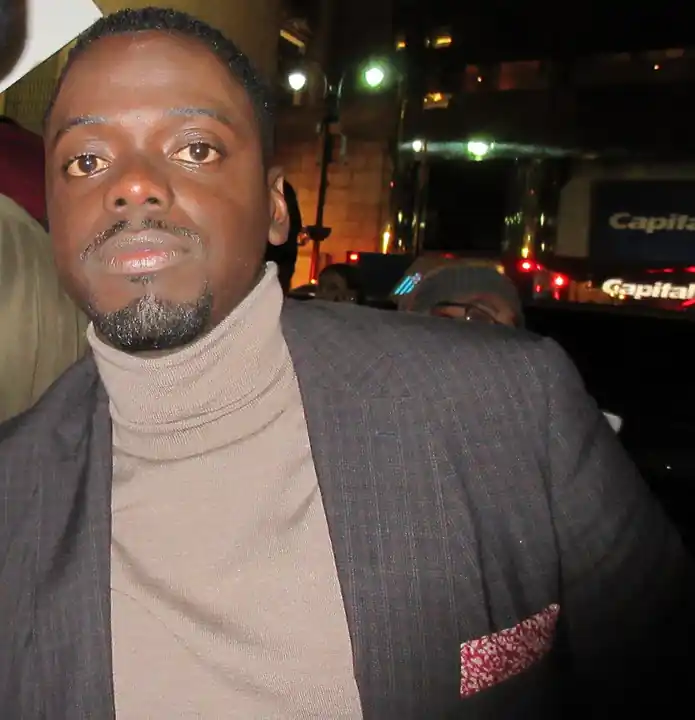
Daniel Kaluuya said he could relate to the party environment. He says: "That party scene was just like 'Ah, I've been to that party. I go to that party.' Like, this kind of racism that isn't seen as racism, that isn't seen as mainstream racism. It's just life, and exploring that is quite an uncomfortable conversation and Jordan just told the truth. He cinematically articulated an experience that millions of people have, and made them feel crazy for having it. But he just said 'No, actually you're not crazy.'".
Get Out (2017): Chris WashingtonImage: Wikimedia Commons · Greg2600, CC BY-SA 2.0 - #013
Contains a major spoiler — show
Allison Williams, who shot her scenes after Rose's evil is revealed, isolated herself from the other actors during breaks to get into the mindset of a cold-hearted sociopath. This was hard for her because she had grown close to the other actors, especially Daniel Kaluuya.
- #014
The original film score was created entirely by Michael Abels, who had never worked on a film before but specialized in traditional concert music with influences of blues, jazz and African music. Jordan Peele found one of Abels's orchestral compositions, "Urban Legends," on YouTube and decided "this guy could terrorize some people in this movie."
- #015
Contains a major spoiler — show
While writing the scene in which Chris is under hypnosis for the first time, Jordan Peele eventually cried. He says: "There was a point where I got to a very sensitive place in the process. The fun turned into tears. So while writing about Chris under hypnosis and The Sunken Place, I ended that day in tears, and it was something cathartic. I couldn't describe it as fun."
- #016
Although Get Out was shot in Alabama, Jordan Peele stressed that the story should not be understood as taking place in Alabama or anywhere in the South. In a February 2017 interview with Bethonie Butler in the Washington Post, Peele said he deliberately avoided setting the film in red-state territory: "It was really important to me that the villains in this film don't represent the typical red-state type that is usually classified as racist. I felt that was too easy," he said. "I wanted this film to explore the false sense of security it might have with a sort of New York liberal type." A 2017 article by Geoff Herbert in the Syracuse (NY) Post-Standard states that the film is set in Upstate New York.
- #017
Contains a major spoiler — show
Knowing that spoilers would be inevitable in order to highlight the film's horror and action scenes, Jordan Peele made suggestions to the marketing team regarding the theatrical trailer. He successfully lobbied against showing the scene with Rose and the keys.
- #018
Contains a major spoiler — show
At around 26 minutes, after the family dinner at which Jeremy tries to do martial arts with Chris, Rose says that Jeremy was about to put him in a chokehold. It is later revealed that Jeremy was the one who abducted André using the naked shock from behind. He tries to subdue Chris with the same move.
- #019
Contains a major spoiler — show
In the DVD commentary, writer, co-producer and director Jordan Peele explained that he created an extensive backstory for the Armitages' group of friends. They belong to an ancient secret society descended from the Knights Templar, who are associated in popular culture with the Holy Grail. For centuries they sought the eternal life promised by the Holy Grail, and they finally achieved it through the Coagula procedure. This also explains the significance of the knight's helmet Jeremy has in the opening scene in which he abducts André.
- #020
Contains a major spoiler — show
In mid-October 2017, Jordan Peele surprised students in a UCLA class titled "Sunken Place: Racism, Survival, and Black Horror Aesthetic," a course created after the film's success and popularity. With the help of Tananarive Due, a university professor at UCLA, Peele secretly sat in the back row while the lecture was in progress. Professor Due asked the question "What do you think the director was trying to say about the coveting of black bodies?" when Peele raised his hand, which both surprised and delighted the class when they recognized him. As he walked to the front of the class, students gave him loud applause and a standing ovation, and Peele eventually began lecturing the students. Those moments were briefly recorded and shared on Twitter.
- #021
Around Christmas 2017, a user on Twitter asked director Jordan Peele whether the film was a Christmas movie, and Peele jokingly tweeted: "Let's see... a man with a white beard, multiple deer, a fireplace, a bunch of snowflakes, and a man named Chris descending into a dark hole! I'd say go for it!"
- #022
Rod Williams, a TSA agent, is a rather likable character. Peele said he has a general affection for TSA screeners and does not see them merely as annoyances at the airport, and various Key and Peele (2012) sketches centered on TSA agents in various settings.
- #023
Contains a major spoiler — show
Regarding the meaning of the Sunken Place, Jordan Peele said: "The Sunken Place means we're marginalized. No matter how hard we scream, the system silences us."
- #024
Contains a major spoiler — show
At around 42 minutes, before the auction, the man who was a professional golfer wants to see Chris's physique. He does this because he is deciding whether to bid on Chris. This is the same reason the wife of a dying man (who has an oxygen tube) asks whether sex with a black man is better.
- #025
Contains a major spoiler — show
At around 18 minutes, during the tour, Dean (Bradley Whitford) says: "We hired Georgina and Walter to help care for my parents. When they died, I couldn't bear to let them go." There is an antecedent-pronoun shift here, and it is intentional. He could not bear to let "them" go, meaning his parents, not Georgina (Betty Gabriel) and Walter (Marcus Henderson).
- #026
Jordan Peele directed scenes in the film while doing impressions of Tracy Morgan, Forest Whitaker and Barack Obama.
- #027
Contains a major spoiler — show
In one of the proposed endings, Rod would finally find Chris after searching for him for months. Regarding this ending, director Jordan Peele says: "There was a period where there was a gated community and we see Chris escaping. But just before he escapes, he faces some kind of final test whose outcome we don't know." He goes on to say, "We cut to Rod a few months later, entering a gated community, driving down the main street, and we see Chris just looking at a reflection in a window. And he says, 'Chris, I've been looking for you. Are you okay?' And Chris turns to him and says, 'I assure you, I don't know who you're talking about.'" This ending was considered by Peele but ultimately rejected and never filmed because of its extremely ambiguous and bleak nature.
- #028
Contains a major spoiler — show
On Late Night with Seth Meyers (2014), Allison Williams (Rose) said that many white viewers of the film struggled to understand or accept her character's evil: "They're like, 'She was hypnotized, right?' And I'm like, no! She's a monster! How hard is it to accept that? She's evil! We gave you so many ways to know she's evil! She has photos of people whose lives she ruined. She hangs them on the wall behind her as soon as she can. It's so crazy! And they're still like, 'But maybe she's a victim too?' And I'm like, 'No! No!' And I say that a hundred percent of the people who tell me this are white."
- #029
Contains a major spoiler — show
(At about the 17th minute) When Dean first shows Chris the kitchen, he mentions that it was his mother's favorite room in the house and tells him: "We like to keep a piece of her in the house." This is also his first meeting with Georgina. Rose later refers to Georgina as "Grandma" in the scene where the car Chris is driving hits Georgina.
- #030
Contains a major spoiler — show
Missy (Catherine Keener) controls her people with a silver spoon, synonymous with privilege.
- #031
(At about the 10th minute) Jordan Peele made the sound of the car hitting the deer.
- #032
Contains a major spoiler — show
The surname "Armitage" is a tribute to twentieth-century horror writer H. P. Lovecraft: it is the surname of the protagonist in Lovecraft's story The Dunwich Horror. Although the Armitage family are the villains in this film, the use of the name reflects the film's respect for elements of Lovecraft's stories: degenerate New England families with ties to occult or secret societies, the transmigration of souls from one body to another, shifting states of reality, and so on. Lovecraft was also known to be racist against Black people.
- #033
Contains a major spoiler — show
(At about the 52nd minute) When Chris begins to suspect that things are going wrong and is talking with Georgina in the bedroom, part of a poster forming the words "Chris is dead" is visible on the wall over his shoulder.
- #034
Contains a major spoiler — show
Throughout the main part of the film, Walter and Logan always wear hats, and Georgina's hair always has bangs to cover the scar left by the brain surgery in Coagula. In the ending scene, the scar is visible on Georgina's head in the car (because her bangs are up) and on Walter's head (because he is not wearing his hat).
- #035
Contains a major spoiler — show
(At about 25 minutes) During the dinner scene, Jeremy mocks Chris for taking judo lessons and praises jiu jitsu as superior, because like chess, jiu jitsu forces a person to think three steps ahead. In the end, while trying to escape Jeremy's clutches (at about 1 hour 30 minutes), Chris makes two attempts to open the front door, but Jeremy kicks the door shut. On the third attempt, Chris outplays Jeremy at his own game by anticipating that Jeremy will kick the door again and stabbing him in the leg.
- #036
Contains a major spoiler — show
(At about the 11th minute) Chris insists on stopping the car to check on the injured deer. The deer is still barely alive, and Chris appears intensely focused on the animal. As is later revealed in the story, Chris's mother was killed this way. A hit-and-run. His mother died alone by the side of the road.
- #037
(At about 18 minutes) In a 2019 interview with GQ Magazine, Bradley Whitford stated that he initially thought the line in this film, "By the way, I would've voted for Obama for a third term if I could," was sincere and not a joke as director Jordan Peele intended.
- #038
Contains a major spoiler — show
According to Jordan Peele, the large number of racist incidents and crimes during the Obama administration, which created the myth of a "post racial America," inspired him to write this film. He explained: "As an African-American, I never saw my own perspective in a horror film. (Get Out) realized my greatest fears as a black man in this country; from the demonic white girl who lies to you to the lacrosse stick, these are foreign to me."
- #039
In a speech at the Directors Guild Awards, Jordan Peele revealed that before directing this film he had been offered the role of voicing the Poop Emoji in The Emoji Movie (2017). Peele said of the situation: "that's fucked up".
- #040
Contains a major spoiler — show
(At about 2 minutes) The song playing in Jeremy's white car when André is abducted, and which finally plays as Chris escapes, is the 1939 British song "Run Rabbit Run," performed by the duo Flanagan and Allen. The song was popular during World War II and became even more popular when the duo changed the lyrics to "Run Adolf, Run" to mock the Nazis.
- #041
Contains a major spoiler — show
"Coagula," the name of the mind-transfer procedure, means "it joins" in Latin. It is better known as half of the alchemical maxim "solve et coagula" ("it separates and it joins," that is, how alchemy transforms matter) and, like the knight's helmet, points to the ancient roots of the nameless body-snatchers' community.
- #042
Jordan Peele stated that he never thought this film would be made and that he wrote the script while he was in a fragile state.
- #043
While filming Black Panther (2018), Daniel Kaluuya took part in the "Get Out Challenge" on set. His co-stars Lupita Nyong'o, Michael B. Jordan and other cast and crew members ran toward him and made sharp turns at the last minute. Kaluuya acted frightened as his character would and quickly moved away while Donald Glover's song "Redbone" played. Nyong'o posted the challenge on her Instagram account.
- #044
Contains a major spoiler — show
(At about the 52nd minute) After explaining why he unplugged Georgina's cell phone, Chris apologizes to her. He tells her he did not mean "snitch." Georgina does not seem to understand. He then uses the term "rat out," but the woman still does not understand. She asks whether he means "tattletale." The reason later becomes clear. Since Georgina is actually Rose's grandmother, she probably would not understand more current slang and would understand only the traditional term "tattletale."
- #045
Despite winning the Oscar for Best Original Screenplay, much of the film was improvised.
- #046
Contains a major spoiler — show
(Around 1 hour 13 minutes) Director Jordan Peele said he asked Richard Herd (Roman Armitage) to think of the scene as "a Viagra commercial trying to hide deep anger." "It feels like every Viagra commercial to me!" He absolutely pulled it off.
- #047
The scenes in which Chris Washington's friend, TSA agent Rod Williams, stands outside the airport were shot in front of a boat terminal, and they were the first scenes filmed.
- #048
The trailer included a brief scene featuring the deer skeleton that does not appear in the final cut of the film.
- #049
Contains a major spoiler — show
In the film, the Sunken Place is an endless, silent void. In the original screenplay, the Sunken Place actually had sound and a floor.
- #050
Contains a major spoiler — show
Rose's parents both have first names that are also words expressing positions of power over others. Rose's father, Dean, shares his name with words meaning "the head of a division or grouping of departments in a university" and "a supervisor of a diocese or other regional unit in church hierarchies." "Missy" is a shortening of the term "mistress," as in a slave-owning white woman married to a man who owned a plantation in the pre-war American South.
- #051
(At about 55 minutes) As in Us (2019) and Nope (2022), a character says the name of this film when a situation becomes tense.
- #052
Contains a major spoiler — show
The story has much in common with H. G. Wells's "The Story of the Late Mr. Elvesham," in which an old, dying man traps a young, healthy student and swaps bodies with him. Wells's story was first published in May 1896.
- #053
Contains a major spoiler — show
(At about the 5th minute) In the opening scene with Chris and Rose together, there are two foreshadowing elements. When Chris is first shown, he is spreading shaving cream all over his face ("white face"). Rose jokes that her father will not meet him on the driveway with a shotgun. In the final scenes, Rose is the one who tries to kill Chris on the driveway with a gun in her hands.
- #054
After the film was released, it received a rare 100% Fresh rating on the Rotten Tomatoes website, though the score dropped somewhat over time.
- #055
Director Paul Thomas Anderson, a fan of director Jordan Peele's television work, was shooting Phantom Thread (2017) in London during the winter. During a troubled and miserable period, the director went to see this film. Anderson was inspired by the film and said that, ironically, it made him feel a connection to his homeland, America. Peele later watched Phantom Thread, Anderson's film that had genuinely affected him. Anderson would later interview Peele about his latest horror film, Us (2019), in Fangoria magazine.
- #056
The detective Rodney visits is named Latoya Peele.
- #057
Contains a major spoiler — show
Except for Rose, most of the Armitages die primarily from head or upper-body injuries. For example: * Dean Armitage dies when the antler of a mounted deer head pierces his throat. * Missy Armitage is stabbed through the eye and into her brain. * Jeremy Armitage dies when Chris crushes his head with a boot. * Georgina/Marianne Armitage dies while attacking Chris when, because she is not wearing a seatbelt, the force of a traffic accident fatally fractures her skull. * Walter/Roman Armitage dies after Walter regains consciousness thanks to a camera flash and commits suicide by shooting himself in the head with a shotgun. * Although he is not a member of the Armitage family, Jim Hudson's head and skull are recorded as having been surgically opened, after Dean Armitage is stabbed in the throat and one of the burning candles accidentally falls to the floor, setting the entire operating room on fire. In the end, while he is still under anesthesia, with the top of his head open and his brain exposed, the fire engulfs and kills him.
- #058
(At about 2 minutes) The music of the song in the abduction scene, "Run, Rabbit, Run," was written by the English composer Noel Gay, whose birth name was Reginald Armitage, connecting him to the Armitage family in the film.
- #059
At about the 46-minute mark, while Chris is talking with Jim Hudson at the party, Daniel Kaluuya's British accent can briefly be heard.
Get Out (2017): Chris Washington, conversation sceneImage: Wikimedia Commons · Ted Eytan, CC BY-SA 2.0 - #060
Daniel Kaluuya appeared in Johnny English Reborn (2011). In one scene he exposes the villain, but Johnny English (Rowan Atkinson) does not believe him and shouts "get out" at him. In the same scene, the villain uses the word "Armitage" — the family name in this film — as the name of a fictitious organization.
- #061
Contains a major spoiler — show
At about 1 hour and 35 minutes, near the end of the film, Chris begins to strangle Rose, but then stops and leaves her to die alone on the road, just as her mother did.
- #062
Daniel Kaluuya is the first actor from the Black Panther (2018) cast to work with Jordan Peele. The other actors in that cast are Lupita Nyong'o and Winston Duke, who appeared in Peele's second film, Us (2019).
- #063
While Jeremy is in the hallway, he passes a photograph of the Fuller Court, which established the "separate but equal" doctrine in Plessy v. Ferguson, a ruling that would be added to justify discrimination against African Americans in the South.
- #064
Contains a major spoiler — show
The dark events at the Armitage house are highlighted in two characters: Walter is a championship-caliber runner (just like Roman Armitage, who lives in his body), and Jeremy is an MMA practitioner, which allows him to quickly and without physical harm render abducted victims (such as Andre) unconscious.
- #065
Contains a major spoiler — show
The blind man, Jim, wants Chris for his eyes. In the BBC black comedy series Psychoville (2009), Daniel Kaluuya played Tealeaf, a character who looks after a blind man and serves as his eyes.
- #066
The film is the first collaboration between director Jordan Peele and actor Daniel Kaluuya. Their second collaboration was Nope (2022).
- #067
It is included among Letterboxd's Top 250 Horror Films.
Production Story (90)
- #068
Contains a major spoiler — show
At around 1 hour 13 minutes, the video explaining the Coagula procedure that Chris watches was not originally in the script. Jordan Peele initially planned for Chris to be forced to listen to James Taylor's "You've Got a Friend" over and over, but the film's budget could not cover the licensing rights. Peele said he preferred the video version and that it reminded him of the Dharma Initiative videos from Lost (2004) and the scene in The Matrix (1999) where Morpheus explains the truth about reality to Neo. Peele also said: "[From the video] you get that feeling: 'Oh my God! There's something manufactured; it goes that deep; we're only seeing the tip of the iceberg.'".
- #069
Contains a major spoiler — show
The film's opening scene was longer as originally written. In the first draft of the screenplay, a white family is eating dinner and talking about Disneyland while André is abducted in front of their house without their knowledge. Jordan Peele ultimately cut this detail because he did not want to stray from the scene's main focus.
- #070
In an interview with Jason Guerrasio, Jordan Peele said the decision to shoot the film in Fairhope and Mobile, Alabama, came at the last minute and was necessary because of budget cuts: "Until about a month before we started shooting, we were going to shoot this film here in Los Angeles, and then I got a phone call saying we had to find somewhere else because of taxes. It was a massive setback and a real lesson that blessings sometimes come in strange packages. Because I think the film turned out the way it was supposed to. If we had done it here in Los Angeles, it would not have been a better film. It's also a great lesson that you can overcome the insurmountable."
- #071
(Around the 12th minute) While Rose argues with the police officer about showing ID, she does not defend Chris; she avoids a paper trail. If the officer had checked both of their licenses, there would have been a record that Chris and Rose were together before they disappeared.
- #072
After a successful audition, Daniel Kaluuya was given the lead role. Writer, co-producer and director Jordan Peele said that Kaluuya shot an important scene in which his character needs to cry about five times, and each take was so perfect that a single tear rolled at the same moment in every take.
- #073
Jordan Peele directed Allison Williams to think of her role as two completely separate characters: Chris's fun and loyal girlfriend "Rose" and the cruel and heartless sociopath "RoRo". He said that in the scene where she talks on the phone with Rod (Lil Rel Howery), he was most worried about her ability to play both at once, carrying RoRo's face and mannerisms while making sounds like Rose. Peele added that it was absolutely important for the audience to believe at the beginning of the film, without any doubt, that Rose and Chris were in love.
- #074
(Around 1 hour 13 minutes) The video explaining the Coagula procedure that Chris watches was not originally in the script. Jordan Peele had initially planned for Chris to be forced to listen to James Taylor's "You've Got a Friend" over and over, but the film's budget could not cover the licensing rights. Peele said he preferred the video version and that it reminded him of the Dharma Initiative videos from Lost (2004), as well as the scene in The Matrix (1999) where Morpheus explains the truth about reality to Neo. Peele also said: "[From the video] you get that feeling: 'Oh my God! There's something manufactured; it goes that deep; we're only seeing the tip of the iceberg.'"
- #075
(Around 30 minutes in) Director Jordan Peele suggested that the scene where Walter (Marcus Henderson) runs toward Chris (Daniel Kaluuya), with viewers running at full speed, is a nod to the power of depth in films. He cited North by Northwest (1959) as an example of this technique and stated: "Somebody running at you or towards you just creates a visceral and physical reaction for the audience."
- #076
In an interview with Bradley Whitford on National Public Radio's "Wait, Wait Don't Tell Me!" program, Whitford explained that Jordan Peele wanted him for the role of Dean Armitage because of his role as Josh Lyman on The West Wing (1999). Whitford said Peele wanted all members of the Armitage family to have their own distinctive "white liberal feel".
- #077
(Around the 30th minute) Roman Armitage never got over losing to Jesse Owens at the 1936 Berlin Summer Olympics and continues to run in Walter's body. In the DVD commentary, director Jordan Peele confirmed that Walter/Roman would run at night, trying to improve his time, as seen when he runs directly toward Chris (Daniel Kaluuya). Near the end of the film, when Walter/Roman is about to kill Chris, Peele considered giving him the line "I finally beat you, Jesse!" but decided against it, thinking it would be over the top.
- #078
Jordan Peele said the only scene Daniel Kaluuya struggled with was the one by the lake where Chris and Rose stop to talk, and they were under pressure to shoot it quickly because the sun was setting. Kaluuya could not understand his character's motivation for immediately leaving her and running to save his own life after everything he had been through, and André had shouted at him to get out. Peele explained that Rose had become like family to Chris, who still felt guilty over his mother's death, and that he needed to prove to himself and to her that he was not a man who would abandon his family. Kaluuya later managed to nail the scene.
- #079
When writer, co-producer and director Jordan Peele was asked whether Universal Pictures wanted a sequel to this film, he said: "Of course they have. It was the first thing they said: 'Let's do a sequel.'" He continues: "Honestly, I'm open to it… but I won't make a sequel just to make cash. If it's right, if it feels good and I feel I can beat the original, I'll do it."
- #080
(At around 1 hour 11 minutes) The voice that says "a mind is a terrible thing to waste." also provides the sounds of the dying deer.
- #081
The main theme, "Sikiliza Kwa Wahenga", was sung in Swahili, except for the English word "brother", which composer Michael Abels felt had a special, universal meaning among Black people that needs no translation. According to Abels, the voices in the song represent the spirits of Black slaves and lynching victims trying to warn Chris to run. The translation of the lyrics is as follows: "Brother, run! Listen to the elders. Listen to the truth. Run away! Save yourself."
- #082
(At around 1 hour 30 minutes) Jordan Peele's comedy partner played one of the "Top NCAA Prospects" Rose (Allison Williams) looks up online.
- #083
(At around the 42nd minute) Another hint that something is wrong is that the guests warmly hug and greet the gardener Walter when they first arrive at the party. If you didn't know that Walter's body had been taken over by the clan's patriarch Roman Armitage, this would be very unusual behavior.
- #084
While shooting the hypnosis scenes between Chris and Missy, Jordan Peele used The Silence of the Lambs (1991) as inspiration. The confrontations between Clarice Starling and Dr. Hannibal Lecter, shot in close-ups with the characters looking directly at the camera, shaped Peele's style in these scenes.
- #085
(At around 32 minutes) Missy (Catherine Keener) is not worried about Chris (Daniel Kaluuya) smoking in front of her daughter, because it will make his body less attractive to potential bidders.
- #086
Daniel Kaluuya said he could relate to the party environment. He says: "That party scene was just like 'Oh, I've been to that party. I go to that party.' Like, this kind of racism that isn't seen as racism, that isn't seen as mainstream racism. It's just life, and exploring it is quite an uncomfortable conversation, and Jordan just told the truth. He cinematically articulated an experience millions of people have had and made them feel crazy for having it. But he just said, 'No, actually you're not crazy.'"
- #087
Allison Williams, who shot her scenes after Rose's evil is revealed, isolated herself from the other actors during breaks to get into the mindset of a cold-hearted sociopath. This was hard for her, as she had grown close to the other actors, especially Daniel Kaluuya.
- #088
The original score music was created entirely by Michael Abels, who had never worked on a film before but specialized in traditional concert music with influences of blues, jazz and African music. Jordan Peele found one of Abels's orchestral compositions, "Urban Legends", on YouTube and decided "this guy could terrorize some people in this movie."
- #089
Jordan Peele ended up crying while writing the scene in which Chris is under hypnosis for the first time. He says: "There was a point in the process where I got to a very sensitive place. The fun turned into tears. So while writing about Chris under hypnosis and The Sunken Place, I ended that day crying, and it was cathartic. I couldn't describe it as fun."
- #090
Although the film was shot in Alabama, Jordan Peele stressed that the story should not be understood as taking place in Alabama or anywhere in the South. In a February 2017 interview with Bethonie Butler in the Washington Post, Peele said he "deliberately avoided setting the film in red-state territory. 'It was really important to me that the villains in this film not reflect the typical red-state type that is generally classified as racist. I felt that was too easy,' he said. 'I wanted this film to explore the false sense of security it might have with a sort of New York liberal type.'" A 2017 Geoff Herbert article in the Syracuse (NY) Post-Standard notes that the film is set in Upstate New York.
- #091
Knowing that spoilers would inevitably be given in order to highlight the film's horror and action scenes, Jordan Peele made suggestions to the marketing team about the theatrical trailer. He successfully lobbied against showing the scene with Rose and the keys.
- #092
(At about 26 minutes) After the family dinner, where Jeremy tries to do martial arts with Chris, Rose says that Jeremy was about to put him in a chokehold. It is later revealed that Jeremy was the one who abducted André from behind using the naked shock. He tries to subdue Chris with the same move.
- #093
The film's opening scene was originally longer as written. In the first draft of the script, a white family is eating dinner and talking about Disneyland while André is abducted in front of their house without their knowledge. Jordan Peele ultimately omitted this detail because he did not want to stray from the scene's main focus.
- #094
In the DVD commentary, writer, co-producer and director Jordan Peele explained that he created an extensive backstory for the Armitages' group of friends. They belong to an ancient secret society descended from the Knights Templar, who are associated with the Holy Grail in popular culture. For centuries they sought the eternal life promised by the Holy Grail, and they finally achieved it through the Coagula procedure. This also explains the significance of the knight's helmet Jeremy has in the opening scene in which he abducts André.
- #095
In mid-October 2017, Jordan Peele surprised students in a UCLA class titled "Sunken Place: Racism, Survival, and Black Horror Aesthetic," a course created after the film's success and popularity. With the help of Tananarive Due, a university professor at UCLA, Peele secretly sat in the back row while the lecture was in progress. Professor Due asked the question "What do you think the director was trying to say about the coveting of black bodies?" when Peele raised his hand; this both surprised and delighted the class when they recognized him. As he walked to the front of the class, the students gave him a big round of applause and a standing ovation, and Peele eventually began lecturing the students. Those moments were briefly recorded and shared on Twitter.
- #096
In an interview with Jason Guerrasio, Jordan Peele said that the decision to shoot the film in Fairhope and Mobile, Alabama, came at the last minute and was necessary because of budget cuts: "Until about a month before we started shooting, we were going to shoot this film here in Los Angeles, and then I got a phone call saying we had to find another place because of taxes. It was a huge setback and a real lesson that blessings sometimes come in strange packages. Because I think the film turned out the way it was supposed to be. If we had done it here in Los Angeles, it would have been a better film. It's also a great lesson that you can overcome what seems insurmountable."
- #097
In the scenes where Chris and Rod talk to each other on the phone, the actors were not actually talking to each other on the phone; instead they were talking to writer, co-producer and director Jordan Peele.
- #098
Around Christmas 2017, a user on Twitter asked director Jordan Peele whether the film was a Christmas film, and Peele jokingly tweeted: "Let's see... a man with a white beard, multiple deer, a fireplace, lots of snowflakes, and a man named Chris descending into a dark hole! I'd say go ahead!"
- #099
Rod Williams, a TSA agent, is a rather likable character. Peele said that he has a general affection for TSA screeners and does not see them merely as annoyances at the airport, and various Key and Peele (2012) sketches centered on TSA agents in various settings.
- #100
(Around the 42nd minute) Before the auction, the man who was a professional golfer wants to see Chris's physique. He does this because he is deciding whether to make an offer on Chris. This is the same reason a dying man's wife (the one with the oxygen tube) asks whether sex with a black man is better.
- #101
A mix of practical effects and CGI was used for the Sunken Place sequences. Daniel Kaluuya was attached to wires and was floating in front of a black background.
- #102
(Around the 18th minute) During the tour, Dean (Bradley Whitford) says: "We hired Georgina and Walter to help care for my parents. When they died, I couldn't bear to let them go." There is an antecedent-pronoun shift here, and it is intentional. He could not bear to let "them" go as in his parents, not Georgina (Betty Gabriel) and Walter (Marcus Henderson).
- #103
In one of the proposed endings, Rod would search for Chris for months and finally find him in a predominantly white neighborhood. Regarding this ending, director Jordan Peele says: "There was a time when there was a gated community and we see Chris escaping. But just before he escapes, he faces some kind of final test whose outcome we don't know." He goes on to say, "We cut to Rod a few months later, we entered a gated community, we went down the main street and we saw Chris just looking at a reflection in a window. And he said: 'Chris, I've been looking for you. Are you okay?' And Chris turned to him and said: 'I assure you, I don't know who you're talking about.'" This ending was conceived by Peele but ultimately rejected and was never filmed due to its extremely ambiguous and bleak nature.
- #104
Jordan Peele said the film puts the audience in the place of the main character, Chris Washington. "When you watch this movie, you are Chris. The power of the story encourages empathy. It lets us see other people's lives."
- #105
On Late Night with Seth Meyers (2014), Allison Williams (Rose) said that many white viewers of the film had difficulty understanding or accepting the evil of her character: "They say, 'She was hypnotized, right?' and I say no! She's a total demon! How hard is it to accept that? She's evil! We gave you so many ways to understand that she's evil! She has photos of people whose lives she ruined. As soon as she can, she hangs them on the wall behind her. It's so crazy! And they still say, 'But maybe she's a victim too?' and I say, 'No! No!' and I say that the people who tell me this are one hundred percent white."
- #106
(Around the 17th minute) When Dean first shows Chris the kitchen, he mentions that it was his mother's favorite room in the house and tells him: "We like to keep a piece of her in the house." This is also his first meeting with Georgina. Rose later refers to Georgina as "Grandma" in the scene where the car Chris is driving hits Georgina.
- #107
Missy (Catherine Keener) controls her people with a silver spoon, which is synonymous with privilege.
- #108
(Around the 10th minute) Jordan Peele made the sound of the car hitting the deer.
- #109
The poorly paced alternative ending that was filmed and included as bonus material on physical media had the police show up instead of Rod. Chris is arrested, and when Rod talks to him in prison, Chris's hypnosis prevents him from telling the details of what happened, but Chris says that he prevented the Armitages from carrying out their actions again. They part gloomily as Chris is taken back to his cell with the assumption that he will spend the rest of his life in prison.
- #110
The surname "Armitage" is a tribute to twentieth-century horror writer H. P. Lovecraft: it is the surname of the protagonist in Lovecraft's story The Dunwich Horror. Although the Armitage family are the villains in this film, the use of this name reflects the film's respect for elements in Lovecraft's stories: degenerate New England families with ties to occult or secret societies, the transmigration of souls from one body to another, shifting states of reality, and so on. Lovecraft was also known to be racist against Black people.
- #111
(Around the 52nd minute) When Chris begins to suspect that things are going wrong and is talking with Georgina in the bedroom, part of a poster forming the words "Chris is dead" is visible on the wall over his shoulder.
- #112
Jordan Peele said: "I wrote 'Get Out' as something that had to be made. I wrote it more as something that would be fun to write and would help me get better as an artist. So I didn't have a deadline for myself. Now that I know this kind of film works, I can give it more purpose. For example, I know I can get it made, so rather than it being an ongoing project where I don't know if anyone will ever see it, let's move forward with that goal in mind."
- #113
Slavery references: it features imagery shared quite openly with slave auctions, such as the "bingo game" and the leather straps on the chair. When Chris tears out the inner material of the leather chair, he is literally saved by "picking cotton." Although most chairs today are filled with polyester fiber, director Jordan Peele confirmed that they made a seat filled with cotton fiber to preserve the symbolism.
- #114
In light of the film receiving four major Oscar nominations, Lil Rel Howery explained in an interview on Jimmy Kimmel Live that he was not invited to the Oscars. Jimmy Kimmel, who hosted the ceremony, also stated that he would get him into the ceremony. Howery said, "We called and they were looking for my ticket and they said: 'Oh, you're not in the first group. I'm not on that list for the first tickets they gave out!'" Kimmel responded saying, "Listen, I'll get you in, don't worry. I'm the host. You had a big role in that film. It's not like you had a small scene."
- #115
In a February 2018 oral history piece on the making of this film in New York Magazine, Jada Yuan and Hunter Harris reported that Marcus Henderson (the groundskeeper Walter/Roman Armitage) revealed that many of the actions he performed were deliberately "absurd by nature": 'Who tries to clean an entire estate? That's crazy! Who tries to use just one of those old-fashioned push lawn mowers?… You automatically assumed he was a gardener because he was doing gardening, but when we looked at him in detail, it didn't make any sense.' Jordan Peele said that he inserted this detail as a "hidden reference" to hint at the fact that "Walter" is not actually a gardener or someone used to any kind of manual labor, because his consciousness really resembles Roman Armitage.
- #116
Director Jordan Peele decided to change the ending to a morale-boosting and satisfying one after thinking about Trayvon Martin and many other tragic cases involving African Americans or people in similar positions killed by law enforcement. At a special screening, Peele observed the audience's reactions and their responses to the end of the film. He notes that at the end of the film, the audience gave loud applause and cheers when they saw Rod.
- #117
(Around 25 minutes) In the dinner scene, Jeremy mocks Chris for taking judo lessons and praises jiu jitsu as superior because, like chess, jiu jitsu forces a person to think three steps ahead. In the end, while trying to escape Jeremy's clutches (around 1 hour 30 minutes later), Chris makes several attempts to open the front door, but Jeremy kicks the door shut each time. On the final attempt, Chris outplays Jeremy at his own game by anticipating that Jeremy will kick the door again and stabbing him in the leg.
- #118
(Around the 11th minute) Chris insists on stopping the car and going to check on the injured deer. The deer is still barely alive, and Chris seems intensely focused on the animal. As the story later reveals, Chris's mother was killed this way. A hit-and-run. His mother died alone on the side of the road.
- #119
(Around 18 minutes) In a 2019 interview with GQ Magazine, Bradley Whitford stated that he initially thought the line in this film, "By the way, I would've voted for Obama for a third term if I could." was sincere and not a joke as director Jordan Peele intended.
- #120
According to Jordan Peele, the large number of racist incidents and crimes during the Obama administration, which created the myth of a "post racial America," inspired him to write this film. He explains: "As an African-American, I never saw my own point of view in a horror film. (Get Out) realized my greatest fears as a black man in this country; from the demonic white girl who lies to you to the lacrosse stick, those things are familiar to me."
- #121
In his speech at the Directors Guild Awards, Jordan Peele revealed that before he directed this film, he was offered the role of voicing the Poop Emoji in The Emoji Movie (2017). Peele said of the situation: "that's fucked up".
- #122
(At about 1 hour 11 minutes) Jordan Peele provided the voice heard repeatedly in the trailer and once in the film, saying "A mind is a terrible thing to waste". This statement is the slogan of the United Negro College Fund, a charity dedicated to making college education more affordable for Black students. Since the Armitages preserve the minds of young, talented hosts so as not to "waste" their clients' minds, it carries an ironic double meaning in the context of the film.
- #123
(At about the 2nd minute) At the beginning of the film, Jeremy is seen wearing a knight's helmet. The helmet is also seen later in the film when Chris is in Jeremy's car (at about 1 hour 30 minutes). Jordan Peele explained that the helmet represents the family's connection to the ancient Knights Templar. Along with the various white guests who attend the party, the family are members of a cult that broke away from the Knights Templar and spent centuries perfecting the Coagula Procedure in order to achieve immortality. The Knights Templar were a powerful order of knights tasked with protecting Christian pilgrims. Their power and influence grew, but political rivalry ultimately led to their sudden elimination, and their influence quickly became insignificant. Because the cult's initiation was secret and the cult's elimination so quickly astonished many over the ages, speculation, legends and fiction were created over the centuries, leading to Peele's understanding of a mysterious ancient order with a connection to history.
- #124
The plain black-and-white cinema poster showing a cropped close-up of the protagonist's eyes is an inverted reference to the poster of La haine (1995). Both films offer contemporary examinations of cultural appropriation, othering and racism.
- #125
On the wall of Chris's kitchen is a picture of a white girl wearing a black mask. This foreshadows the theme of white people wanting "the African-American experience", and likewise the house's guests who wear black and drive black cars. The abductor is a white man in a black mask who abducts Black men in a white car.
- #126
(At about 2 minutes) The song playing in Jeremy's white car when André is abducted, and which finally plays as Chris escapes, is the 1939 British song "Run Rabbit Run", performed by the duo Flanagan and Allen. The song was popular during World War II and became even more popular when the duo changed the lyrics to "Run Adolf, Run" to mock the Nazis.
- #127
"Coagula", the name of the mind transfer procedure, means "it joins" in Latin. It is better known as half of the alchemical maxim "solve et coagula" ("it separates and it joins", that is, how alchemy transforms matter) and, like the knight's helmet, points to the ancient roots of the nameless body-snatchers' community.
- #128
While filming Black Panther (2018), Daniel Kaluuya took part in the "Get Out Challenge" on set. His co-stars Lupita Nyong'o, Michael B. Jordan and other cast and crew members ran toward him and made sharp turns at the last minute. Kaluuya acted frightened as his character required and quickly moved away while Donald Glover's song "Redbone" played. Nyong'o posted this challenge on her Instagram account.
- #129
(At about the 52nd minute) After Chris explains why he unplugged Georgina's cell phone, he apologizes to her. He tells her he didn't mean "snitch". Georgina doesn't seem to understand. He then uses the term "rat out", but the woman still doesn't understand. She asks if he means "tattletale". The reason later becomes clear. Since Georgina is actually Rose's grandmother, she probably would not understand more current slang and would only understand the traditional term "tattletale".
- #130
(Around 1 hour 13 minutes) Director Jordan Peele stated that he asked Richard Herd (Roman Armitage) to think of the scene as "a Viagra commercial trying to hide deep anger." 'It feels like every Viagra commercial to me!' Then he absolutely nailed it."
- #131
(Around 1 hour 6 minutes) Jordan Peele claimed that shooting the key scene was the most difficult scene, because they had to complete it in one day and he did not have time to rehearse with the actors as he normally did. The actors struggled to understand how to play the scene in which Rose reveals the keys, by which Chris has already discovered her guilt in the Armitage conspiracy. Peele told them they had to trust that the rising tension and the relief would work in the finished film, and encouraged Daniel Kaluuya to channel his frustration about the scene into the character.
- #132
The scenes in which Chris Washington's friend, TSA agent Rod Williams, stands outside the airport were shot in front of a boat terminal, and were the first scenes filmed.
- #133
Dean has a lot to say about how little he cares about deer and bucks. "Black buck" was a racist slur in post-Reconstruction America directed at Black men who refused to submit to white authority.
- #134
The trailer included a short scene featuring the deer skeleton that does not appear in the final cut of the film.
- #135
(Around 1 hour 35 minutes in) After Rod finds him at the end of the film, he says to Chris: "I mean, I told you not to go in that house." This is apparently a nod to film audiences shouting at characters in horror films not to enter creepy-looking houses or places, because of prior warnings of foreboding about eerie places and surrounding environments.
- #136
In the film, the Sunken Place is a never-ending, silent void. In the original screenplay, The Sunken Place actually had sound and a floor.
- #137
Rose's parents both have first names that are also words expressing positions of power over others. Rose's father, Dean, shares his name with words meaning "the head of a division or grouping of departments in a university" and "a supervisor of a diocese or other regional unit in church hierarchies." "Missy" is a shortening of the term "mistress," like a white slave-owning woman in the antebellum South of the United States who was married to a man who owned a plantation.
- #138
(Around 55 minutes) As in Us (2019) and Nope (2022), when a situation becomes tense, a character says the name of this film.
- #139
This film inspired the creation of university courses about the film's racial themes and symbolism.
- #140
The story has a great deal in common with H. G. Wells's "The Story of the Late Mr. Elvesham," in which an old and dying man traps a young and healthy student and switches bodies with him. Wells's story was first published in May 1896.
- #141
(Around the 5th minute) In the opening scene with Chris and Rose together, there are two foreshadowing elements. When Chris is first shown, he is spreading shaving cream all over his face ("white face"). Rose jokes that her father won't meet him in the driveway with a shotgun. In the final scenes, Rose is the one trying to kill Chris in the driveway with a shotgun in her hands.
- #142
(Around 1 minute) The opening scene grows tense as André is followed by Jeremy Armitage's white Porsche. The color of the car is, of course, very deliberate, and Jordan Peele said that Jeremy's car following André is a tribute to Duel (1971), Jaws (1975) and Christine (1983) in terms of symbolizing danger.
- #143
(Around 1 hour 30 minutes) When Chris escapes the Armitage estate in the white car, he sees a medieval helmet sitting on the passenger seat. The trailer also includes a shot, not used in the film, showing a person wearing the helmet sitting in the driver's seat and holding a modern weapon. The same person can also be seen on the film's official poster. This person is implied to be Jeremy Armitage, the one who abducted André in the opening scene. The car Chris uses to escape is probably Jeremy's car, in which André was abducted.
- #144
Director Paul Thomas Anderson, a fan of director Jordan Peele's television work, was shooting Phantom Thread (2017) in London during the winter months. During a troubled and miserable period, the director went to see this film. Anderson was inspired by the film and said that, ironically, it made him feel it had established a connection between him and his homeland, America. Peele had later watched Anderson's Phantom Thread, a film that truly affected him. Anderson would later interview Peele for Fangoria magazine about his latest horror film, Us (2019).
- #145
The name of the detective Rodney visits is Latoya.
- #146
Except for Rose, most of the Armitages die primarily from head- or upper-body-related injuries. For example: * Dean Armitage dies when the antler of a mounted deer head pierces his throat. * Missy Armitage dies after being stabbed through the eye and into the brain. * Jeremy Armitage dies as a result of Chris crushing his head with a boot. * Georgina/Marianne Armitage dies when, while attacking Chris, she is not wearing a seatbelt and the excessive force of the traffic accident fatally fractures her skull. * Walter/Roman Armitage dies after Walter regains consciousness thanks to a camera flash and commits suicide by shooting himself in the head with a shotgun. * Although he is not a member of the Armitage Family, it is recorded that Jim Hudson's head and skull were surgically opened as a result of Dean Armitage being stabbed in the throat and dying, which caused one of the burning candles to accidentally fall to the floor and set the entire operating room on fire. In the end, while he was still under anesthesia, with the top of his head open and his brain exposed, the fire engulfed and killed him.
- #147
(Around 1 hour 26 minutes) The music playing during the surgical transplant procedure is a Requiem that can be described by the Latin text Tuba mirum. Assuming this is part of the score, since no source material is indicated, it can be said that both individuals die: one's body, the other's mind.
- #148
(About 2 minutes in) The music of the song in the abduction scene, "Run, Rabbit, Run," was written by the English composer Noel Gay, whose birth name was Reginald Armitage, connecting him to the Armitage family in the film.
- #149
(About 1 hour 10 minutes in) After Chris is officially "captured" and sent to the "sunken place," Rod's attempt to contact him outside the airport is cut off. In the background there is a flight announcement for "Flight 2-3-7." This may be a reference to The Shining (1980), which features Room 237 as the Overlook Hotel's most malevolent room. The Shining (1980) may also have been an inspiration because it deals metaphorically with violence and prejudice in American history. The Shining likewise intersects an isolated location with someone's attempt at a rescue.
- #150
(At about the 46th minute) Daniel Kaluuya's British accent can briefly be heard while Chris is talking to Jim Hudson at the party.
- #151
(About 1 hour 35 minutes in) At the end of the film, Chris begins to strangle Rose, but then stops and leaves her alive on the road.
- #152
(About 13 minutes in) When Rose and Chris first approach the Armitage house, they see Walter standing at the edge of the driveway, and Rose says, "that's the groundskeeper." However, she slightly distorts the word "grounds," so that it sounds more like "grands-keeper," which is fitting, because Walter and Georgina are vessels living inside stolen bodies, "keeping" Rose's "grands," her grandfather and grandmother. Dean tells Chris: "We like to keep a piece of her (Rose's grandmother) in the house."
- #153
Early in the film, when Dean calls Chris "my man" several times, it initially seems like nothing more than an awkward white father's attempt to connect with him as a Black man. However, once the film's turning point arrives and the Armitages' true motives are revealed, Dean's use of the term "my man" takes on a sinister double meaning: Dean actually intends to seize Chris's body and brain in a form of modern-day surgical slavery; he wants to possess Chris and literally make him "his man."
- #154
Universal Pictures officially launched its Oscar campaign for this film eight months after it hit theaters.
- #155
While Jeremy is in the hallway, he passes a photograph of the Fuller Court, which established the "separate but equal" doctrine in Plessy v. Ferguson, one you would add for discrimination against African Americans in the South.
- #156
The dark events in the Armitage house come to the fore in two characters: Walter is a championship-quality runner (just like Roman Armitage, who lives in his body), and Jeremy is an MMA practitioner, allowing him to quickly and without physical harm render kidnapped victims (such as Andre) unconscious.
- #157
In the original script, Jeremy drove a cream-colored Porsche Boxter instead of the white Porsche 944 that appears in the final film. Also, Rose drove a white BMW X5 instead of the red Lincoln MKC 2.0.
Behind the Scenes (2)
- #158
Contains a major spoiler — show
A mix of practical effects and CGI was used for the Sunken Place sequences. Daniel Kaluuya was attached to wires and floated in front of a black background.
- #159
Contains a major spoiler — show
(Around 1 hour 6 minutes) Jordan Peele said the key scene was the hardest to shoot, because they had to complete it in one day and he had no time to rehearse with the actors as he normally would. The actors struggled to work out how to play the scene in which Rose reveals the keys, since Chris has already discovered her guilt in the Armitage conspiracy. Peele told them to trust that the rising tension and the relief would work in the finished film, and encouraged Daniel Kaluuya to channel his frustration about the scene into the character.
Characters & Cast (3)
- #160
In an interview with Bradley Whitford on National Public Radio's "Wait, Wait Don't Tell Me!", Whitford explained that Jordan Peele wanted him for the role of Dean Armitage because of his role as Josh Lyman on The West Wing (1999). Whitford said Peele wanted every member of the Armitage family to have their own distinctive "white liberal feel".
- #161
Director Jordan Peele approached Tiffany Haddish, with whom he had worked on Keanu (2016), to audition for a role in this film. Haddish turned it down because she was "too afraid of horror films."
- #162
Director Jordan Peele performed the "Get Out Challenge" on The Tonight Show Starring Jimmy Fallon (2014), the program on which he was first introduced.
Easter Eggs & References (8)
- #163
At around 30 minutes, director Jordan Peele argued that the scene in which Walter (Marcus Henderson) runs toward Chris (Daniel Kaluuya) at full speed is a nod to the power of depth in film. He cited North by Northwest (1959) as an example of this technique and said, "Somebody running at you or towards you just creates a visceral and physical reaction for the audience."
- #164
Jordan Peele said the title is also a nod to the shouts Black audiences often hear on screen while watching horror films: shouting "Get out!" at a character. In this film, Rod and Andre say it to Chris.
- #165
Contains a major spoiler — show
In a February 2018 oral history of the film's production in New York Magazine, Jada Yuan and Hunter Harris reported that Marcus Henderson (groundskeeper Walter/Roman Armitage) revealed that many of the actions he performed were deliberately "absurd by nature": "Who tries to clean an entire estate? That's crazy! Who tries to use just one of those old-fashioned push reel mowers?… You automatically assumed he was a gardener because he was doing gardening, but when we looked at him in detail it didn't make any sense." Jordan Peele said he inserted this detail as a "hidden reference" to hint at the fact that "Walter" is not actually a gardener or someone used to any kind of manual labor, because his consciousness is really that of Roman Armitage.
- #166
The plain black-and-white cinema poster showing an extreme close-up of the protagonist's eyes is an inverted reference to the poster for La haine (1995). Both films offer contemporary examinations of cultural appropriation, othering and racism.
- #167
Contains a major spoiler — show
(Contains spoilers for Rosemary's Baby (1968).) Jordan Peele cited Rosemary's Baby as a major influence on his film, and there are several direct homages: in addition to the characters named Rose(mary) and Roman (which may also be a reference to Roman Polanski, the director of the earlier film), a Japanese man in an otherwise white group mirrors a similar character in Rosemary's Baby. Finally, the climax of both films involves the revelation that the protagonist's love interest is complicit in the conspiracy.
- #168
The film's title refers to roadside signs posted along highways at town or county lines in the United States. The signs read "GET OUT" and were aimed at African Americans, advising them to leave town before sundown in areas that practiced a form of discrimination through a combination of discriminatory local laws, intimidation and violence, excluding people of non-white races from all-white municipalities or neighborhoods in the US known as "sundown towns." In some areas these notices remained posted until the 1970s.
- #169
Contains a major spoiler — show
(Around 1 hour 35 minutes in) After Rod finds him at the end of the film, he tells Chris: "I mean, I told you not to go in that house." This is apparently a nod to film audiences shouting at characters in horror films not to enter creepy-looking houses or places, because of earlier warnings of foreboding about the places and surrounding environments.
- #170
A poster in Rose's room reads "Death Cheetah vs. Matter."
Deeper Meaning (9)
- #171
Contains a major spoiler — show
While shooting the hypnosis scenes between Chris and Missy, Jordan Peele used The Silence of the Lambs (1991) as inspiration. The confrontations between Clarice Starling and Dr. Hannibal Lecter, filmed in close-ups with the characters looking directly into the camera, shaped Peele's style in these scenes.
- #172
Contains a major spoiler — show
Slavery references: it features imagery shared quite openly with slave auctions, such as the "bingo game" and the leather straps on the chair. When Chris tears out the chair's stuffing, he is literally saved by "picking cotton." Although most chairs today are filled with polyester fiber, director Jordan Peele confirmed that they made a seat filled with cotton fiber to preserve the symbolism.
- #173
While writing and directing his first feature film, Jordan Peele cited Night of the Living Dead (1968) as an inspiration because that film had an African-American protagonist.
- #174
Contains a major spoiler — show
(At about 1 hour 11 minutes) Jordan Peele provided the voice heard on television saying "A mind is a terrible thing to waste," a line heard repeatedly in the trailer and once in the film. The phrase is the slogan of the United Negro College Fund, a charity dedicated to making college education more affordable for black students. Since the Armitages preserve the minds of young, talented hosts so as not to "waste" their clients' minds, it carries an ironic double meaning in the context of the film.
- #175
Contains a major spoiler — show
On the wall of Chris's kitchen is a picture of a white girl wearing a black mask. This foreshadows the theme of white people wanting "the African-American experience," as do the house's guests, who wear black and drive black cars. The abductor is a white man in a black mask who abducts black men in a white car.
- #176
Contains a major spoiler — show
(At about 1 minute) The opening scene grows tense as André is followed by Jeremy Armitage's white Porsche. The car's color is of course very deliberate, and Jordan Peele said that Jeremy's car following André is a tribute to Duel (1971), Jaws (1975) and Christine (1983) in that it symbolizes danger.
- #177
Contains a major spoiler — show
(At about 1 hour 30 minutes) When Chris escapes the Armitage estate in the white car, he sees a medieval helmet sitting on the passenger seat. The trailer also includes a shot, not used in the film, of a person wearing the helmet sitting in the driver's seat and holding a modern weapon. The same person can also be seen on the film's official poster. This person is implied to be Jeremy Armitage, the one who abducted André in the opening scene. The car Chris uses to escape is probably Jeremy's car, the one in which André was abducted.
- #178
Contains a major spoiler — show
(At about 1 hour 26 minutes) The music playing during the surgical transplant procedure is a Requiem that can be described by the Latin Tuba mirum text. Since no source material is indicated, assuming this is part of the score, it can be said that both individuals die: one's body, the other's mind.
- #179
Contains a major spoiler — show
About 1 hour and 10 minutes in, after Chris is officially "captured" and sent to the "sunken place," Rod's attempt to reach him outside the airport is cut off. A flight announcement for "Flight 2-3-7" plays in the background.
Career & Awards (7)
- #180
In light of the film's four major Oscar nominations, Lil Rel Howery explained in an interview on Jimmy Kimmel Live that he was not invited to the Oscars because he was not considered important enough. Jimmy Kimmel, who hosted the ceremony, also stated that he would get him into the event. Howery said, "We called and they were looking for my ticket and they said, 'Oh, you're not in the first group. I'm not on that list of first tickets they gave out!'" Kimmel responded, saying, "Listen, I'll get you in, don't worry. I'm the host. You had a big role in that film. It's not like you had a small scene."
- #181
After winning the Oscar for Best Original Screenplay, director Jordan Peele posed with his Emmy alongside the statue and said: "This is exactly what it was like watching my wife give birth."
- #182
With this film, Jordan Peele became the fifth African-American filmmaker nominated for the Best Director Oscar, after John Singleton for Boyz n the Hood (1991), Lee Daniels for Precious (2009), Steve McQueen for 12 Years a Slave (2013) and Barry Jenkins for Moonlight (2016). Peele also became the fourth filmmaker nominated for Oscars in the producing, directing and writing categories, after Orson Welles (1941) with Citizen Kane (1941) (though Welles was not listed as a producer nominee, since at the time the Best Picture award went to the studio rather than to individual producers), Warren Beatty with Heaven Can Wait (1978) and James L. Brooks with Terms of Endearment (1983).
- #183
Jordan Peele is the twenty-third filmmaker nominated for the Best Director Oscar for a directorial debut, after Orson Welles (Citizen Kane (1941)), Delbert Mann (Marty (1955)), Sidney Lumet (12 Angry Men (1957)), Jack Clayton (Room at the Top (1958)), Jerome Robbins (West Side Story (1961)), Mike Nichols (Who's Afraid of Virginia Woolf? (1966)), Warren Beatty and Buck Henry (Heaven Can Wait (1978)), Robert Redford (Ordinary People (1980)), Hugh Hudson (Chariots of Fire (1981)), James L. Brooks (Terms of Endearment (1983)), Roland Joffé (The Killing Fields (1984)), Kenneth Branagh (Henry V (1989)), Jim Sheridan (My Left Foot (1989)), Kevin Costner (Dances with Wolves (1990)), John Singleton (Boyz n the Hood (1991)), Spike Jonze (Being John Malkovich (1999)), Sam Mendes (American Beauty (1999)), Rob Marshall (Chicago (2002)), Bennett Miller (Capote (2005)), Tony Gilroy (Michael Clayton (2007)) and Benh Zeitlin (Beasts of the Southern Wild (2012)).
- #184
This is the first Universal Pictures film to win an Oscar in the screenwriting category since A Beautiful Mind (2001), and the first film to win the Academy Award for Best Original Screenplay since Tender Mercies (1983).
- #185
Contains a major spoiler — show
Early in the film, when Dean calls Chris "my man" several times, it initially seems like just an unpleasant white father's attempt to relate to him as a Black man. However, at the film's turning point, when the Armitages' true motives are revealed, Dean's use of the term "my man" takes on a malicious double meaning: Dean actually intends to take over Chris's body and brain in a modern form of surgical slavery; he wants to possess Chris and literally make him "his man."
- #186
It is the first Best Picture Oscar nominee released in February since The Silence of the Lambs (1991).
Life & Family (1)
- #187
Contains a major spoiler — show
At about 13 minutes in, when Rose and Chris first approach the Armitage house, they see Walter standing at the edge of the driveway and Rose says, "that's the groundskeeper." However, she slightly distorts the word "grounds" so that it sounds more like "grands-keeper," which is fitting, because Walter and Georgina are "keeping" Rose's "grands," her grandfather and grandmother, living vessels inside stolen bodies. Dean tells Chris: "We like to keep a piece of her (Rose's grandmother) in the house."
Related pages
- It — Get Out comes up in the facts on that page
- The Last of Us — Get Out comes up in the facts on that page
Sources & editorial notes
Reference databases
- Wikipedia
- IMDb
Information from external sources is independently selected, consolidated and edited by Arka Evren. Sources are listed for verification and further reading. Encyclopedia text is used under its licence (CC BY-SA). How we work