

FILM · 1999 · USA
The Matrix
- Directed by
- Lana Wachowski, Lilly Wachowski
- Runtime
- 136 min
- Studio
- Village Roadshow Pictures, Groucho II Film Partnership, Silver Pictures
364 archived facts 8 topics 2 sources Last reviewed Nov 2026
Set in the 22nd century, The Matrix tells the story of a computer hacker who joins a group of underground insurgents fighting the vast and powerful computers who now rule the earth.

364 Interesting Facts About The Matrix
Interesting Facts (107)
- #001
- #002
- #003
- #004
- #005
- #006
- #007
The iconic sunglasses worn by the Matrix characters are from the label "Blinde," which prides itself on producing handmade glasses. The company's founder, Richard Walker, had to tender against large companies, such as Ray-Ban and Arnette, to win the film's sunglasses contract, and set himself apart by scratch-designing pairs of glasses based purely on the characters' unusual names. When his tender was successful, Walker was flown into Sydney where he spent the duration of the Matrix shoot custom-designing sunglasses for the cast in the back of an Oxford Street optometrist.
- #008
- #009
The Wachowskis nurtured their vision for five and a half years and produced fourteen drafts of the script. Although most studio executives who read the script liked the ideas, they struggled to imagine how it would be put on screen. The Wachowskis hired leading illustrators Steve Skroce and Geofrey Darrow to prepare more than 600 storyboards. Executives were reportedly convinced immediately after seeing this bold vision and greenlit the film.
- #010
- #011
- #012
- #013
- #014
The Lafayette Hotel escape sequence actually continued into the sewers and then back out onto the street; Morpheus was captured while trying to create a diversion. Storyboards for this version can be seen in 'The Art of the Matrix', and the video game 'Path of Neo' includes a somewhat different sewer escape section at this point.
- #015
- #016
- #017
- #018
- #019
All the scenes set inside the Matrix have a green tint, as though they were being viewed on a computer monitor. The real-world scenes have a blue tint. Blue was used sparingly inside the Matrix because the directors considered it more of a real-world color, ironically despite blue being one of the least common colors in nature. The fight scene between Morpheus and Neo, which takes place neither in the real world nor in the Matrix, has a yellow tint.
- #020
- #021
- #022
- #023
- #024
While Tank is uploading Neo's martial arts training, the computer screen displays a list of different styles. The graphics show a computer image of a person with the style's name underneath. 'Drunken Boxing' is fifth on the list. The film's fight choreographer, Yuen Woo-Ping, choreographed Jackie Chan's first hit, Drunken Master (1978), in which Chan masters Zui Chuan, or Drunken Boxing. Other downloaded styles include Jiu-jitsu, Savate, Kempo, Tae Kwon Do and, of course, Kung Fu.
- #025
According to the film's weapons specialist, John Bowring, the guns Keanu Reeves carried in the lobby and elevator scenes were actually lightweight plastic weapons. They had made a very faithful cast of the MP5K, weighing about 150–200 grams, so Keanu could carry it without worrying about the weight. Heavier versions were also made for scenes in which the guns had to be dropped on the floor.
- #026
- #027
- #028
Rooftops, buildings and other exterior sets from Dark City (1998) were used in this film. The rooftops Trinity runs across at the beginning are the same ones John Murdoch runs across in Dark City. Both films deal with humanity being kept in a carefully constructed illusion by outsiders, which led to accusations that The Matrix copied Dark City. However, the script for The Matrix was written long before Dark City was released.
- #029
- #030
- #031
- #032
- #033
The actors had to undergo months of intensive training to prepare for wire fu. The Wachowski siblings initially planned four months of training. Yuen Woo-Ping was optimistic, but began to worry when he realized how out of shape the actors were. Yuen allowed their physiques to develop, then worked with each actor's strengths. He built on Keanu Reeves's diligence, Laurence Fishburne's resilience, Hugo Weaving's precision and Carrie-Anne Moss's feminine grace. Yuen designed Moss's movements to suit her agility and lightness.
- #034
- #035
- #036
- #037
- #038
The Wachowski siblings' approach to action scenes drew on their admiration for Japanese animated films such as Ninja Scroll (1993) and Akira (1988). Ghost in the Shell (1995) was a particularly strong influence. Joel Silver said the Wachowski siblings first explained their intentions for the film by showing him this anime and saying, 'We really want to do this.'
- #039
The film pays a major tribute to Lewis Carroll's Alice in Wonderland; it also references Karl Marx, Franz Kafka, Zen and Homer's Odyssey. One of its principal literary works is French philosopher Jean Baudrillard's Simulacra and Simulation. The book can be seen open in Neo's apartment and was required reading for the entire main cast and crew.
- #040
According to costumer Gloria Bava, Neo's original coat was silver leather. It was replaced because the heavy material barely moved even under a wind machine, while the directors wanted something that could ripple and billow, described in their script as 'liquid sky.' They found a lighter black fabric that cost only $3 per meter.
- #041
- #042
- #043
- #044
While Lana and Lilly Wachowski's script for Assassins (1995) was being made for producer Joel Silver, the Wachowski siblings brought Silver the script for this film. Silver was very impressed by their script, but not by their insistence on directing the film themselves. He told them to gain experience by directing something else, so they made Bound (1996). The success of this lesbian thriller provided the credentials the Wachowski siblings needed to win Warner Bros.'s confidence.
- #045
- #046
- #047
When Morpheus explains 'What is the Matrix?' to Neo, he uses the phrase 'Welcome to the desert of the real.' This is a quotation from Jean Baudrillard's Simulacra and Simulation, the same book Neo has hollowed out to hide his illegal software. The quotation appears in Chapter One, The Precession of Simulacra, page 1, paragraph 2: 'It is the real, and not the map, whose vestiges subsist here and there, in the deserts which are no longer those of the Empire, but our own. The desert of the real itself.' Note: the American title of Baudrillard's book is Simulations, published by Semiotext(e) in 1983.
- #048
- #049
- #050
Two different city skylines can be spotted during Trinity's rooftop chase at the beginning of the film. The BellSouth Building and the L & C Tower in Nashville, Tennessee, appear behind the Agents. San Francisco's TransAmerica and Coit Towers can be seen behind Trinity after she jumps past the Guns & Ammo billboard.
- #051
- #052
The handgun the Agents use throughout the film is a variation of the Desert Eagle, a deliberate choice by the Wachowskis against their armorers' wishes. Desert Eagles are generally regarded as showy weapons; their .50 caliber is considered enormous by handgun standards. The recoil is almost uncontrollable even with two hands, making the use of this pistol rather unrealistic. However, it fits the film's continuity because the Agents always fire it with one hand, emphasizing their inhuman 'machine' qualities.
- #053
The Nebuchadnezzar was designed to look patched together rather than to have the clean, cold, sterile spaceship interiors seen in films such as Star Trek (2009). Cables were left visible to show the ship's working mechanisms, and every composition was carefully designed to portray the ship as a 'marriage between man and machine.'
- #054
- #055
- #056
- #057
- #058
- #059
- #060
- #061
The screenplay appears to borrow several plot elements from the 1973 German television miniseries Welt am Draht, or World on a Wire: a computer-simulated world indistinguishable from reality to its inhabitants; distinctive, self-aware computer programs that recognize the artificial nature of the simulated world and know that the real world exists; and real-world people who enter the simulation as their own avatars and return to the real world through a telephone call.
- #062
- #063
- #064
- #065
An anecdote about the 'red dress' scene is repeated in the documentary The Matrix Revisited and the book The Art of the Matrix. Apparently, when the actress first appeared in costume, an unnamed person was pulling his car out of a nearby garage. He was so mesmerized that he drove straight into the garage door before it had fully opened. After ruining the paintwork and windshield wipers, he slowly drove away from the set in embarrassment.
- #066
- #067
The Lafayette Hotel escape scene originally continued into the sewers and then back onto the street, with Morpheus being captured while trying to create a diversion. Storyboards for this version can be seen in The Art of the Matrix, and the video game Path of Neo includes a slightly different sewer escape section at this point.
- #068
The logo on the FedEx envelope Neo receives has red and blue lettering. Neo signs for the envelope with a pen offering a choice of red or blue ink. These details foreshadow Neo's choice between the red and blue pills. The pen is most likely the Bic 4-color ballpoint, which offers red, blue, green and black ink.
- #069
- #070
- #071
- #072
- #073
Neo, played by Keanu Reeves, carries at least two Beretta 92FS pistols on his mission to rescue Morpheus, played by Laurence Fishburne. Although carrying several of the same gun may seem absurd, dropping empty pistols and drawing a 'new' one would be faster than trying to reload them, particularly when firing with both hands as Neo does in the film. The practice also has a rich history in the flintlock era, when pirates or outlaws would carry up to six single-shot pistols into battle.
- #074
- #075
- #076
- #077
The antique television Morpheus shows Neo in the construct is an AWA (Amalgamated Wireless – Australasia) Radiola 'Deep Image' Model 209C from around 1958, or a very similar model. The fabric-grille speaker section at the bottom was probably removed by the set designers for a cleaner appearance.
- #078
- #079
- #080
- #081
The opening fight with Trinity, played by Carrie-Anne Moss, required about six months of training and four days of filming. Part of the original screen test involved fighting with a wire team from Hong Kong for about three hours. The Wachowski siblings wanted to ensure the actors could perform most of their fight scenes, which was unusual at the time.
- #082
- #083
- #084
The shot in which Trinity tells Neo that he knows 'exactly where it ends' was filmed in Sydney, New South Wales, Australia, on Elizabeth Street looking north along CityRail's Central–City Circle railway line, at the intersection of Campbell Street and Wentworth Street. The illuminated white wooden scaffolding on the left was already there before filming. Rain was added with a fire engine for the night scene. Local street signs were removed and remained dismantled at the roadside for several days after filming at the location ended.
- #085
- #086
- #087
- #088
- #089
- #090
- #091
When Neo asks Choi, 'Have you ever had that feeling where you're not sure if you're awake or still dreaming?' Choi replies, 'All the time. It's called mescaline. It's the only way to fly. Hey, it sounds to me like you need to unplug, man.' This foreshadows Neo's fate throughout the film: not only is Neo unplugged from the Matrix, but he eventually gains the ability to fly.
- #092
- #093
- #094
In the final scene, as Agent Smith chases Neo through a building, Neo passes through an apartment occupied by two elderly women while searching for an exit, just after Tank tells him to go to his other left. The television is showing the iconic late-1960s series The Prisoner (1967), in which a secret agent, whose name is not officially given, is abducted and finds himself imprisoned in an unnamed village. This groundbreaking series posits that 'we are all prisoners.'
- #095
The Agents, including Agent Smith, played by Hugo Weaving, carry IMI Desert Eagle Mark XIX pistols chambered in .50 Action Express as sidearms throughout the film. The Wachowski siblings chose the Desert Eagle as the Agents' weapon of choice despite weapons specialist John Bowring dismissing them as 'show-off' pistols.
- #096
When we are introduced to Neo, he is asleep at his computer. Rapidly changing images appear on the screen; one is the front page of a real Arabic newspaper. Roughly translated, the newspaper's title means 'Noon.' The main body of the page concerns negotiations between Lebanese Christians and Syrian President Assad in the late 1990s.
- #097
- #098
- #099
- #100
- #101
All the Agent programs appear to have gold-colored linings in their black suits. This is only noticeable during running and fighting scenes. Interestingly, it may be the first hint that 'programs' in the Matrix can be recognized by certain people with the ability to 'see,' something revealed after this film, particularly near the beginning of The Matrix Reloaded when Neo looks closely at the program Seraph before meeting the Oracle.
- #102
Hugo Weaving explains that, when we first meet Agent Smith, he is a machine, an Agent of the system, and the system represents the machine world. As the film progresses, we see Agent Smith gradually evolve, becoming less of a machine and increasingly human, and deciding to disobey the system, as when he removes his earpiece.
- #103
The proof-of-concept tests for the bullet-time scene were first carried out by Mass.Illusions in Lennox, Massachusetts. In a 2019 interview with VFX magazine before & afters, Pierre Jasmin said, 'We did the bullet-time tests to help producer Joel Silver raise money for the film.' According to Jasmin, the Wachowski siblings presented the Mass.Illusions team with impressive storyboards showing what bullet time would look like. John Gaeta, who directed the test shoots at Mass.Illusions, would later supervise the visual effects for The Matrix through Manex, a VFX facility in Northern California. The first step in accomplishing bullet time is blocking, because you need to know how the subject will move in order to set up the substantial camera rig, in effect the camera arrangement. Gaeta and his team therefore began by blocking the action using an array of still cameras. They then scanned the images into a computer so the filmmakers could map out and plan the characters' positions and the path the 'virtual camera' would follow. Using these simulations as a guide, the cameras were placed side by side on a custom rig set up using a motion-controlled laser-pointing system that could determine the correct angle and focal distance. For the most famous example of bullet time in The Matrix, the rooftop scene in which Neo dodges bullets, the rig contained 120 still cameras and two movie cameras. Placing the cameras close together was essential to creating the illusion of movement, since each camera took only a single still photograph. These cameras were triggered at extremely short intervals so that the action appeared to unfold slowly while the viewpoint moved at a 'normal' speed. The cameras were fired sequentially or simultaneously, depending on the desired effect. Single frames from each camera were then edited and shown in succession to create an orbiting perspective on frozen or slowed action. Once scanned into the computer, the resulting strip of still images is not very different from animation cels. Speaking of animation, this is the right moment to discuss interpolation, the first of several techniques that give the final effect its fluid appearance. Roughly speaking, 'motion interpolation' is a process that uses an AI-powered algorithm to 'animate' additional frames within a sequence of still frames. Also known as motion interpolation, this technique increases the perceived frame rate by creating new intermediate frames. It makes the movement feel less jerky and allows parts of the image, such as Neo's coat, to flow more smoothly. The Matrix's bullet-time sequences could not be filmed on location because most of the cameras could see one another. The scenes were shot against a green screen, and the backgrounds were replicated using photographs of real locations as textures for the 3D-modeled environment. The actors were secured with wires both to prevent falls and to extend their movements, making the final filmed movement look effortless. Digital elements, such as bullets and light, were then added in post-production.
- #104
At about 41 minutes, while showing Neo what the Matrix is, Morpheus displays the skyline of a ruined, deserted city on an old television monitor in the Construct loading program. Although this is not explicitly explained or stated, Morpheus is showing Neo the New York City skyline: the clearly visible Twin Towers and the old coastline around Manhattan stand out. Interestingly, the Twin Towers would be destroyed in the September 11 attacks two and a half years after the film's premiere.
- #105
Three times, Neo experiences anxiety about returning to his previous life instead of moving forward: first with Trinity, when he is about to get out of the car and she tells him, 'Because you've been there, Neo. You know that road. You know exactly where it ends. And I know that's not where you want to be'; second with Morpheus a few minutes later, when he offers Neo the choice of taking the blue pill and returning to his life; and third with the Oracle, when she tells him he is not The One, but perhaps he could be in his next life.
- #106
- #107
Production Story (48)
- #108
At the directors' request, the actors were to be able to understand and explain The Matrix, not only as a film, but a philosophy. Simulacra and Simulation by Jean Baudrillard was required reading for most of the principal cast and crew. Keanu Reeves said even before they opened the script the Wachowskis had him read Simulacra and Simulation, Out of Control by Kevin Kelly, and Introducing Evolutionary Psychology by Dylan Evans. Eventually, he was able to explain all the philosophical nuances involved. Carrie-Anne Moss commented that she had difficulty with this process.
- #109
Gabrielle Union auditioned to play Trinity, and took inspiration from Janet Jackson to prepare. She said, "I wanted to get the good hair, the Janet hair, from the weave emporium. I literally [found] the exact outfit from her album cover. I [drew] in the damn mole. I [was] fully committed." However, the real Jackson had also been asked to audition, and Union recalled, "Then in walks Janet, and I'm cosplaying as Janet, with a weird drawn-on mole." Neither woman got the part, and Union joked, "I think we canceled each other out."
- #110
The key of the beginning theme you hear at the beginning of every Matrix movie (rousing strings and horn blasts) ascends with each movie. The Matrix (1999) starts in the key of E minor, The Matrix Reloaded (2003) ascends a whole step to F-sharp minor, and The Matrix Revolutions (2003) ascends half a step to the key of G minor.
- #111
- #112
- #113
- #114
- #115
William Gibson's novel Neuromancer was an influence on the film (in particular, use of the term "Matrix"). After watching the film, Gibson commented that the way that the film's creators had drawn from existing cyberpunk works was "exactly the kind of creative cultural osmosis" he had relied upon in his own writing. However, he noted that the film's Gnostic themes distinguished it from Neuromancer, and believed that it was thematically closer to the work of Philip K. Dick.
- #116
As a part of the casting process, the Wachowskis, the writer director duo behind the movie, ordered a screen test to see if the leads envisioned for Neo and Trinity had chemistry. It was the first time Carrie-Anne Moss and Keanu Reeves met. Moss walked into the room and said, "Hi, I'm Carrie-Anne." Reeves said, "Hi, I'm Keanu."
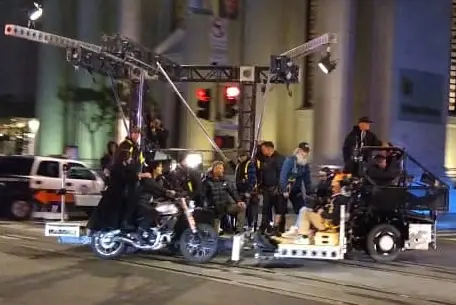
The Matrix (1999): Thomas A. Anderson / Neo, death sceneImage: Wikimedia Commons · Jdlrobson, CC BY-SA 4.0 - #117
When Will Smith was being offered the part of Neo, the Wachowskis thought of pairing him with Val Kilmer as Morpheus. According to Smith, the only portion of the film that the Wachowskis pitched to him was the frozen-in-mid-air jump kick scene. This made Smith skeptical and he opted to make Wild Wild West (1999) instead, which was a massive critical and commercial flop winning him two Razzie awards in the process. The film also won Worst Picture.
- #118
Janet Jackson was initially approached for the role of Trinity, but scheduling conflicts prevented her from accepting it. In an interview, she stated that turning down the role was difficult for her, so she later referenced the film in the "Intro" and "Outro" interludes on her tenth studio album "Discipline".
- #119
- #120
The pistol that the Agents use throughout the film are a variation of the Desert Eagle--this was a deliberate choice by the Wachowskis against the will of their armorer. This is mostly due to Desert Eagles mostly being seen as novelty guns; they're chambered in .50 caliber--which is considered massive by pistol standards. The recoil is nearly impossible to control even with two hands, making the use of this pistol to be considered very unrealistic. However this fits within the continuity of the film as the Agents always fire this pistol one-handedly, emphasizing their inhuman "machine" qualities.
- #121
- #122
The Wachowskis harbored their vision for five and a half years, working through fourteen drafts of the screenplay. Although most studio executives who read the script loved their ideas, they had extreme difficulty imagining how this would translate onto the screen. The Wachowskis then hired leading illustrators Steve Skroce and Geofrey Darrow, who created over 600 storyboards. Executives were reportedly sold immediately after seeing the bold vision on display, and green-lit the film.
- #123
- #124
The Lafayette Hotel escape sequence originally continued in to the sewers and then back up in to the streets as Morpheus attempted to create a diversion, resulting in his capture. The storyboards for this version can be seen in "The Art of the Matrix", and a somewhat different sewer escape segment was included at this point in the "Path of Neo" videogame.
- #125
- #126
Jennifer Connelly, Marisa Tomei, Salma Hayek, Catherine Zeta-Jones, Halle Berry, Jennifer Lopez, Angelina Jolie, Angie Harmon, Drew Barrymore, Kate Hudson, Uma Thurman, Ming-Na Wen, Michelle Yeoh, Winona Ryder, Lucy Liu, Courteney Cox, Heather Graham, Elizabeth Hurley, Mariska Hargitay, Jennifer Beals and Ashley Judd all auditioned or were considered or were offered or turned down the role of Trinity.
- #127
- #128
The Nebuchadnezzar was designed to have a patched-up look, instead of clean, cold and sterile space ship interior sets as used on films like Star Trek (2009). The wires were made visible to show the ship's working internals, and each composition was carefully designed to convey the ship as "a marriage between man and machine."
- #129
There was a rumor that the studio had little faith in the project, and only gave the Wachowskis $10 million instead of the $60 million dollar budget that they had asked for. Allegedly, the directors spent that entire amount on the opening scene alone, which impressed the studio sufficiently for them to green-light the rest of the budget. This story was later discredited, although there was a hint of truth: when studio executives were unhappy with how the production moved along and threatened to intervene during filming, the directors and editor hastily compiled the opening scene and finished it with temporary sound and visual effects. The result was enough to keep the studio off their back for the rest of the shoot.
- #130
- #131
- #132
- #133
The Wachowskis' approach to action scenes drew upon their admiration for Japanese animation such as Ninja Scroll (1993) and Akira (1988). Ghost in the Shell (1995) was a particularly strong influence. Joel Silver has stated that the Wachowskis first described their intentions for the film by showing him that anime and saying, "We wanna do that for real."
- #134
When Lana and Lilly Wachowski's screenplay for Assassins (1995) was being made for producer Joel Silver, the Wachowskis brought Silver the script to this film. He was bowled over by their screenplay, but not by the Wachowskis' insistence that they direct the film themselves. He told them to cut their teeth by directing something else instead, which is why they made Bound (1996). The success of that lesbian crime thriller proved to be the calling card that the Wachowskis needed to earn the trust from Warner Bros. to direct this movie themselves.
- #135
- #136
The screenplay appears to have borrowed several plot elements from the 1973 German TV miniseries Welt am Draht (World on a Wire), including a computer simulated world that's indistinguishable from reality to its inhabitants; unique self-aware computer programs who recognize the artificial nature of the simulated world and know of the real world's existence; and real world people who enter the simulation as avatars of themselves and return to the real world by making a phone call.
- #137
- #138
- #139
The 44 cue names in Don Davis' musical score include: 10 gags based on character names (7 around "Switch"); 5 anagrams of "Wachowski Brothers"; 3 anagrams of "The Matrix"; and only one reference to philosophy. The cue for the "Spoon Boy" scene is titled "Boon Spoy", which is of course a spoonerism.
- #140
- #141
- #142
- #143
The character of Switch was supposed to be played by two people. A man in the real world but once they were plugged into the Matrix it would be played by the female we saw in both here. The Wachowski's decided to change it because they felt audience's weren't ready for a gender dysphoric character.
- #144
- #145
- #146
The Wachowskis harbored their vision for five and a half years, working through fourteen drafts of the screenplay. Although most studio executives who read the script loved their ideas, they had extreme difficulty imagining how this would translate onto the screen. The Wachowskis then hired leading illustrators Steve Skroce and Geofrey Darrow, who created over 600 storyboards. Executives were reportedly sold immediately after seeing the bold vision on display, and green-lit the film.
- #147
- #148
There was a rumor that the studio did not believe much in the project and gave the Wachowskis only 10 million dollars instead of the 60 million dollars they wanted. Allegedly the directors spent that entire amount on the opening scene alone, which impressed the studio and got the rest of the budget greenlit. This story was later denied, but it had a grain of truth: when studio executives were unhappy with the way shooting was going and threatened to intervene, the directors and the editor hastily cut together the opening scene and completed it with temporary sound and visual effects. The result kept the studio off their backs for the rest of the shoot.
- #149
There was a rumor that the studio had little faith in the project and gave the Wachowskis only $10 million instead of the $60 million they wanted. Allegedly, the directors spent all of it on the opening scene, which impressed the studio so much that it approved the rest of the budget. Although this story was later denied, it contained a grain of truth: when studio executives were unhappy with how filming was progressing and threatened to intervene, the directors and editor hurriedly assembled the opening scene and completed it with temporary sound and visual effects. The result persuaded the studio to leave them alone for the rest of filming.
- #150
The crew used the term 'Frankensteining' to describe the digital manipulation of someone's body in post-production. It was used particularly when Trinity jumps through the window during the opening chase. The crew had to move her arms and legs slightly to make her look more natural as she flew through the air.
- #151
- #152
- #153
Contains a major spoiler — show
When Belinda McClory auditioned for the role of "Switch," she was only going for half the role; the character was originally planned to be played by androgynous actors. In the real world Switch would be a male actor, and in the Matrix, a female--hence the name "Switch". Warner Bros. refined the idea and McClory ended up getting a single female role in both environments. In interviews many years later, the Wachowskis (who at the time had been considering undergoing gender reassignments) stated that there were trans elements in the film. This was one of them.
- #154
- #155
Behind the Scenes (84)
- #156
- #157
A combination of practical and digital effects were used for the interrogation scene where Neo is implanted with the bug. A prosthetic stomach was used for the scene where the agents hold down Neo so that Agent Smith can activate the bug that digs into his belly button, notice the small indentation a few inches away from his navel where the plastic had slightly bent. A remote controlled device was also used to simulate the bug's tendrils that were squirming around once they were inside of his stomach. The bug itself was also a combination of CGI and an animatronic. The scene where it activates is CGI while the shot where it's squirming on his stomach is practical, when it's digging into his navel it's CGI.
- #158
In the early stages of developing what was to become the famous Bullet Time sequence, visual effects supervisor John Gaeta and director of photography Bill Pope constructed many gimbals and dollies in the hope of creating the effect the old-fashioned way. The original dolly they created for the camera would be led around the action at a tremendous speed, but after many failed tests and broken dollies, they opted for computer graphics, which meant writing an entirely new program for the effect. However, the Bullet Time sequence does still use one very old-fashioned technique: still photography.
- #159
- #160
- #161
The iconic sunglasses worn by the Matrix characters are from the label "Blinde," which prides itself on producing handmade glasses. The company's founder, Richard Walker, had to tender against large companies, such as Ray-Ban and Arnette, to win the film's sunglasses contract, and set himself apart by scratch-designing pairs of glasses based purely on the characters' unusual names. When his tender was successful, Walker was flown into Sydney where he spent the duration of the Matrix shoot custom-designing sunglasses for the cast in the back of an Oxford Street optometrist.
- #162
There are many who might legitimately claim to have invented the time-freezing photographic technique used in the movie. It might have been Michel Gondry, who used it for the first time in a commercial (for an insurance company) and then in a video clip for Björk. It might have been architectural graphics artist Matthew Bannister, who, in his academic work, suggested that motion and time in video could be separated, and proposed an apparatus for doing it much like that used for the film (but who was unable to make it work with then-available technology), or even artist Tim MacMillan, who demonstrated the technique on British television in 1993. It may be that each of them, and others, invented it independently.
- #163
- #164
The "bullet time" sequences in the film were actually some of the least labor intensive to shoot. Because the scenes involved an array of still cameras taking still photographs which were later digitally arranged into the sequence in the film, the Wachowski Siblings were able to shoot the sequence in only 90 minutes.
- #165
The shootout in the lobby took about ten days to shoot, and all of the effects were practical, with the exception of wire removal. Carrie-Ann Moss did her cartwheel off the wall in one take, which was the goal because it took six to eight hours to re-set and re-dress the blown up columns.
- #166
- #167
- #168
The shots of Neo and Morpheus dangling from the helicopter were shot with stuntmen, with the exception of the times you can see Fishburne and Reeves' faces in the closer shots. Editor Zach Staenberg claims they had to "literally re-write the laws of Sydney" in order to get all the flying shots.
- #169
- #170
- #171
- #172
- #173
- #174
In order to achieve the bullet-time shots, the production had to design a customized and standardized lens for the still cameras. This was done because still camera lenses aren't standardized the way motion picture camera lenses are, so they'd make it difficult to edit shots together smoothly.
- #175
- #176
- #177
- #178
According to costumer Gloria Bava, Neo's original coat was a silvery leather. It was changed because the heavy material barely moved, even under the influence of a wind machine, and the directors wanted something that was able to billow and float, like "liquid sky," a reference in their script. A lighter, black fabric was found, and only cost $3/yard.
- #179
- #180
The shot as Trinity tells Neo, "you know exactly where it ends", was filmed on Elizabeth Street (Sydney, New South Wales, Australia) looking north alongside CityRail's - Central to City Circle - train line from where Campbell Street also intersects with Wentworth Avenue. The white wooden scaffolding illuminated to the left was actually there before filming. Shot at night, the rain was added by a firetruck. Local street signs were pulled out and remained uprooted street-side for several days after location filming had moved on.
- #181
- #182
- #183
The antique television Morpheus shows to Neo in the construct is an AWA (Amalgamated Wireless - Australasia) Radiola "Deep Image" Model 209C or very similar model, circa 1958. Its bottom speaker section with fabric grille is missing, probably removed by set design to create a cleaner appearance.
- #184
On the first day of shooting, Hugo Weaving suffered an injury to his leg, which turned out to be a polyp that had to be surgically removed. For a while, there was a suggestion that he would have to be re-cast, but, by shifting the schedule around so that all of his stuntwork would take place at the end of shooting, Weaving was able to keep the part.
- #185
- #186
To prepare for the wire fu, the actors had to train hard for several months. The Wachowskis first scheduled four months for training. Yuen Woo-Ping was optimistic, but then began to worry when he realized how unfit the actors and actresses were. Yuen let their body style develop, and then worked with each actor's or actress' strength. He built on Keanu Reeves' diligence, Laurence Fishburne's resilience, Hugo Weaving's precision, and Carrie-Anne Moss's feminine grace. Yuen designed Moss' moves to suit her deftness and lightness.
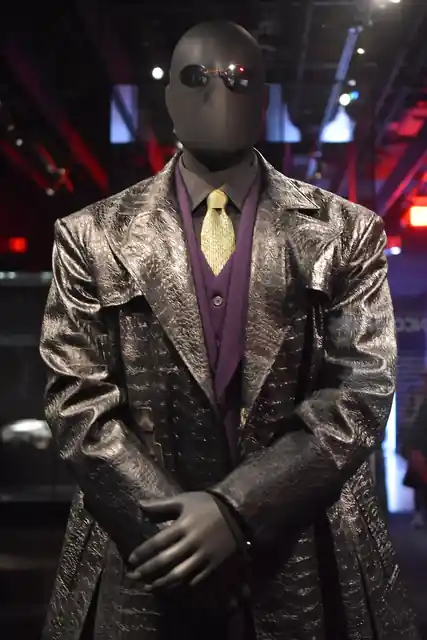
The Matrix (1999): MorpheusImage: Wikimedia Commons · Fred Cherrygarden, CC BY-SA 4.0 - #187
- #188
For the "bullet time" scene Proof of concept tests were first conducted by Mass.Illusions in Lennox Massachusetts. "We did the bullet time tests to help producer Joel Silver raise money for the movie," explained Pierre Jasmin to the VFX magazine before & afters in a 2019 interview. According to Jasmin, the Wachowskis presented the team at Mass.Illusions with evocative storyboards for what bullet time would look like. John Gaeta, who directed the test shots at Mass.Illusions, would go on to supervise the visual effects for The Matrix via Manex, a VFX facility in Northern California. The first step to realizing bullet time is blocking. Because in order to set up the all-important camera rig (well, cameras rig), you need to know how your subject is going to move. So, first things first, Gaeta and co. blocked out the action using a series of still image cameras. They then scanned the images into a computer so that the filmmakers could map and strategize the position of characters and the path the "virtual camera" would take. Using these simulations as a guideline, cameras were placed side-by-side on a specialized rig that was set up using a motion-controlled laser-pointing system that could judge the correct angle and focal distance. For the most famous iteration of bullet-time in The Matrix, where Neo dodges bullets on a rooftop, the set-up involved 120 still cameras and two film cameras. Placing the cameras close together was imperative to create the illusion of motion, as each camera only captured a single still photo. These cameras were triggered at extremely close intervals, so the action would appear to unfold slowly as the viewpoint moved at a "normal" pace. The cameras were either fired sequentially or all at the same time depending on the desired effect. Single frames from each camera were then arranged and displayed consecutively to produce an orbiting viewpoint of a frozen or slowed action. Once scanned into the computer, the resulting strip of still images is not dissimilar to animation cels. And speaking of animation, now is as good a time as any to talk about interpolation, the first of several techniques that give the final effect a fluid appearance. Bluntly put, "motion interpolation" is a process that uses an AI-powered algorithm to "animate" more frames in a sequence of stills. Also known as motion interpolation, the technique effectively creates a perceived increase in frame rate by creating new intermediate frames. This makes the motion feel less jittery and allows parts of the image (e.g. Neo's cape) to flow more smoothly. The Matrix's bullet-time sequences could not be shot on location, since most of the cameras could "see each other." Scenes were shot on a green screen and the backgrounds were replicated using photos of the real locations as textures for the 3D modeled environment. Actors were held in position by wires to both prevent them from falling over and to prolong their actions so that the final filmed movement looked effortless. Digital elements (bullets, light, etc.) were then added in post-production.
- #189
- #190
- #191
- #192
- #193
- #194
- #195
- #196
Prior to pre-production, Keanu Reeves suffered a two-level fusion of his cervical spine, which had begun to cause paralysis in his legs, requiring him to undergo neck surgery. He was still recovering during pre-production, but insisted on training. Stunt coordinator Yuen Woo-Ping let him practice only punches and lighter moves. Reeves trained hard, and even requested training on days off, however, the surgery left him unable to kick for two out of the four months of training. As a result, Reeves did not kick much in the film.
- #197
The effects team coined the term "Frankensteining" to describe the digital manipulation of someone's body in post production. In particular, this was used when Trinity jumps through the window during the chase sequence of the first scene. The effects team had to move around her arms and legs a bit to make her look more natural as she glides through the air.
- #198
There is an anecdote repeated in the "Matrix Revisited" documentary and "Art of the Matrix" book about the "red dress" scene. Apparently when the actress emerged in costume for the first time, a nameless someone was pulling their car out of a nearby garage. They were so transfixed that they drove directly in to the garage door before it had finished raising. After destroying their paint job and windshield wipers they slowly drove off the set in embarrassment.
- #199
- #200
- #201
Prior to pre-production, Keanu Reeves suffered a two-level fusion of his cervical spine, which had begun to cause paralysis in his legs, requiring him to undergo neck surgery. He was still recovering during pre-production, but insisted on training. Stunt coordinator Yuen Woo-Ping let him practice only punches and lighter moves. Reeves trained hard, and even requested training on days off, however, the surgery left him unable to kick for two out of the four months of training. As a result, Reeves did not kick much in the film.
- #202
- #203
- #204
During the early development of the famous 'Bullet Time' sequence, visual effects supervisor John Gaeta and cinematographer Bill Pope built numerous gimbals and dollies to create the effect the old-fashioned way. Their original camera dolly was meant to circle the action at high speed, but after failed tests and broken dollies, they turned to computer graphics, which required writing a new program for the effect. However, the Bullet Time sequence still uses a very old technique: still photography.
- #205
While filming the scene in which Neo slams Smith into the ceiling of the subway tunnel, Keanu Reeves's stunt double Chad Stahelski suffered several injuries, including broken ribs and knees and a dislocated shoulder. Another stunt performer was injured by his hydraulic pulling device during a shot in which Neo crashes into a booth.
- #206
- #207
Neo's mouth melting during the interrogation scene is a deliberate tribute to Harlan Ellison's science-fiction novel I Have No Mouth, and I Must Scream, one of the film's many inspirations. The scene was achieved with CGI and practical effects. The shots of his lips joining and separating as sticky flesh, and closing up, are CGI, while the other shots are practical. The latter effect was simulated using a cast and prosthetic makeup over Keanu Reeves's mouth.
- #208
- #209
- #210
A combination of practical and digital effects was used in the interrogation scene in which the bug is implanted in Neo. A prosthetic stomach was used for the shot in which the Agents hold Neo down and Agent Smith activates the bug that enters his navel; a small indentation can be seen a few centimeters from the navel, where the plastic bends slightly. A remote-controlled device was also used to simulate the bug's tentacles writhing after it enters the stomach. The bug itself combined CGI and animatronics. The shot of it being activated is CGI, the shot of it writhing in his stomach is practical, and the shot of it entering his navel is CGI.
- #211
The three pieces of music that play while Neo fights Morpheus in the construct are called the 'Bow Whisk Orchestra' by composer Don Davis. They consist of a semi-improvised piece by Davis using Asian instruments, Lunatic Calm's 'Leave You Far Behind' and another Davis piece called 'Switch or Break Show.' Both 'Bow Whisk Orchestra' and 'Switch Or Break Show' are anagrams of 'Wachowski Brothers.' The piece that plays when Neo, Morpheus and Trinity return to the building after visiting the Oracle is called 'Threat Mix.' Later, the piece accompanying Morpheus's fight with Agent Smith in the same building is called 'Exit Mr. Hat.' Both 'Threat Mix' and 'Exit Mr. Hat' are anagrams of 'The Matrix.'
- #212
- #213
- #214
- #215
Contains a major spoiler — show
Neo's mouth melting in the interrogation scene is an intentional homage to the sci-fi novel "I Have No Mouth, and I Must Scream," by Harlan Ellison which served as one of the many influences for the film. The scene was accomplished with CGI and practical effects. His lips joining together and separating as gooey flesh before sealing shut is CGI, while the rest of the shots were practical. Plaster and prosthetic makeup was used over Keanu Reeves' mouth to simulate the latter effect.
- #216
Contains a major spoiler — show
While filming the scene where Neo slams Smith into the ceiling of the subway tunnel, Chad Stahelski, Keanu Reeves' stunt double, sustained several injuries, including broken ribs, knees, and a dislocated shoulder. Another stuntman was injured by a hydraulic puller during a shot where Neo was slammed into a booth.
- #217
- #218
- #219
Contains a major spoiler — show
When Mouse is cornered by the S.W.A.T. team during the raid, the guns he pulls out are a pair of cam-operated, electrically-driven 12-gauge automatic shotguns with 25-round drum magazines, capable of firing at 900 RPM. They were built specially for the movie by John Bowring, the film's key armorer.
- #220
- #221
- #222
- #223
- #224
- #225
- #226
- #227
Contains a major spoiler — show
The dojo set was built well before it was used. During the dojo sequence, there was significant physical contact between both actors, earning them bruises. Because Keanu Reeves's neck injury prior to filming meant he had insufficient training with wires up to that point, and due to the physical toll he had taken by Fishburne up to that point, he was unable to perform the triple kick move satisfactorily and became frustrated with himself, causing the scene to be postponed. The scene was shot successfully a few days later, with Reeves using only three takes. Yuen Woo-Ping altered the choreography of the scene from then on, and made the actors pull their punches in the last sequence of the scene, creating a training feel, and giving them both much-needed relief.
- #228
Contains a major spoiler — show
Due to Keanu Reeves' neck injury, some of the action scenes had to be re-scheduled to accommodate his full recovery. As a result, filming began with scenes that did not require much physical exertion, such as the scene in Thomas Anderson's boss' room, the interrogation room, or the car ride where Neo is taken to see the Oracle.
- #229
- #230
Contains a major spoiler — show
For the scene between Agent Smith and Cypher in the restaurant, the crew actually used shiitake mushrooms rigged to look like a rare steak for wide shots and when the actor had to handle it for long periods. Joe Pantoliano (Cypher) disliked eating rare beef and it made him gag, so a spit bucket was kept nearby during filming.
- #231
Contains a major spoiler — show
The opening fight with Trinity (Carrie-Anne Moss) took about six months of training and four days to shoot. Part of her original screen test was to fight with a wire team from Hong Kong for about three hours. The Wachowskis wanted to make sure the actors could perform in most of their fighting sequences, which was uncommon at the time.
- #232
Contains a major spoiler — show
The Agents, including Agent Smith (Hugo Weaving), famously carry IMI Desert Eagle Mark XIX pistols, chambered in .50 Action Express, as their sidearms throughout the movie. The Desert Eagle was specifically chosen by the Wachowski brothers as the Agents' sidearm-of-choice, against the advice of armorer John Bowring, who dismissed them as "wanker" pistols
- #233
- #234
- #235
- #236
Contains a major spoiler — show
According to the film's armorer, John Bowring, the guns held by Keanu Reeves in the lobby and elevator sequences were actually plastic, lightweight weapons. They made a very faithful cast of the MP5K, which weighs about 150-200 grams, so that Keanu could carry them without worrying about the weight. Heavier versions were also made if they were meant to be dropped on the floor.
- #237
- #238
Contains a major spoiler — show
For the scene when Neo wakes up in the pod connected to the Matrix, the pod was constructed to look dirty, used, and sinister. During the testing of a breathing mechanism in the pod, the tester suffered hypothermia in under eight minutes, so the pod had to be heated.
- #239
Characters & Cast (22)
- #240
- #241
- #242
- #243
After reading the script, Carrie-Anne Moss stated that at first, she did not believe she had to do the extreme acrobatic actions as described in the script. She also doubted how the Wachowskis would get to direct a movie with a budget so large, but after spending an hour with them going through the storyboard, she understood why some people would trust them. She underwent a three-hour physical test during casting, so she knew what to expect subsequently.
- #244
Hugo Weaving stated that the character of Agent Smith was enjoyable to play because it amused him. He developed a neutral accent with specific "character" for the role. He wanted Smith to sound neither robotic, nor human, and also said that the Wachowskis' deep voices influenced Smith's own. When filming began, Weaving mentioned that he was excited to be a part of something that would extend his abilities.
- #245
Neo (Keanu Reeves) takes at least two pair of Beretta 92FS pistols with him on his mission to save Morpheus (Laurence Fishburne). While it may seem ridiculous to carry several copies of the same gun, it would be faster to drop the pistols when empty and pull out "fresh" ones than it would be trying to reload them, particularly when dual-wielding, as Neo does in the film. Also, such practice would have a rich precedent in the flintlock era, when bandits or pirates were known to carry up to six loaded one-shot pistols into battle.
- #246
- #247
- #248
Switch was originally meant to change genders upon entering the Matrix, which coined their name "Switch". In the real world, Switch would be male, and in the Matrix, Switch would be female - a very clever and critical point of the 'residual self-image' idea. When actress Belinda McClory auditioned for the role, she was going for only half the role. Warner Brothers made the decision to cut this and give Switch one form for both environments. Switch's presentation is deliberately androgynous to pay homage to their original concept. Lilly Wachowski would later say that The Matrix contains a "trans metaphor" by the name of "Switch". Switch highlighted "where [their] headspaces were" when it came to the idea of The Matrix, but from a "closeted point of view." The early concept for Switch's presentation may be a reflection of Lilly and Lana Wachowski's struggles with their gender identity, which were unknown to the public at the time.
- #249
- #250
- #251
When Belinda McClory auditioned for 'Switch,' she was applying for only half of the role; the character was originally going to be played by androgynous actors. Switch would be male in the real world and female in the Matrix, hence the name 'Switch.' Warner Bros. refined the idea, and McClory received a single female role in both settings. In interviews years later, the Wachowski siblings, who were considering transitioning at the time, said the film contained trans elements. This was one of them.
- #252
The book in which Neo hides his belongings is Jean Baudrillard's Simulacra and Simulation, which explores the postmodern concepts of simulation and hyperreality. The chapter where the belongings are hidden is titled 'On Nihilism.' Nihilism generally involves despair and the belief that life is meaningless. All the lead actors were required to read the same book before reading the script.
- #253
- #254
- #255
Carrie-Anne Moss said that, after reading the script, she initially did not believe she would have to perform the extreme acrobatics it described. She also said she doubted how the Wachowski siblings would direct such a big-budget film, but after spending an hour going through the storyboards, she understood why people trusted them. She underwent a three-hour physical test during the audition, so she knew what to expect afterward.
- #256
- #257
The original concept for Switch was that the character would change gender upon entering the Matrix, hence the name 'Switch.' Switch would be male in the real world and female in the Matrix. This was a very clever and critical aspect of the idea of 'residual self-image.' When Belinda McClory auditioned for the role, she was applying for only half of it. Warner Brothers canceled the idea and gave Switch one form for both settings. Switch's presentation is deliberately androgynous in tribute to the original concept. Lilly Wachowski later said that The Matrix contained a 'trans metaphor' called 'Switch.' Switch highlighted 'where their heads were' regarding the idea of the Matrix, but from a 'closeted point of view.' The early concept for Switch's presentation may reflect Lilly and Lana Wachowski's struggles with their gender identities, which were not publicly known at the time.
- #258
Janet Jackson was initially offered the role of Trinity, but scheduling conflicts prevented her from accepting. She said in an interview that turning down the role was difficult for her, and later referenced the film in the 'Intro' and 'Outro' interludes on her tenth studio album, Discipline.
- #259
As part of the casting process, the film's writer-director duo, the Wachowski siblings, ordered a screen test to see whether the lead actors being considered for Neo and Trinity had chemistry. This was when Carrie-Anne Moss and Keanu Reeves first met. Moss entered the room and said, 'Hi, I'm Carrie-Anne.' Reeves replied, 'Hi, I'm Keanu.'
- #260
- #261
Easter Eggs & References (60)
- #262
- #263
- #264
During the Trinity rooftop chase at the film's beginning, two distinctive city skylines are noticeable. Nashville, Tennessee's BellSouth Building and L & C Tower are visible behind the Agents. San Francisco's TransAmerica and Coit Towers can be seen behind Trinity after she jumps past the Guns & Ammo billboard.
- #265
- #266
- #267
- #268
- #269
- #270
- #271
- #272
According to the inscription on the Nebuchadnezzar's core, the ship was "Made in the USA" in the year 2069. It also states that it is a "Mark III, No. 11" model, which is a possible reference to Mark 3:11, which reads "And whenever those possessed by evil spirits caught sight of him, they would fall down in front of him shrieking, 'You are the Son of God!'"
- #273
- #274
- #275
According to the time stamp of Trinity's call at the start of the film (Thursday, February 19th, 1998 at 1:24:18 p.m.) and that of Neo's call at the end of the film (on Saturday September 18th, 1999 at 2:31:21 p.m.). The elapsed time comes to precisely one hour, seven minutes and three seconds shy of 576 days
- #276
- #277
When Neo fights Morpheus in the construct, the three pieces of music that play on the score are termed the "Bow Whisk Orchestra" by Composer Don Davis. It consists of a semi-improvisational piece with Asian instruments by Davis, the song "Leave You Far Behind" by Lunatic Calm, and another piece by Davis called "Switch or Break Show". Both "Bow Whisk Orchestra" and "Switch Or Break Show" are anagrams of "Wachowski Brothers". Also, when Neo, Morpheus, and Trinity return to the building after visiting the Oracle, the piece of music that plays is called "Threat Mix". Later, when in the same building Morpheus fights Agent Smith, the musical piece is called "Exit Mr. Hat". Both "Threat Mix" and "Exit Mr. Hat" are anagrams of "The Matrix".
- #278
Neo's first scene chatting with his friends (the ones that take him to the nightclub where he meets Trinity) is rife with foreshadowing. One of his friends calls Neo "my savior, my own personal Jesus Christ" and then, after hearing the strange story about his computer, quips "you need to unplug, man".
- #279
When Morpheus is explaining "What the Matrix is" to Neo, he uses the phrase "Welcome to the desert of the real." This is a paraphrase from Jean Baudrillard's "Simulacra and Simulation", the hollowed-out book where Neo keeps his illegal software. The quote can be found in Chapter One - The Precession of Simulacra, Page one, Paragraph 2, "It is the real, and not the map, whose vestiges persist here and there in the deserts that are no longer those of the Empire, but ours. The desert of the real itself." NB: The American title of Baudrillard's book is Simulations. It was published by Semiotext(e) in 1983.
- #280
- #281
- #282
- #283
The FedEx envelope that Neo receives has the FedEx logo in red and blue lettering. Neo signs for the envelope with a pen that allows the selection of either red or blue ink. These items foretell and reference Neo's upcoming selection between the red and blue pills. This is most likely the Bic 4 colour biro pen offering red, blue, green and black ink options.
- #284
- #285
- #286
The name of Morpheus's ship, the Nebuchadnezzar, is a biblical reference to King Nebuchadnezzar II of Babylon in the Book of Daniel. King Nebuchadnezzar the Great is famous for conquering Israel, particularly Judah and Jerusalem, in biblical times. He also had the Hanging Gardens of Babylon, one of the Seven Wonders of the Ancient World, built for his wife. In Daniel 2:1–49, he has a dream he cannot interpret and keeps searching for an answer. This reflects the quest of those who want to escape the Matrix, and the answers Morpheus and his crew try to provide after freeing their minds.
- #287
'Matrix' means 'womb' in Late Latin, making 'The Matrix has you...' an apt warning with a double meaning: it refers both to the Matrix, the computer-generated dream world imprisoning the human mind, and to the cocoon-like physical state in which the human body is harvested for bioelectric power in an artificial womb.
- #288
All references to street corners, such as Wells and Lake, are real intersections in Chicago, Illinois, the Wachowski siblings' hometown. The subway train has 'Loop' signs, another Chicago reference. These references appear even though the film was not explicitly shot in Chicago or any other real city; it was filmed in Sydney.
- #289
In a subtle example of foreshadowing, Cypher references The Wizard of Oz while everyone else references Alice in Wonderland. This shows that Cypher is somehow separate from the Nebuchadnezzar's crew, but also reveals a fundamental difference in how he perceives his awakening. At its core, Alice in Wonderland is the story of a girl finding freedom in a dangerous and confusing world, whereas The Wizard of Oz tells of a girl swept into a new land amid tragedy, hunted for something she does not want, forced to become a killer and longing to return home throughout it all; when she finally wakes up, she remembers the other world as a strange dream and will probably forget it.
- #290
- #291
- #292
- #293
- #294
- #295
- #296
- #297
- #298
The film's opening and closing scenes take place at the Heart O' The City Motel. Although the official name of the city where the film takes place is Edge City, this is a clear tribute to the Wachowskis' hometown of Chicago: there is actually a 'Heart O' The City' motel in Skokie, Illinois, just outside Chicago. Although it does not share the same aesthetic, it is definitely a reference.
- #299
- #300
The first tracing program shows the city's area code, but the camera zooms in before it can be identified precisely, leaving the number as (3?2) 555-0690. Three places in the United States have similar codes: Chicago (312), Delaware (302) and the northwestern Florida peninsula (352). Since the original script specified 312-555-0690, and the film includes numerous other references to Chicago, such as State Street in downtown Chicago, we can assume the area code is 312.
- #301
- #302
- #303
Contains a major spoiler — show
Some personal information can be seen on Thomas Anderson's criminal record that Agent Smith glances at during interrogation: The last update to the file was July 22, 1998. Anderson's place and date of birth are "Lower Downtown, Capital City on March 11, 1962. Anderson's mother's full maiden name is "Michelle McGahey," while his father's name is "John Anderson." Thomas attended "Central West Junior High" and "Owen Paterson High" (named after the film's Production Designer). A few seconds later, a photocopy of his passport can be seen. There, the place of his birth is CAPITAL CITY, USA, and his date of birth is 13 September, 1971. The passport was issued on 12 September 1991 and set to expire on 11 September 2001, a Tuesday, infamously the day of the 9/11 attacks on the World Trade Center in New York City.
- #304
Contains a major spoiler — show
The opening (and closing) scenes take place at Heart O' The City Motel. While the official name of the city in which the film takes place is Edge City, it is very clearly an homage to Chicago, the hometown of the Wachowskis, there is in fact a "Heart O' The City" motel in Skokie, IL; which is just on the outskirts of Chicago. While it doesn't share the same aesthetic, it's certainly a nod.
- #305
Contains a major spoiler — show
When Neo gets in the car with Trinity for the first time, Switch refers to him as "Coppertop." Coppertop is her slang for the Duracell brand of batteries, which is also the battery Morpheus shows Neo as he explains how the human race became an energy source.
- #306
Contains a major spoiler — show
The first trace program gives a view of the City's area code, but the camera zooms in before it can be completely determined, leaving the phone number as (3?2) 555-0690. Three locations exist in the United States with similar codes: Chicago (312), Delaware (302), and the northwestern Florida peninsula (352). Since the original script indicates that the number is 312-555-0690, and there are numerous other references to Chicago in the film (such as State street, which is in downtown Chicago), we can assume that the area code is 312.
- #307
Contains a major spoiler — show
It appears that all the agent programs have golden lining in their black suits. This is only visible during running and fighting scenes. Interestingly, this might be the first hint that "programs" in the Matrix can be identified by some people with "the sight" which was revealed only after the movie: most notably in the beginning of "Matrix: Reloaded" when Neo takes a good look at the program, Seraph, before being allowed to meet The Oracle.
- #308
- #309
- #310
Contains a major spoiler — show
The book Neo hides things in is called "Simulacra and Simulation," a treatise by Jean Baudrillard that explores the post-modern concept of simulation and hyperreality. The chapter where they're hidden is called "On Nihilism." Nihilism often involves a sense of despair coupled with the belief that life is devoid of meaning. This same book was required reading for all principal cast prior to reading the script.
- #311
- #312
Contains a major spoiler — show
In the last scene, in which Agent Smith's chasing Neo through a building, as Neo's looking for an exit, he runs through an apartment occupied by two old women (right after Tank said for Neo to go to his "other" left). On the television, is The Prisoner (1967), the iconic late 1960s television series, in which a secret agent (no name officially given) has been abducted, and awakens to find himself imprisoned in an unnamed village. The landmark series supposes how "we're all prisoners".
- #313
- #314
- #315
Contains a major spoiler — show
When we are introduced to Neo, he's asleep at his computer. Images are seen rapidly changing on the screen, one of which is the front page of an actual Arabic newspaper. Loosely translated, the title of the newspaper means "Midday". Additionally, the main body of the page is about the negotiations between Lebanese Christians and Syrian President Al Asaad in the late 1990s.
- #316
Contains a major spoiler — show
When Tank is uploading the martial arts training to Neo, there is a shot of the computer screen as it scrolls through the various martial arts styles. The graphics have a computer image of a person and the title of the style below. The fifth one on the screen is entitled "Drunken Boxing". Yuen Woo-Ping, the fight choreographer for this movie, was director and fight choreographer for Jackie Chan's early hit, Drunken Master (1978), in which Chan's character masters the style of Zui Chuan, or Drunken Boxing. Some of the other martial arts fighting styles being downloaded are Jiu-jitsu, Savate, Kempo, Tae Kwon Do, and, of course, Kung Fu.
- #317
Contains a major spoiler — show
Numerous sets of identical twins were cast as extras in the "Woman in Red" scene to create the illusion of a repeating training program made with limited resources. Example: the tall man with slicked-back hair and sunglasses in the opening shot is seen a few seconds later as a police officer writing a parking ticket.
- #318
Contains a major spoiler — show
The vintage TV seen in an early scene in the film is an AWA (Amalgamated Wireless Australia) brand model. In the helicopter scene later in the film the white tower on top of a building seen in the background in several shots is the AWA Radio Tower, an iconic Sydney landmark.
- #319
- #320
Contains a major spoiler — show
When Morpheus offers Neo to choose blue pill or red pill, blue pill is on his left hand and red pill in his right hand. However, when camera focuses Morpheus' face at a very closeup, his sunglasses reflect like a mirror his hands with the pills, exchanging left and right, symbolizing that reality can be deceiving and that perceptions as "left" and "right" can be fading.
- #321
Contains a major spoiler — show
The film bears a couple of similarities to the "Terminator" films: The film takes place in a dark post-apocalyptic future, in which machines have taken over the world. Morpheus and a band of rebel warriors are fighting to free humanity from the machines and the Matrix computer program. Neo is believed to be the chosen one who will destroy The Matrix and end the war between man and machine. Neo, Morpheus, and Trinity wear sunglasses and leather outfits. Trinity rides a motorcycle in one scene. Neo works as an employee of a computer company and is also a computer hacker. Agent Smith, a law enforcement program, has the ability to change into the form of other individuals in The Matrix and one of the weapons Neo uses on the Agents is a Mini gun.
Deeper Meaning (36)
- #322
- #323
- #324
- #325
'Matrix' is the late Latin word for 'womb' - which would make "The Matrix has you..." an apt warning with a double meaning, referring to both the computer-generated dream world, known as The Matrix, that imprisons the human mind, and also to the cocooned physical state of the human body which is being simultaneously harvested for bioelectric power in an artificial womb.
- #326
- #327
At the directors' request, the actors were to be able to understand and explain The Matrix, not only as a film, but a philosophy. Simulacra and Simulation by Jean Baudrillard was required reading for most of the principal cast and crew. Keanu Reeves said even before they opened the script the Wachowskis had him read Simulacra and Simulation, Out of Control by Kevin Kelly, and Introducing Evolutionary Psychology by Dylan Evans. Eventually, he was able to explain all the philosophical nuances involved. Carrie-Anne Moss commented that she had difficulty with this process.
- #328
At the directors' request, the actors had to be able to understand and explain the Matrix as a philosophy, rather than simply as a film. Jean Baudrillard's Simulacra and Simulation was required reading for the lead actors and most of the crew. Keanu Reeves said the Wachowski siblings made him read Simulacra and Simulation, Kevin Kelly's Out of Control and Dylan Evans's Introducing Evolutionary Psychology before he had even opened the script. Eventually, he could explain all the philosophical nuances. Carrie-Anne Moss said she struggled with this process.
- #329
Many pairs of identical twins were used as extras in the 'Woman in Red' scene to create the illusion of a repetitive training program built with limited resources. For example, the tall man with slicked-back hair and sunglasses in the opening shot appears a few seconds later as a police officer writing a parking ticket.
- #330
- #331
- #332
- #333
- #334
The company Thomas Anderson works for is called Metacortex. The word's roots are meta-, which Webster defines as 'transcending, higher, beyond,' and -cortex, the outer layer or boundary of the gray matter surrounding the brain. Metacortex therefore means 'going beyond the boundaries of the brain,' which is exactly what Neo does.
- #335
William Gibson's novel Neuromancer influenced the film, particularly its use of the term 'Matrix.' After seeing the film, Gibson commented that the filmmakers' use of existing cyberpunk works was the same kind of 'creative cultural osmosis' that informed his own writing. However, he said the film's Gnostic themes distinguished it from Neuromancer and that he believed it was thematically closer to the work of Philip K. Dick.
- #336
The key of the opening theme heard at the start of each Matrix film, with its exuberant strings and brass bursts, rises with each film. The Matrix (1999) begins in E minor, The Matrix Reloaded (2003) moves up a whole step to F-sharp minor, and The Matrix Revolutions (2003) rises another half step to G minor.
- #337
Neo is frequently associated with the number one. 'Neo' is an anagram of 'one,' and a major plot point is whether he is 'The One.' Meanwhile, Cypher's name means zero, from the Arabic sifr. Together, zero and one represent the basis of binary data, and therefore of all modern computer data. Neo also lives in apartment 101, a number composed entirely of those two digits. Finally, Trinity's name means a 'group of three,' and she first appears in room 303.
- #338
- #339
- #340
- #341
- #342
When Morpheus offers Neo the choice of the blue pill or the red pill, the blue pill is in his left hand and the red pill in his right. However, when the camera moves very close to Morpheus's face, his sunglasses reflect his hands and the pills like a mirror, reversing left and right. This symbolizes how reality can be deceptive and how perceptions of 'left' and 'right' can disappear.
- #343
When Neo meets Morpheus, Morpheus offers him two pills: red and blue. Blue symbolizes remaining in the Matrix, while red represents leaving it and entering the real world. This foreshadows Neo's own decision: when Neo wakes up after taking the red pill, he finds himself inside an enormous pod filled with red fluid. In other words, a giant 'red pill' containing not just him, but all the other people encapsulated in countless red pills.
- #344
The man Neo meets at his apartment to buy illegal software is named Choi, and his girlfriend is DuJour. Together they form 'Choi Dujour,' or 'choice of the day' in French, another playful reference to the importance of choice in the film. Dujour has a white rabbit tattoo, one of the many references to Alice in Wonderland. Choi calls Neo 'my own personal Jesus Christ,' pointing to Neo's status as The One, a religious figure. Dujour can also carry a double meaning as 'Femme duJour,' or 'girl of the day,' possibly implying that Choi's girlfriend is a prostitute.
- #345
- #346
- #347
Contains a major spoiler — show
After The Oracle reveals Neo that he is not the One, she says him: "You got the gift, but it looks like you're waiting for something. Your next life, maybe". The quote proves to be true at the ending of the movie: after Neo is killed by Smith, Trinity gets to resurrect him, finally turning him into the One.
- #348
Contains a major spoiler — show
Neo is often associated with the number one. (Neo is an anagram for one, and a major plot point is whether or not he is "the One".) Meanwhile, Cypher's name means zero (from the Arabic sifr). Together, zero and one represent the basis of binary data, and thus the basis of all modern computer data. (Neo also lives in apartment 101, a number composed entirely of those two digits.) Finally, Trinity's name means "group of three", and she first appears in room 303.
- #349
Contains a major spoiler — show
When Neo asks Choi "You ever have that feeling where you're not sure if you're awake or still dreaming?", Choi responds Neo "Mm, all the time. It's called Mescaline. It's the only way to fly. Hey, it just sounds to me like you need to unplug, man." It foreshadows Neo's fate through the movie: not only Neo is unplugged from The Matrix, at the ending he's capable to fly.
- #350
Contains a major spoiler — show
The name of the company where Thomas Anderson works is Metacortex. The roots of this word are meta-, which according to Webster's means "going beyond or higher, transcending," and -cortex, which is "the outer layer (boundary) of gray matter surrounding the brain." Thus, Metacortex is "transcending the boundaries of the brain," which is precisely what Neo proceeds to do.
- #351
- #352
- #353
Contains a major spoiler — show
Along with the many other Christian parallels in this movie, the character Cypher is a reflection of Judas Iscariot in the New Testament. Judas was one of the twelve apostles that Jesus chose to minister in his name, but, in a tragic turn of events, Judas denied his perfect knowledge of the Savior by betraying Him in exchange for thirty pieces of silver. Cypher likewise betrays Morpheus and the entire cause of Zion in exchange for the vanities of the Matrix.
- #354
Contains a major spoiler — show
One subtle bit of foreshadowing comes in the form of Cypher making a Wizard of Oz reference while everyone else makes allusions to Alice in Wonderland. This shows Cypher is somehow apart from the rest of the Nebuchadnezzar crew, but also can be seen as illustrating a fundamental difference in how he perceives his awakening. While Alice in Wonderland is at its core a story about a girl finding freedom in an otherwise dangerous and confusing world, Wizard of Oz is a story about a girl slipping into a new land in the midst of tragedy, being hunted for something she never asked for, and forced to become a killer, all while yearning to return home, where she awakens with memories of the other world as if they were an odd dream, presumably to eventually forget them.
- #355
Contains a major spoiler — show
When Neo meets Morpheus, this one offers him two pills, red and blue, symbolizing blue to keep in the Matrix and red to get out of Matrix and to be in the real world. It foreshadows his own decision: when Neo wakes up after to take the red pill, he is inside a giant pod which contains him in red liquid. It means, a giant "red pill" which contains not only him, but the rest of human beings encapsulated in uncountable red pills.
- #356
Contains a major spoiler — show
The name of Morpheus' ship, the Nebuchadnezzar, is a Biblical reference to King Nebuchadnezzar II of Babylon, from the Book of Daniel. King Nebuchadnezzar the Great was famous for his conquests of Israel in Biblical times (specifically Judah and Jerusalem). He also built the Hanging Gardens of Babylon (one of the lost Seven Wonders of the Ancient World) for his wife. He has a dream he can't interpret, but keeps searching for an answer, in Daniel 2:1-49. This reflects the search for answers those who wish to escape the Matrix pursue, and which Morpheus and his crew attempt to provide after freeing their minds.
- #357
Contains a major spoiler — show
All scenes that take place within the Matrix have a green tint, as if watching them through a computer monitor. Scenes in the real world have a blue tint. Blue was also used at a minimum within the Matrix, since the directors thought blue was more of a real-world color (despite, ironically, blue being often the least-occurring color in nature). The fight scene between Morpheus and Neo, which is neither in the real world, nor in the Matrix, is tinted yellow.
Career & Awards (5)
Life & Family (2)
- #363
Carrie-Anne Moss was offered many high-profile roles after the success of the Matrix franchise, but she turned them all down to focus on motherhood. She said, "I remember being torn, having a little twinge like 'Gosh, I'm getting offered such great things. That would be such a huge deal.' I was holding my baby in my arms, and I remember thinking, 'At the end of my life, will it matter to me that I have another movie on my résumé? Or will it matter to me that I held my baby?' And I instantly thought, no. It was just a no-brainer."
- #364
Some personal information appears in Thomas Anderson's criminal record, which Agent Smith examines during the interrogation: the file was last updated on July 22, 1998. Anderson's place and date of birth are 'Lower Downtown, Capital City, March 11, 1962.' His mother's maiden name is 'Michelle McGahey,' and his father's name is 'John Anderson.' Thomas attended 'Central West Junior High' and 'Owen Paterson High,' named after the film's production designer. A photocopy of his passport appears a few seconds later. It gives his birthplace as CAPITAL CITY, USA, and his date of birth as September 13, 1971. The passport was issued on September 12, 1991, and was set to expire on September 11, 2001, a Tuesday and the day of the September 11 attacks on the World Trade Center in New York.
Related pages
- Prom Night — The Matrix comes up in the facts on that page
- Cyberpunk 2077 — The Matrix comes up in the facts on that page
- John Wick — The Matrix comes up in the facts on that page
Continue through the archive


Sources & editorial notes
Reference databases
- Wikipedia
- IMDb
Information from external sources is independently selected, consolidated and edited by Arka Evren. Sources are listed for verification and further reading. Encyclopedia text is used under its licence (CC BY-SA). How we work