
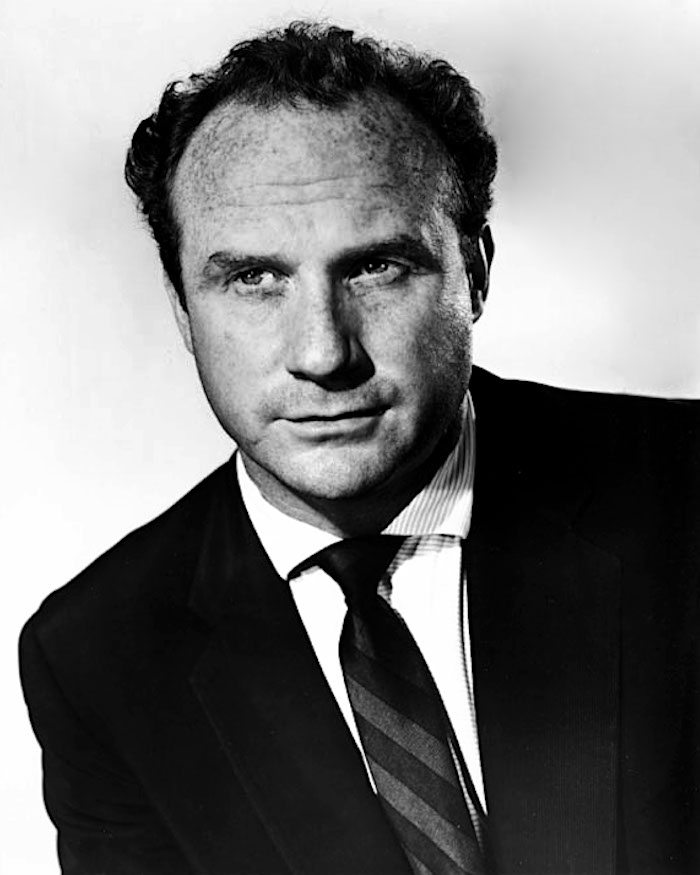
ACTOR · BORN 1920 · DIED 2006
Jack Warden
- Born
- 18 September 1920, Newark, New Jersey, USA
- Died
- 19 July 2006
- Known for
- 12 Angry Men (1957), All the President's Men (1976), Being There (1979), The Verdict (1982)
19 archived facts 4 topics 1 source Last reviewed Nov 2026
Jack Warden (18 September 1920 – 19 July 2006) was an actor best known for 12 Angry Men, All the President's Men and Being There.
19 Interesting Facts About Jack Warden
Interesting Facts (2)
- #001
Jack Warden and Gilbert Gottfried are the only two actors to appear in all three films of the 'Problem Child' series. Unlike Gottfried, however, Warden did not voice a role in the series' animated version, a choice that reflects the importance he placed on live-action performances. The trilogy is one of the key works in which Warden displayed his comedic talent.
- #002
Jack Warden played the character Corporal Steve Henshaw in the unaired pilot episode of 'The Phil Silvers Show' (1955). Although the pilot was not included in the series, it is noteworthy as one of Warden's early works in his television career. The experience laid the groundwork for him to take on major roles in later television projects.
Characters & Cast (7)
- #003
Jack Warden and Gilbert Gottfried are the only two actors to appear in all three films of the 'Problem Child' series. Unlike Gottfried, however, Warden did not voice a role in the animated version of the series; this choice shows the importance he placed on live-action performances.
- #004
In the mid-1970s, Jack Warden began living apart from his wife Wanda Ottoni, but the couple never divorced. As a result, they remained legally married until Warden's death in 2006. This shows a stable commitment in his private life; that they maintained their marriage officially despite living apart is also notable in terms of the social norms of the era.
- #005
Warden had the opportunity to work with the master director Sidney Lumet five times: '12 Angry Men' (1957), 'That Kind of Woman' (1959), 'Bye Bye Braverman' (1968), 'The Verdict' (1982) and 'Guilty as Sin' (1993). These collaborations show his depth in dramatic roles and his ability to adapt to the director's character-driven storytelling. His performances in Lumet's films dealing with themes of justice and morality form one of the most important cornerstones of Warden's career.
- #006
Warden appeared in six films selected by the Library of Congress for the National Film Registry as being 'culturally, historically, or aesthetically' significant: 'Sunset Boulevard' (1950), 'From Here to Eternity' (1953), 'Edge of the City' (1957), '12 Angry Men' (1957), 'All the President's Men' (1976) and 'Being There' (1979).
- #007
Jack Warden played the character Corporal Steve Henshaw in the unaired pilot episode of 'The Phil Silvers Show' (1955). Although this pilot episode was not included in the series, it is noteworthy as one of Warden's early works in his television career. This experience laid the groundwork for him to take on important roles in later television projects.
- #008
Both of Warden's Oscar nominations are based on his performances in films starring Warren Beatty and Julie Christie and written by Beatty: 'Shampoo' (1975) and 'Heaven Can Wait' (1978). These two films are productions in which Beatty stood out as both actor and writer, and Warden's roles in these projects lay bare his mastery of transitions between comedy and drama.
- #009
Jack Warden is best remembered by the public for his role as Lieutenant Mike Haines in the series 'N.Y.P.D.' (1967). This series dealt with the daily work of detectives in the New York Police Department and held an important place among the police series of its era. Warden's lead performance made him known to a wide audience on television and became one of the best-known works of his career.
Career & Awards (8)
- #010
Jack Warden served in the United States Navy from 1938 to 1941 before joining the Merchant Marine, where he worked as a water supplier in the engine room. He disliked convoy duty, however, because of Axis aircraft attacks and his position three decks below, an experience that, in his own words, ended his 'romance with the sailor's life.' In 1942 he left the Navy and joined the United States Army, serving in the 101st Airborne Division as a platoon sergeant and jumpmaster and fighting in the Battle of the Bulge; while recovering in a hospital from a leg wound suffered during a jump, he read a play, a turning point that steered him toward an acting career.
- #011
As a young man, Warden boxed as a welterweight under the name 'Johnny Costello,' and during that period he fought on the same card as Charles Durning, later a famous actor, at a boxing night held at Madison Square Garden. The experience helped him develop his physical endurance and his courage to stand before an audience, qualities he drew on often in his acting career in later years.
- #012
Over his career, Warden appeared in five different productions nominated for the Academy Award for Best Picture: 'From Here to Eternity' (1953), '12 Angry Men' (1957), 'All the President's Men' (1976), 'Heaven Can Wait' (1978) and 'The Verdict' (1982). Of these films, only 'From Here to Eternity' went on to win the prestigious award.
- #013
Warden had the opportunity to work with the master director Sidney Lumet five times: '12 Angry Men' (1957), 'That Kind of Woman' (1959), 'Bye Bye Braverman' (1968), 'The Verdict' (1982) and 'Guilty as Sin' (1993). His performances in Lumet's films dealing with themes of justice and morality form one of the most important building blocks of Warden's career.
- #014
Jack Warden was accepted as a member of the Actors Branch of the Academy of Motion Picture Arts and Sciences (AMPAS). Because Academy membership also granted the right to vote at the Oscar ceremonies, it was a significant privilege that increased Warden's influence in the film world.
- #015
Warden appeared in six films selected by the Library of Congress for the National Film Registry as being 'culturally, historically, or aesthetically' significant: 'Sunset Boulevard' (1950), 'From Here to Eternity' (1953), 'Edge of the City' (1957), '12 Angry Men' (1957), 'All the President's Men' (1976) and 'Being There' (1979).
- #016
Both of Warden's Oscar nominations were based on performances in films starring Warren Beatty and Julie Christie and written by Beatty: 'Shampoo' (1975) and 'Heaven Can Wait' (1978). These two films are productions in which Beatty stood out as both actor and writer, and Warden's roles in these projects lay bare his mastery of moving between comedy and drama.
- #017
Jack Warden is best remembered by the public for his role as Lieutenant Mike Haines in the series 'N.Y.P.D.' (1967). The series dealt with the daily work of detectives in the New York Police Department and held an important place among the police series of its era. Warden's lead performance made him widely recognized by television audiences and became one of the best-known works of his career.
Life & Family (2)
- #018
In the mid-1970s, Jack Warden began living apart from his wife, Wanda Ottoni, but the couple never divorced. As a result, they remained legally married until Warden's death in 2006. This shows a steady commitment in his private life; that they kept their marriage officially intact despite the separation is also notable in terms of the social norms of the period.
- #019
Jack Warden was born the son of John Warden Lebzelter and Laura M. Costello; his father was of German and Irish descent, while his mother was entirely of Irish descent. His father's father, Phillip Lebzelter, was the son of German immigrants Johann Wilhelm Lebzelter and Martha Ackerman. Jack's other three grandparents (his father's mother, Catherine O'Brien, and his mother's parents, Edward F. Costello and Mary H. McGrath) were also of Irish descent. In his youth Warden moved to Louisville, Kentucky, to live with his grandparents, a period that shaped his character and values.
Continue through the archive
Sources & editorial notes
Reference databases
- Wikipedia
- IMDb
Information from external sources is independently selected, consolidated and edited by Arka Evren. Sources are listed for verification and further reading. Encyclopedia text is used under its licence (CC BY-SA). How we work