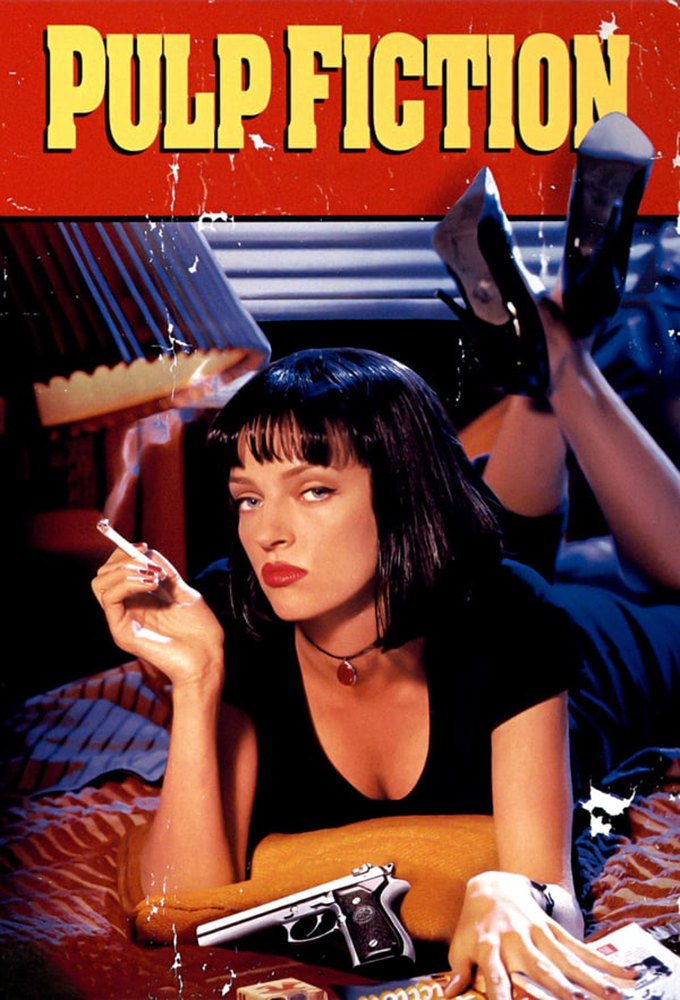
FILM · 1994 · USA
Pulp Fiction
- Directed by
- Quentin Tarantino
- Runtime
- 154 min
- Studio
- Miramax, A Band Apart, Jersey Films
29 archived facts 4 topics 1 source Last reviewed Sep 2026
A burger-loving hit man, his philosophical partner, a drug-addled gangster's moll and a washed-up boxer converge in this sprawling, comedic crime caper. Their adventures unfurl in three stories that ingeniously trip back and forth in time.
Summary: TMDB

All facts (29)
- #001
Pulp Fiction traces its roots to the late 1980s, when Quentin Tarantino and Roger Avary worked together at Video Archives, a video store in Southern California.
- #002
According to Roger Avary, the original concept behind Pulp Fiction was three short films by three different filmmakers: Avary, Quentin Tarantino and their friend Adam Rifkin.
- #003
Roger Avary wrote the first element of what became the Pulp Fiction screenplay in the fall of 1990, titled "Pandemonium Reigns", which grew into a feature-length screenplay.
- #004
The Tarantino–Avary project was provisionally titled "Black Mask", after the hardboiled crime fiction magazine, and drew initial inspiration from Mario Bava's three-part horror anthology Black Sabbath (1963).
- #005
Quentin Tarantino said he conceived Pulp Fiction as a trilogy-style film, telling three separate stories in which characters appear with different weights depending on the story.
- #006
Tarantino described the film's approach as drawing on the oldest crime-story chestnuts, citing the tale of a man who must take out the big man's wife without touching her as an example.
- #007
According to Tarantino, part of the film's trick was to apply genre characters and genre situations to real-life rules and see how they unravel.
- #008
Tarantino modeled the boxer Butch Coolidge on Ralph Meeker's portrayal of Mike Hammer in Aldrich's Kiss Me Deadly (1955), wanting the character to be a bully and a jerk.
- #009
The crimeworld "cleaner" at the center of "The Bonnie Situation" was inspired by Curdled, a short Quentin Tarantino saw at a film festival. Tarantino cast its lead actress, Angela Jones, in Pulp Fiction and later backed the filmmakers' feature-length version of Curdled.
- #010
The Pulp Fiction script featured invented commercial brands that recurred in later Quentin Tarantino films: Big Kahuna burgers, whose soda cup appears in Reservoir Dogs, and Red Apple cigarettes. Tarantino completed the script in January 1993 while also accompanying Reservoir Dogs around European film festivals.
- #011
Quentin Tarantino and producer Lawrence Bender took the Pulp Fiction script to Jersey Films, which had tried to sign Tarantino for his next project before seeing Reservoir Dogs.
- #012
A development deal worth roughly $1 million gave A Band Apart, the production company formed by Bender and Tarantino, initial financing and office space, while Jersey Films received a share of the project and the right to shop the script to a studio.
- #013
Pulp Fiction was the first Miramax Films project to receive a green light after the studio's acquisition by Disney.
- #014
Pulp Fiction was budgeted at $8.5 million, and $500,000 was returned, leaving a final budget of $8 million.
- #015
According to executive producer Michael Shamberg, only Harvey Weinstein bid on Pulp Fiction, though Weinstein believed he was in a bidding war.
- #016
Pulp Fiction became the first movie that Miramax Films completely financed.
- #017
According to The New York Times, most of the actors received relatively small salaries along with a percentage of the profits.
- #018
Danny DeVito, an executive producer of Pulp Fiction, recalled that Harvey Weinstein proposed casting Daniel Day-Lewis, who had just won an Academy Award for My Left Foot. DeVito said Quentin Tarantino wanted John Travolta instead and reminded Weinstein that Tarantino held final cut and cast approval.
- #019
Danny DeVito later reflected that Weinstein "called me every name in the book" over the casting disagreement, but that Quentin Tarantino got what he wanted and was absolutely right.
- #020
During casting for Pulp Fiction, casting director Bender found Samuel L. Jackson's first audition impressive, but a later candidate's performance "blew them away", leading Bender to warn Jackson's agent that the other actor might be chosen.
- #021
Jackson's agent rejected the idea of replacing him, telling Bender, "No, no, no, you can't do that. Sam will come back."
- #022
Bender was initially hesitant to request another audition from Samuel L. Jackson, having learned that Jackson thought he was only reading for the role rather than auditioning.
- #023
At his return audition for Pulp Fiction, Samuel L. Jackson was annoyed at having to come back, was mistakenly addressed as "Mr. Fishburne" by an assistant, and read his lines while angrily waving a hamburger he had bought because he was hungry; the gesture was so real that it became part of the scene and secured him the role.
- #024
Tim Roth, who was initially interested in the role intended for Bruce Willis, suggested Amanda Plummer as a co-star for Pulp Fiction and insisted her character should have a gun, which he considered would be terrifying.
- #025
Quentin Tarantino later incorporated Tim Roth's idea that Amanda Plummer's character should have a gun into the Pulp Fiction script.
- #026
Bruce Willis had read the Pulp Fiction script and told Quentin Tarantino he was interested in playing Vincent or Jules. Tarantino encouraged him to read the script again with the Butch character in mind.
- #027
Before being cast, Bruce Willis could recite practically the entire movie Reservoir Dogs, which he loved. Bender and Tarantino went to see Willis at his house in Malibu, where they learned this.
- #028
The role of Butch in Pulp Fiction was written with Matt Dillon in mind.
- #029
Matt Dillon was hesitant to commit to Pulp Fiction and preferred the part of Vincent, which Quentin Tarantino wanted John Travolta for.
Continue through the archive


Sources & editorial notes
Reference databases
Sources for the entries on this page
- Wikipedia Pulp Fiction — Wikipedia
Information from external sources is independently selected, consolidated and edited by Arka Evren. Sources are listed for verification and further reading. Encyclopedia text is used under its licence (CC BY-SA). How we work